
RE+ was huge this year. Here are 3 solar innovations that stood out.
The solar industry’s annual gathering in Las Vegas showcased endless solar panels, batteries, and new technologies illuminating the sector’s next phase of growth.


LAS VEGAS — It was unusually cool under the desert sun as the U.S. solar industry’s biggest annual convention got underway last week. The live sheep munching hay under a solar display in the convention center parking lot had a layer of wool to keep them warm when the sun dipped behind the looming monorail track. The herds of solar professionals, meanwhile, had to warm themselves with thoughts of the business cycle to come.
After two years in political purgatory, the solar and wind industries saw Americans from coast to coast vote for lawmakers who want to deploy clean technologies to combat rising energy costs. Now, these businesses can look forward to proactive policymaking that could hasten the clean energy transition. But even through the recent hard times, the industries kept building, and now can accelerate to full throttle, like the F1 drivers that zoomed down the Strip after the solar pros flew home Thursday.
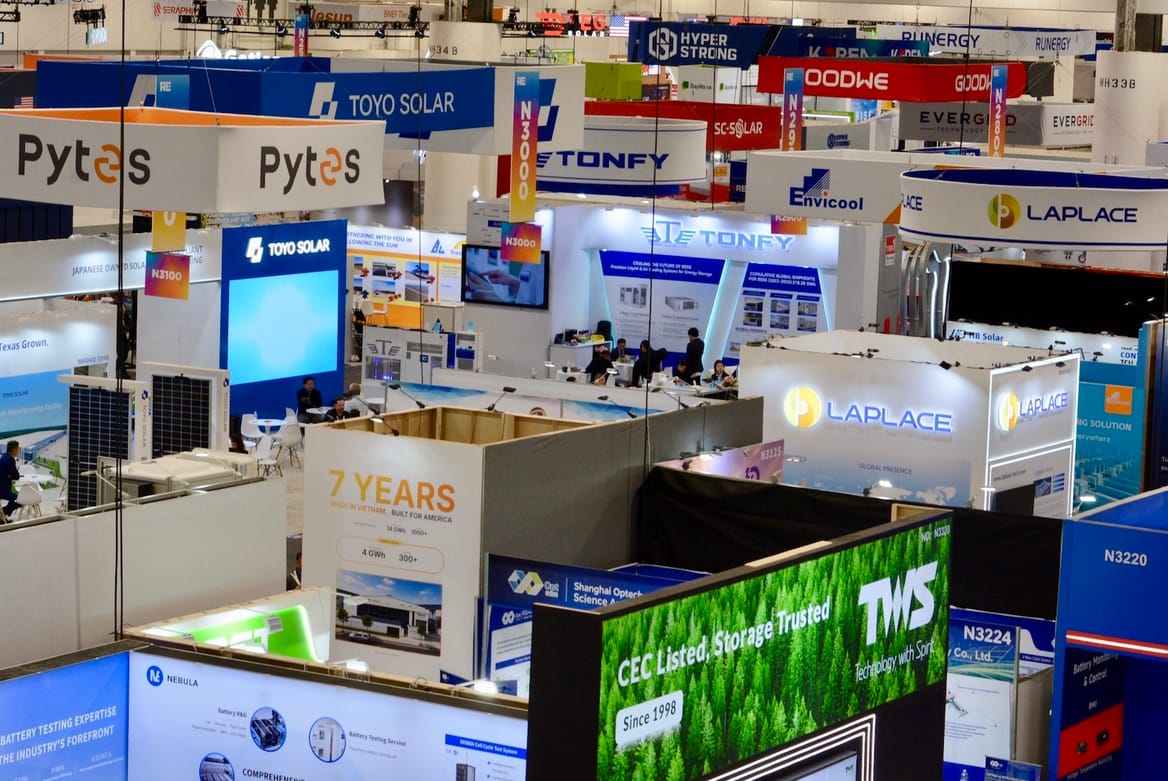
A decade ago, RE+, the industry’s flagship annual event — hosted by the Solar Energy Industries Association and the Smart Electric Power Alliance — was a relatively intimate gathering, where you could, say, follow a plush solar-inverter mascot into a party atop the skyscraping Strat tower and see familiar faces. This fall, for the first time, it was held in the Las Vegas Convention Center, a conglomeration of concrete and steel so sprawling that Elon Musk convinced the city it made sense to drill single-lane subterranean tubes so that chauffeured Teslas could ferry people between the various halls.
Inside, vendors displayed more brands of identical-looking solar panels than anyone could rightly recall. But the convening also featured batteries large and small, grid transformers, electric vehicle chargers, customized electronics packages for smooth data center deployment, and the occasional green hydrogen venture not yet gone out of business.
“If you look at how broad RE+ has become, it’s no longer solar and batteries anymore,” said Raghu Belur, chief products officer at Enphase, the pioneering solar microinverter company. “It’s all elements that interconnect to a more modern, sophisticated grid.”
Things that would have been shocking five years ago are now commonplace, like booths touting American-made solar and batteries. Claims of compliance with “foreign entity of concern” rules — which Republicans imposed last year to restrict tax credit eligibility — were ubiquitous on this year’s floor.
Even a thoroughly settled industry must have its frontiers, however, and amid the miles walked under fluorescent lights and the fruitless search for available chairs, I found three technological innovations that, taken together, show us something about where Big Solar is headed next.
Perovskites you can touch
Scientists have long contended that crystalline structures called perovskites can propel solar panel efficiency to a whole new level. Now, some companies are taking this tech out of the lab and into the real world. I got my first chance to see it in person in Vegas.
Startup Caelux built a factory in Los Angeles where it prints perovskites as a thin film on a standard panel of solar glass. It has a deal to ship that glass to Heliene, a company that started assembling solar modules in Minnesota well before it became cool. Heliene had an example of this full-size silicon-perovskite sandwich on display.
There’s not much to see: The perovskite coating appears as an inky midnight wash that dulls the natural blue of the silicon cells beneath. Narrow pinstripes run down the panel, channeling the electrical production, which then emerges via the same two cables as in Heliene’s conventional product.
“Essentially, it’s the same as installing a regular module,” said Aaron Thurlow, Caelux’s chief commercial officer.
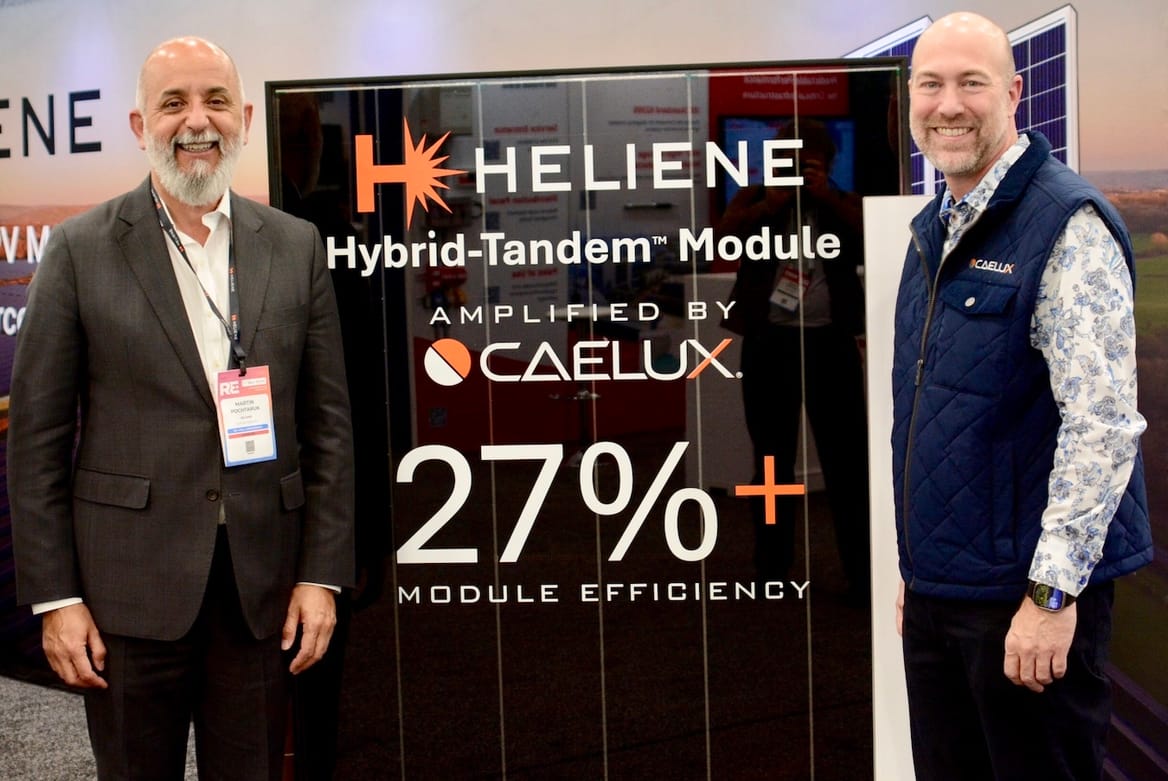
Heliene advertises the perovskite-coated panel as being 27% efficient, a notable jump from its previous standard of 24%. Conventional solar panels have improved incrementally, but this prototype leaps ahead of them. Plus, Heliene CEO Martin Pochtaruk told me, the current leading solar design, TOPCon, “is asymptotically getting to the maximum possible capacity for that technology.”
More-efficient panels let customers generate more power with less space. But before they can take over the market, perovskite producers need to prove that their product won’t fall apart in real-world conditions. Caelux and Heliene are shipping small numbers of their full-size panels to paying customers who will install and monitor them, to see if they live up to the hype.
A lot of people seem interested in trying them.
“Now, it’s late and everybody’s gone,” Pochtaruk said one day near closing time, as many happy hours beckoned. “But you should have been here in between noon and 4 p.m. It was like a beehive.” The eager attendees had snatched all his printed data sheets.
For now, Caelux is waiting to receive certifications like the UL labels that are table stakes for widespread adoption. It’s also expanding the LA factory to produce 100 megawatts per year of its special glass. That quantity is inconsequential in today’s roaring market, so the startup aims to build a gigafactory as soon as it can. Global solar giant Qcells and Silicon Valley startup Tandem PV have also staked a claim on being the first to build a perovskite gigafactory, so a proper technological race is in the offing.
Shippable solar for rural America
James Showalter has a bone to pick with the rooftop solar industry: The focus on door-to-door sales has left behind swaths of America that are sparsely populated. Furthermore, rooftop solar costs way more in the U.S. than in most countries, undercutting the solar pitch for Americans who live in places with cheap utility rates.
Showalter’s Texas-based company EG4 Electronics (intended to reference “energy generation for all”) takes aim at both problems with a new product called the Homestead 60. I saw the whole thing on the expo hall floor: It’s a 7-kilowatt solar array, pre-wired and assembled on a steel frame in a factory, so it can be slipped off a truck bed and positioned in a yard like a mobile trailer. It comes with a rugged 60-kilowatt-hour battery, among the largest storage products marketed to residences, which turns the solar array into a dependable microgrid for round-the-clock resilience.

By standardizing much of the work in the factory — the homeowner needs an electrician only to connect the inverter to the home — EG4 claims it can drop the price of solar power tremendously.
The company advertises the getup at $1.20 per watt for solar only, and $2.62 per watt with storage. As it happens, EG4’s 14.4 kilowatt base package nearly matches the average residential ground-mount system sold on the solar marketplace EnergySage, where they average nearly $3 per watt. Even with EG4’s below-market pricing, a set of four solar racks and a battery costs $37,700, so it’s not a casual purchase.
Students of solar market history know to be skeptical of claims that a new piece of hardware can solve problems that have flummoxed the industry for years. Tesla’s solar roof did not change the game as promised, nor did efforts to put solar in new places like walls, windows, and roadways. But the Homestead is really an engineering efficiency play, and all the key components are proven to work.
This marks a novel entry into the ongoing effort to lower the price of solar for homeowners after the loss of federal tax credits. The panels themselves have already gotten supercheap, so the next frontier is tackling the costs associated with packaging and installing them.

Hot new thing: Solid state transformers
The humble transformer is a 140-year-old technology for taking power from high-voltage transmission lines and dropping it down to the levels that homes and businesses can use, or taking production from a power plant and stepping it up for transmission.
Lately, transformers have made headlines because there’s not enough of them, and the supply chain bottleneck is holding up solar projects as well as data centers. So it was notable to see at RE+ that the cleantech industry has set its sights on transforming transformers.
The trend is to adapt smart inverters to do the work of transformers, but with mass-produced modular components instead of one big piece of heavy machinery. This neatly parallels what solar and batteries have already achieved by replacing complex turbomachinery for power production.
Tesla Energy alum Drew Baglino launched a whole company, Heron Power, to commercialize solid-state transformers. At RE+, Baglino’s former employer joined the fray, releasing a solid-state transformer it calls Powercore. Tesla leans on its famous power electronics expertise, honed first in the course of building electric roadsters and then a market-leading grid-storage business. The company has now shipped an astonishing 3 terawatts of power converters across all its products, Tesla Head of Energy and Charging AJ Booth told me when I stopped by Tesla’s display.
“I think it’s the most advanced version out there, and then it’s also backed by Tesla with our history of being able to do this in high volume at scale,” Booth said. “It really simplifies the supply chain and allows projects to be installed faster.”
The new product slots right into Tesla’s vertically integrated strategy: A data center developer looking to buy Tesla batteries to manage its fluctuating energy usage could add some transformers onto the same purchase order.
Elsewhere on the exhibition floor, Enphase showed off its new prototype solid-state transformer, essentially a big box full of about 528 smaller boxes, which collectively convert and condition 2.5 MW of electrical power. The main product will be twice as large.

Enphase rose to prominence by disrupting the large inverters that used to be the go-to for switching solar panels’ direct current production into alternating current for use in homes or on the grid. Enphase instead offered a miniaturized inverter that could snap onto each solar panel. Twenty years later, the company has grown into a powerhouse of the industry, making not only inverters but batteries and EV chargers as well.
Enphase onshored its manufacturing in 2023, so its move into solid-state transformers would strengthen the constrained domestic supply for that critical machinery. Belur, the company’s product lead, said that this wasn’t simply about meeting AI demand and securing a key infrastructure supply chain.
“There’s nothing wrong with horses and buggies, but we moved away from them,” he explained. “The grid needs to modernize. … And part of the biggest thing about upgrading the grid is making it more electronic- and software-driven.”
Customers can’t take home Tesla or Enphase transformers just yet; both companies aim to start shipping sometime next year, implying a hidden world of frantic engineers racing to back up these announcements with a reliable product. The companies have every incentive to work quickly. And while breakthroughs like perovskites and solid-state batteries have taken far longer than their boosters said they would, solid-state transformers don’t rely on any particular invention so much as finessing existing tech for a new purpose.
Should they prove successful, this will be the latest example of the cleantech industry knocking down a seemingly impenetrable barrier with a bit of pluck and creative engineering. Solar wasn’t efficient enough; manufacturers made it more efficient. Solar couldn’t deliver power on demand; developers added batteries. Now, the legacy transformer industry can’t keep up with demand for new power plants, so it’s time to reinvent the transformer.
Julian Spector is a senior reporter at Canary Media. He reports on batteries, long-duration energy storage, low-carbon hydrogen, and clean energy breakthroughs around the world.


