Want 24/7 clean power for data centers? Try giant heat batteries.
A new report argues that clean-powered heat batteries are a cost-effective, fast, and pollution-free way for data centers to get the electricity they want.

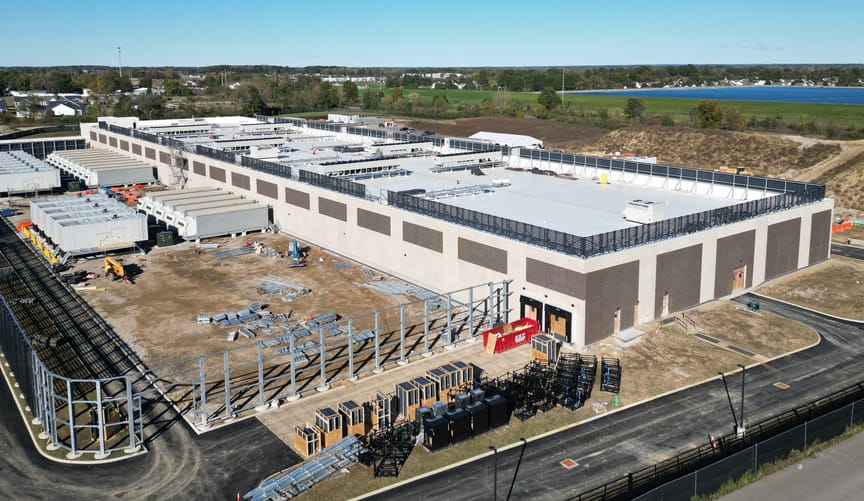
Data center developers are scrambling to find enough electricity to power their energy-intensive facilities. Some are building their own fossil gas power plants. But that comes with tradeoffs — sky-high equipment costs, yearslong waits for backlogged turbines, and growing public backlash against their polluting plans.
A new report from think tank Energy Innovation proposes a faster, cheaper, and cleaner route for powering off-grid data centers: giant heat batteries that are fueled by low-cost solar and wind.
This “hybrid thermal power” approach can be cost-competitive with fossil gas in many parts of the country, said Eric Gimon, the report’s author and an Energy Innovation senior fellow. Even more important, it can deliver power within a year or two in places where renewable energy is under development, he said — much faster than the wait for a gas plant.
“It’s a pretty simple solution that hyperscalers and developers can pursue,” Gimon said. “You can do off-grid that’s fast, clean, reliable, and affordable.”
Nevertheless, Gimon said he’s unaware of a U.S. data center taking this approach today. That’s despite the availability of heat batteries from a number of different companies, including Antora, Brenmiller Energy, Electrified Thermal Solutions, and Rondo Energy.
These energy storage systems use electricity to heat rocks, bricks, or other materials to temperatures exceeding 1,000 degrees Celsius (1,832 degrees Fahrenheit). The systems can retain that heat for hours, days, or even weeks at a time, and then dispatch it later.
Most thermal storage systems installed today supply industrial process heat for everything from food processing to cement production. But they can also use that heat to boil water, spin a steam turbine, and produce electricity.
Storing heat to make electricity has its drawbacks. The process recovers only about 40% of the total energy that’s been put into it, mainly because of losses in converting heat to steam and then to power, Gimon said. That’s not great, compared with the typical low-to-mid-90% “round-trip efficiency” rate for lithium-ion batteries.
“But when I started modeling it, I realized TES [thermal energy storage] is cost-effective,” he said.
Data centers that want to run independently of the grid and on clean energy will need to store enormous amounts of power for when solar and wind aren’t available. As long as the solar and wind power is cheap enough, and the value of the electricity being generated from the steam turbines is high enough, the efficiency losses are tolerable. In fact, thermal batteries would be cheaper than conventional lithium-ion storage over longer durations, Gimon said.
Gimon also looked at how fossil-fueled boilers could run on fuel stored on-site, to give the thermal storage and gas turbines emergency backup power, much like data centers rely on emergency backup diesel generators today. This graphic shows how all the pieces fit together.
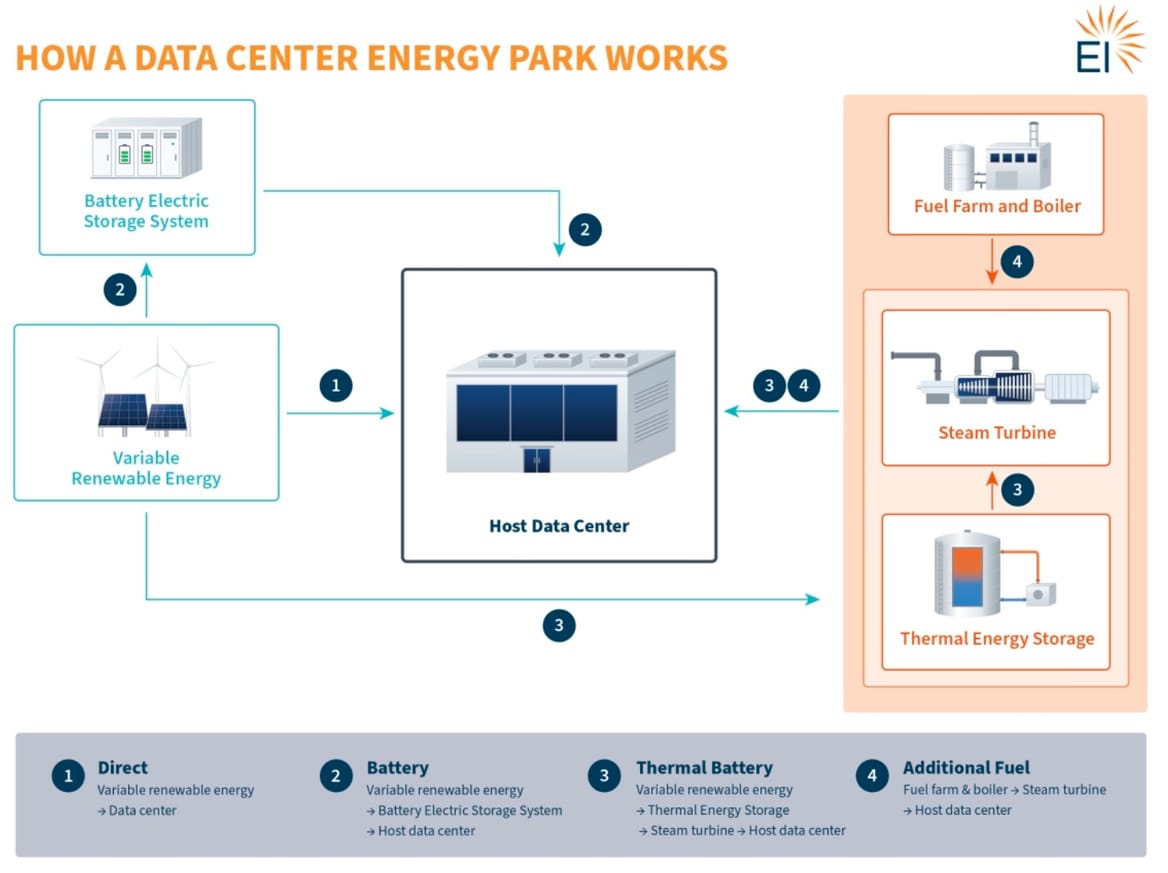
All told, Gimon estimated that these “hybrid thermal power brick” systems can deliver reliable, round-the-clock power at a cost of about $120 per megawatt-hour — a figure that includes the cost of developing the renewables that deliver their primary power.
Depending on where a data center is located, that can be competitive with building a dedicated gas-fired power plant. References range from about $72 per MWh for a data center in West Texas to the $140 to $165 per MWh that investment bank Jeffries estimated Meta is paying for an off-grid gas power plant in Ohio.
But for large data center developers, “the issue right now isn’t so much cost, but speed to power,” Gimon said. Data center developers have proposed hundreds of gigawatts of gas-fired power plants across the country, but those plans are constrained by the gas-turbine supply chain, workforce availability, and pipeline capacity.
By comparison, thermal energy storage systems are relatively new technologies whose producers are eager to scale up, he said. And while demand for steam turbines is beginning to tick up, those manufacturers are not nearly as backlogged, he said.
Arpit Dwivedi, founder and CEO of thermal energy storage startup Cache Energy, agreed that the industry could scale up quickly. His company’s technology uses standard steel components and stores heat in limestone-derived pellets coated in a proprietary binder. Those components are “simple and abundant,” which makes it easier to “build things faster,” he said.
The startup has enough manufacturing capacity today to build about a gigawatt-hour of its systems per year, “and we haven’t made a big deal about it,” Dwivedi said. He estimated the company could scale up to 10 GWh per year in 12 months and 100 GWh per year in 24 months without much trouble.
Cache Energy has already deployed its technology to store on-site wind power for industrial heating and space heating, Dwivedi said. The company has been talking with data center developers about using its heat batteries for electricity generation, though he declined to share more information. For data center developers to adopt thermal energy storage at scale, “we need one or two real projects that show it really works” in that setting, he said.
Hybrid thermal systems also open opportunities for solar and wind developers. Gimon estimated that a renewables-only project could boost its value threefold by adding a thermal battery and steam turbine that can deliver reliable “clean, firm” power. Landing an off-grid data center client could help them avoid the risk of yearslong wait times to connect to the grid, and would give them enough time to secure federal tax credits before they expire.
Data center developers could also look to hybrid thermal systems to streamline their path to securing a grid interconnection, he said. Utilities and grid operators are increasingly pressuring data centers to build or pay for their own power, so the facilities don’t overload the grid during heat waves, winter storms, and times of peak power demand.
And while many data centers are building gas power plants for that explicit purpose, more and more states are demanding that they bring clean alternatives to the table. Batteries are one such option, and thermal energy storage could play a similar role, Gimon said
“I want the hyperscalers to look at how the grid at large is dealing with growing load mainly with new renewables and batteries,” he said. “Why aren’t they doing that themselves? Instead, they’re doing it with gas.”
Jeff St. John is chief reporter and policy specialist at Canary Media. He covers innovative grid technologies, rooftop solar and batteries, clean hydrogen, EV charging, and more.


