• Senate permitting bill could greatly expand power lines and clean energy
  • Account
  • Donate
Clean energy journalism for a cooler tomorrow

Senate permitting bill could greatly expand power lines and clean energy

The U.S. transmission grid isn’t growing fast enough to meet surging electricity demand. Fast-tracking transmission upgrades could change that.
By Jeff St. John

  • Link copied to clipboard
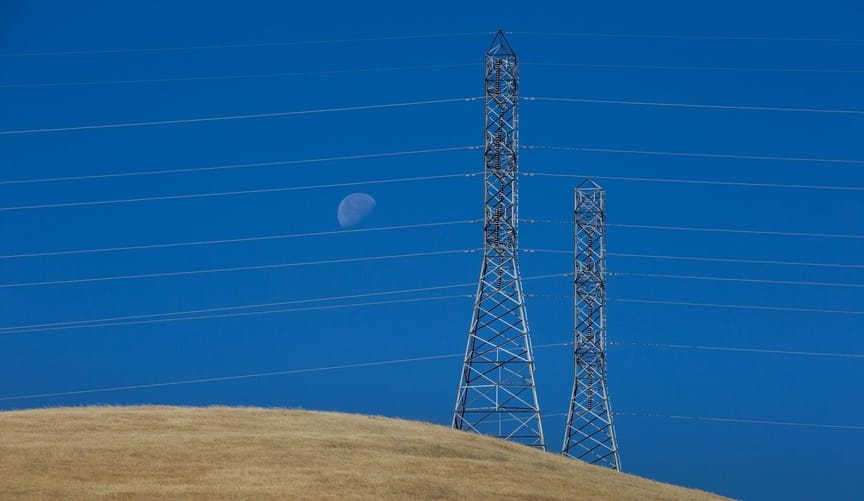
Two transmission towers on dry-grass hilll with blue sky and moon visible behind
(George Rose/Getty Images)

The U.S. Senate energy permitting bill unveiled Wednesday could streamline the buildout of high-voltage power lines across the country, potentially delivering billions of dollars in electricity cost savings and dramatically improving the power system’s reliability over the coming decade — if Congress manages to pass it into law.

So say grid experts digging into the transmission grid policy directives contained in the text of the long-awaited bipartisan reform package. The bill would order the country’s regional grid operators and utilities to streamline how power lines are planned and permitted. It would require the use of advanced transmission technologies that can expand the capacity of new and existing grids.

It would give state and federal regulators tighter oversight over less efficient local transmission planning. And it would require grid operators and utilities to coordinate grid buildouts to enable more new power plants, solar and wind farms, batteries, and other resources to serve growing demand for electricity.

“If Congress wanted to expand and de-congest the nation’s transmission grid, these are the policy changes that can get that done,” said Rob Gramlich, president of consultancy Grid Strategies and a longtime proponent of transmission grid reform. ​“It is very likely that this bill, if passed, would reduce consumer utility bills over time as the transmission system expands and access to low-cost generation improves.”

That view is backed up by analysis commissioned by the Center for Climate and Energy Solutions, a nonprofit research organization, which studied the impact of the bill’s reforms on four major grid regions — from the mid-Atlantic coast to the California border — that provide electricity to more than half the country.

The analysis found that by 2035, the reforms in the bill could enable a grid buildout that would reduce the cost of delivering electricity by roughly $7 billion, compared with a business-as-usual scenario — a net savings after accounting for $1.9 billion in new transmission investment. That, in turn, could reduce residential electricity bills by about $1.1 billion.

“Really simply, we need to build more energy infrastructure in this country,” Nathaniel Keohane, the group’s president, said in a Wednesday press conference. ​“We need to do that faster, and these reforms will help.”

Many of the transmission provisions in the new legislation were previously proposed under a 2024 bill, Keohane said. And other parts of the bill would essentially strengthen previously mandated grid interconnection and transmission planning reforms.

But the new bill also adds reforms that will ​“make it more predictable, easier for new energy generation to connect to the grid,” he said. ​“That’s really important.” Across the country, transmission bottlenecks are preventing hundreds of gigawatts of solar, wind, and battery projects from being connected to the grid.

Ashna Aggarwal, director of analysis at Greenline Insights, which conducted the study for C2ES, said the modeling her group used indicated the reforms in the bill could enable almost 100 gigawatts more wind, solar, and battery storage, as well as nearly 40 GW of increased interregional transmission capacity that can carry power to far-off regions suffering from extreme weather events.

It’s unclear how the Senate package will fare in the House of Representatives, which has been adjourned by House Speaker Mike Johnson (R) until after the November midterm elections. Republicans and Democrats have squabbled over proposed reforms to environmental regulations, with Republicans pushing for changes that favor the fossil fuel industry, and Democrats demanding the Trump administration halt its attacks on clean energy.

Some environmental groups oppose reforms that would limit the time and scope of challenges to energy projects under federal environmental regulations, saying that such streamlining will unleash a harmful expansion of fossil fuel infrastructure.

But clean energy groups including Advanced Energy United, the American Clean Power Association, and the Solar Energy Industries Association are backing the bill. The reforms, the groups say, are vital to unblocking bottlenecks that are preventing all but a fraction of the country’s potential clean energy from being built to serve fast-growing demand for power from data centers, electric vehicles, and broader economic growth.

“Across categories, this tries to rein in delays and uncertainties that add time and cost to building new infrastructure in this country,” Caitlin Marquis, Advanced Energy United’s managing director, said in a Wednesday interview.

To be clear, the reforms in the Senate bill will also ease permitting and interconnection for the massive amounts of new fossil gas power plants being proposed across the country. ​“This is not a world in which natural gas disappears completely,” Aggarwal said. ​“It does remain the largest source of electricity generation in 2035.”

The Electric Power Supply Association, a trade group representing power plant operators with a preponderance of fossil-gas power plants in their portfolios, expressed support for the Senate bill. ​“Demand for electricity is rising, and the energy infrastructure, including power plants, transmission lines, and natural gas pipelines, required to supply that demand needs a more efficient and predictable path for investment,” the association’s CEO Todd Snitchler said in a Wednesday statement.

But clean energy groups argue that solar, batteries, and wind power are cheaper and faster to build than fossil-fuel power plants, giving them an advantage if the grid can accommodate new additions.

Conversely, if the grid can’t grow quickly enough, data centers may press on with plans to build tens of gigawatts of ​“behind-the-meter” gas-fired power plants, despite the costs and the climate and environmental harms, Keohane said.

“We all see the enormous booming energy demand that’s happening right now. That demand is going to be met,” he said. ​“Whether it’s met with clean energy that can compete on the economics on a level playing field, or whether it’s met behind the meter with all sorts of other kinds of technologies that don’t serve the communities they’re in, that’s really what’s at issue.” 

This signup form requires necessary cookies.

Allow marketing cookies to load the newsletter signup form.

Jeff St. John is chief reporter and policy specialist at Canary Media. He covers innovative grid technologies, rooftop solar and batteries, clean hydrogen, EV charging, and more.