Next Upcoming
Canary Live Bay Area
By Canary Media
The nation’s biggest grid operator is about to start working on a fix that would make it much easier to add batteries to existing power plants and solar and wind farms.
(Photo illustration by Thomas Fuller/SOPA Images/LightRocket via Getty Images)
PJM Interconnection is finally taking steps that could let a lot of new battery capacity connect to its grid without eons of delay.
PJM is the biggest grid operator in the U.S., serving customers across 13 mid-Atlantic, Midwestern, and Southern states. Its grid is notoriously bogged down and congested, especially now that data centers are clamoring for more power, and that’s leading to high electricity prices in its territory.
Among other shortcomings, it’s been falling behind its counterparts elsewhere in the country in pursuing a straightforward solution: allowing power plants to add batteries on-site in order to get more out of grid connections that aren’t always used to full capacity.
The Federal Energy Regulatory Commission has directed grid operators to pave the way for these kinds of battery additions under Surplus Interconnection Service (SIS) rules. The idea is to let existing power plants — mainly solar and wind farms — add batteries that can soak up excess power when it’s not needed, and then inject it through existing grid connections when power plants aren’t generating at their full potential.
That could be particularly valuable when region-wide demand for electricity spikes, usually on hot summer afternoons or cold winter mornings. PJM has seen the cost of capacity resources to keep the grid running during these times skyrocket over the past few years, largely due to pressures to supply power to proposed data centers.
But PJM has been a laggard in reforming its SIS procedures, according to grid experts and clean energy groups that have been pushing for changes for years. It has approved very few such projects, even as grid operators in other regions have crafted regulations and processes that have opened the door to tens of gigawatts of SIS capacity.
Now — better late than never — PJM has agreed to kick off a stakeholder process to reform its market rules to clear the way for SIS battery additions. Its Market Implementation Committee is set to consider the next steps at its Nov. 4 meeting, according to Jon Gordon, a senior director at clean-energy trade group Advanced Energy United. If a plan wins approval, PJM could complete work on the changes and seek FERC’s permission as early as April 2027 to enact them.
Taking advantage of SIS opens up huge opportunities. “It’s clearly catching on” in other parts of the country, said Gavin Ahern, co-founder of Surplus Interconnection, which consults with power plant owners on adding capacity through these approaches. His company has tracked 44 gigawatts of historical SIS project requests as of mid-2026, about 80% of them in the form of proposals to add batteries to existing projects.
Some notable projects that have been proposed or approved include the addition of batteries to North Dakota wind farms by NextEra Energy and Great River Energy and to gas power plants in California, and the addition of solar power to gas plants in Illinois.
For clean energy developers looking to boost the value of their projects and supply capacity to meet booming data center demand, SIS is a no-brainer, Ahern said. “Renewable energy developers have been among the quickest to see the potential,” he said. “They’re looking to get more out of sites they’ve already paid to connect.”
The lion’s share of this activity is in the territories of two Midwestern grid operators: Midcontinent Independent System Operator, with 14.8 GW proposed across 138 active requests, and Southwest Power Pool, with 14.3 GW proposed across 89 active requests. Another 6 GW across 51 active requests are pending across the U.S. West, and the Southeast has 1 GW proposed across 29 active requests.
But in PJM, only 14 SIS requests have been submitted, and of those, only two have been approved, as of the grid operator’s most recent update in November 2025.
That’s wasting an enormous amount of potential, according to data from Umed Paliwal, a principal scientific engineering associate in the Electricity Markets and Policy Department at Lawrence Berkeley National Laboratory. His research indicates that PJM could add 24 GW of energy storage through surplus interconnection at existing power plant sites.
(Paliwal also estimates that PJM could add 102 GW of solar and 28 GW of wind through SIS by building solar and wind farms that share the grid connections of gas peaker plants, which generally fire up only when demand peaks, leaving a lot of capacity for renewable energy to flow during the majority of the year.)
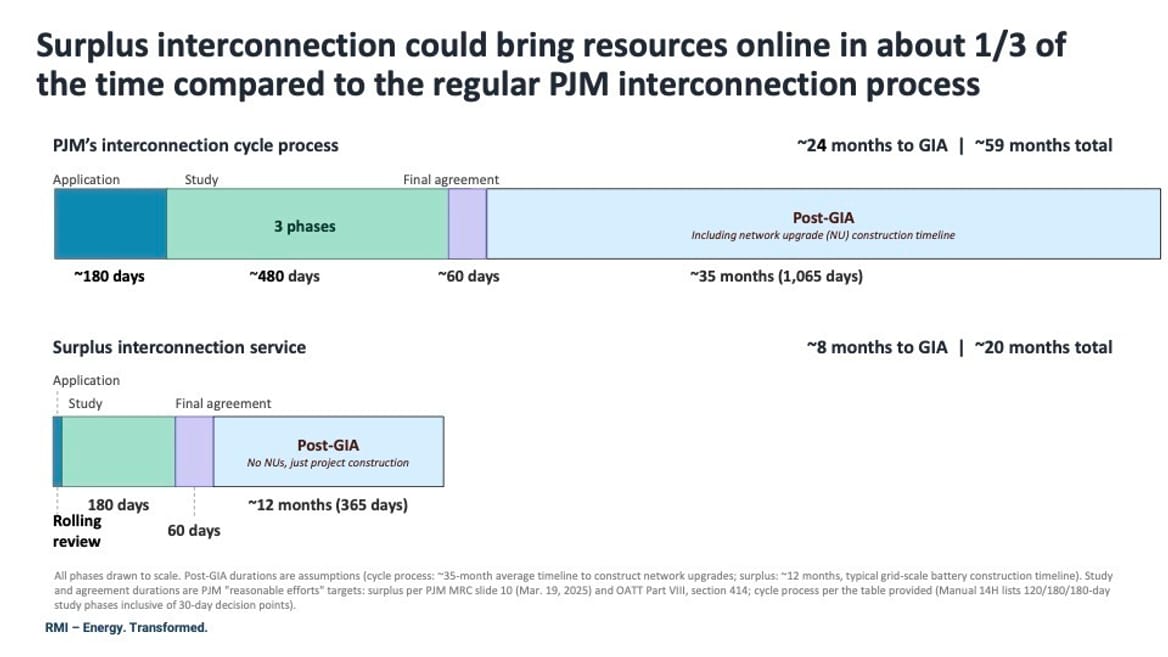
Using SIS to get projects going could help developers save more than $31 billion in interconnection costs and grid upgrades, according to Paliwal. What’s more, since they’re riding on existing grid connections, SIS projects can add their capacity within one to two years — far faster than new power plants and battery installations, which face yearslong wait times in PJM’s backlogged interconnection queues.
This chart from decarbonization think tank RMI shows how much more quickly SIS can bring new resources online than PJM’s standard interconnection process.
“We have members who are really rip-roaring to go on this,” said Gordon of Advanced Energy United. “What I’ve learned is that the devil’s really in some of the wonky details that have become obstacles to solving this problem.”
So what has been holding SIS back in PJM? The answer can be broken into two parts: First, PJM needs to fix its approach to studying SIS projects’ impacts on its grid. Then, it needs to fix its approach to how those projects operate in its energy and capacity markets.
Clean energy groups got to work on the first part of the challenge back in 2024, asking FERC to force PJM to restructure how it studied the grid impacts of adding new resources to an existing generation or battery project. They cited a number of technical barriers that PJM imposed but other grid operators didn’t.
In advance of FERC reviewing these complaints, PJM proposed a series of fixes. That proposal secured support from clean energy groups, and FERC gave PJM permission to institute the changes in early 2025.
But that alone hasn’t opened up the market, Gordon said. In fact, no new SIS project has moved forward in PJM since those changes were made. That’s because it still hasn’t dealt with the second part of the challenge — related to how it differentiates between old resources and new resources at the same point of interconnection.
To understand this barrier, keep in mind that owners of power plants, wind and solar farms, and batteries sign power purchase agreements with utilities, corporations, municipalities, and other offtakers that commit the generators to deliver the energy and capacity from those projects for years into the future. Adding a new resource at the same grid interconnection point will require some modification to those contracts.
That’s especially true if the owner of a project wants to sell the capacity value from the newly added resource — say, a battery that’s storing power to deliver at times when the solar or wind farm isn’t generating power — to a different customer altogether.
In parts of the country where SIS projects are moving forward, grid operators have structured straightforward rules around such contracts, said Connor Valaik, a senior transactions manager at LevelTen Energy, a company that manages markets for these kinds of deals.
He offered the example of Southwest Power Pool, which “makes it easier to add batteries to existing resources,” even in “places where you have an existing PPA, even with a different offtaker. You can add surplus storage, and sell the capacity rights from that.”
But PJM’s existing market rules mean this is almost impossible. In essence, PJM insists that a “hybrid resource” — a power project that combines more than one type of technology — be treated as a single “market unit” in both its energy markets and its capacity markets.
That’s a near-insurmountable barrier to arranging workable deals between existing and new customers who might want different values out of the old and new resources being combined, said Katie Siegner, a manager on RMI’s Clean Competitive Grids team.
For example, PJM rules would bar a solar farm from continuing to comply with a contract to deliver power to an existing offtaker while also adding batteries that could provide valuable capacity to a data center looking to offset its impact on PJM’s grid. “The solar and battery might have different offtakers, different obligations,” she said.
To fix this problem, PJM has proposed a set of changes that, in essence, will allow hybrid projects to separate the contributions of their different resources in both PJM’s energy market and capacity market. “You might think of it as an itemized receipt,” Siegner said. “It makes it easier to split the bill.”
That simple fix could unlock an enormous amount of pent-up demand for batteries to help meet PJM’s growing hunger for capacity. The new energy storage capacity could be added to existing projects or be integrated into plans for tens of gigawatts of clean power projects that have won permission to connect to PJM’s grid, she said.
This new pathway for bringing batteries more quickly online would be especially welcome in PJM states with energy storage targets, including Illinois, Maryland and New Jersey, Siegner said. Laws passed in Indiana and Virginia that require major utilities to identify and analyze the potential for surplus interconnection could also help boost deployment.
These market rule changes could still be a long way off. Even if PJM moves proposed reforms through swiftly, FERC’s approval of them might take until late next year.
That slow pace is “frustrating,” Advanced Energy United’s Gordon said. “We’re not talking about physical limitations to the grid. We’re just talking about this quagmire of administrative processes and legal rights.”
If the barriers to surplus interconnection service can be lifted, that could spur a lot of investment in batteries, relatively cheaply and speedily, he said. “Given PJM’s desperate situation for capacity, anything that would help PJM manage peaks better — like getting batteries online — would make a massive difference.”
In particular, data center developers might want to bankroll batteries. Data centers are under increasing pressure from state and federal regulators to build their own capacity resources to avoid pushing more costs onto everyday customers — and PJM’s attempts to solve that problem have been stalled.
Earlier this month, FERC rejected PJM’s painstakingly developed plan to require data centers and other “large loads” to supply their own capacity or face having their power cut off during grid emergencies.
Given that setback, data center developers and other PJM stakeholders that are trying to curb rising electricity prices are eager for options that can serve their needs as quickly as possible, Siegner said — and surplus interconnection is one of the best ones out there.
“I would like to think that if you threw a battery onto an existing solar project, given how capacity-constrained PJM is today, you could find someone as an offtaker,” she said.
Jeff St. John is chief reporter and policy specialist at Canary Media. He covers innovative grid technologies, rooftop solar and batteries, clean hydrogen, EV charging, and more.
This video requires marketing cookies.
Update your cookie preferences to watch the video.