Clean energy journalism for a cooler tomorrow

These cranberry bogs come with a side of solar

Two Massachusetts projects are the nation’s first to grow cranberries beneath solar panels, in another example of how agriculture and clean energy can coexist.
By Sarah Shemkus

  • Link copied to clipboard
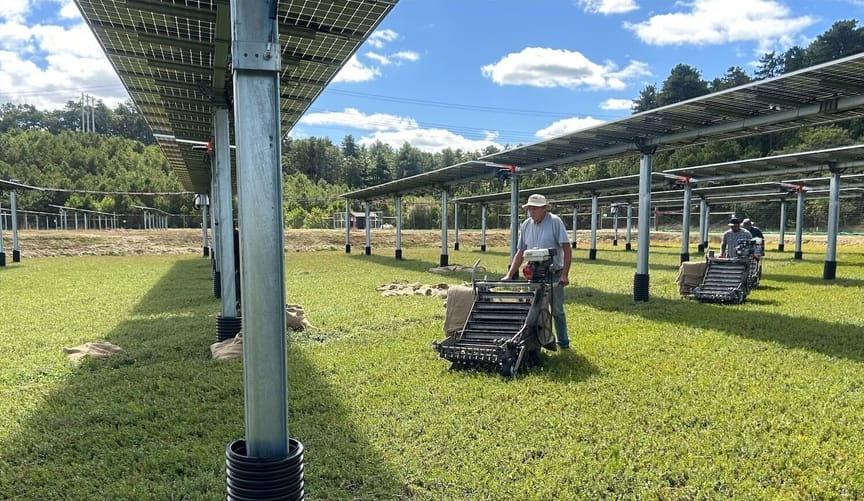
Solar panels on metal poles above a cranberry bog with several harvesters using specialized equipment
(Distributed Energy Infrastructure)

It’s cranberry season in southeastern Massachusetts. At bogs throughout the region, growers are collecting the ruby-red berries destined for holiday cakes, juice bottles, and cans of jellied sauce. At two farms, however, the harvesting process looks a little different: Pickers are navigating equipment around metal poles in the shade of solar panels. 

The two bogs are the first in the country — perhaps the world — to grow cranberries beneath an operating solar installation. This fall marks the second season cranberries have been harvested from beneath the panels.

“We are literally proving it can be done,” said Prateek Tare, co-founder and executive vice president of Distributed Energy Infrastructure. His company constructed the two projects — a 4.4-megawatt array paired with a 13.5-megawatt-hour battery in the town of Kingston, and a 1-MW solar array in neighboring Plymouth. 

Solar development is a major part of Massachusetts’ plan to reach net-zero carbon emissions by 2050. The state has offered solar incentives since 2001, evolving and expanding them over the decades to drive even more development. 

However, the question of where to site solar projects has become a major point of contention in the densely populated and heavily wooded state. Building on rooftops and parking lots in developed areas can increase costs and limit generation capacity. But proposals for arrays on previously undeveloped land often spark protests from locals worried about the character of their community and environmental groups opposed to disrupting ecosystems. Using pre-cleared farmland has potential, but raises concerns about taking agricultural acres out of production. Many of these same dynamics are at play in communities across the U.S.

One of the solutions Massachusetts has been encouraging is agrivoltaics, or dual-use solar, which involves building solar panels above active agricultural operations. This strategy, which is gaining traction nationwide, allows farmland to be used for energy generation even as livestock graze or crops flourish beneath the elevated arrays. 

In 2018, Massachusetts became the first state to offer a financial boost to dual-use solar projects like these. The state’s solar incentive program pays participants a set rate for every kilowatt-hour of electricity they generate; an array with a capacity between 1 MW and 5 MW currently gets a base rate of 23.17 cents. Agrivoltaic projects get an extra 9 cents per kilowatt-hour. 

That can be enough money to attract developers interested in leasing land for solar arrays or, less commonly, buying property outright with an agreement to keep it in agricultural use. Farmers who agree to lease are also generally paid for their services maintaining the landscape around the panels and poles. 

In Kingston and Plymouth, clean energy developer Greenbacker Renewables bought the land, which had been home to cranberry-growing operations for decades, from farmers who were ready to get out of the business. Greenbacker then worked with Distributed Energy Infrastructure to build the arrays, and hired Iain Ward, a solar consultant and longtime cranberry farmer in the area, to manage the growing operations. Both projects use a community solar model, selling power to customers interested in the lower prices and environmental benefits offered by renewable energy.

Solar can be particularly advantageous for cranberry farmers in Massachusetts, which grows more of the fruit than any state other than Wisconsin. While sheep farms and cornfields can often be sold to housing or commercial developers, cranberry bogs are protected wetlands: Even if they go out of production, they cannot be built on. Not all bogs are well placed to connect to the grid, but for those that are, solar panels can be a financial lifeline. 

“This is a farm viability opportunity,” Ward said. 

How to put solar on a cranberry bog

Figuring out how to build a solar array over a cranberry bog was a unique puzzle, Tare said. The first challenge was the foundations. For most solar arrays, the foundation goes 8 to 10 feet into the ground, he said. But in a cranberry bog, you have to go well past that to find ground solid and stable enough to hold the pilings. It took some trial and error to find the right machine to sink piles that deep. Wiring couldn’t be buried in the boggy ground, so it had to be hung overhead. 

“You’re trying to figure it out from a farmer’s perspective,” said Tare, who worked closely with Ward on the design of the two projects. 

The resulting installations have photovoltaic panels mounted 10 feet off the ground on an axis that allows them to tilt throughout the day to follow the sun. Pilings are spread farther from each other than standard so that harvesting equipment can be moved freely through the bog. 

These successes in Kingston and Plymouth have led to more agrivoltaic opportunities for Tare’s company, including arrays in apple orchards, a cattle pasture, and a Christmas tree farm. Preliminary work is also underway at another bog. 

Meanwhile, a stalled cranberry solar project in the nearby town of Carver could be resuscitated. Five years ago, a different pair of bogs there were set to become the nation’s first cranberry agrivoltaic operations. The arrays were built, and crops are growing beneath them, but the company behind the developments went bankrupt before they could get up and running. Today, the new bog owner has ​“every intention to finish them,” Ward said. 

“They’re not a failure,” Ward said. ​“There is an opportunity for them to be finished.”

Tare expects future cranberry projects to get easier each time, as the company carries forward the lessons it learns. Though momentum has been slow so far, Ward expects development to accelerate soon. 

“It is picking up steam, and the lessons learned have been significant, he said. ​“When you change a paradigm it takes a little time.”

This signup form requires necessary cookies.

Allow marketing cookies to load the newsletter signup form.

Sarah Shemkus is a reporter at Canary Media who is based in Gloucester, Massachusetts, and covers New England.