Next Upcoming
Rural America & The Clean Energy Transition at Climate Week NYC
By Canary Media
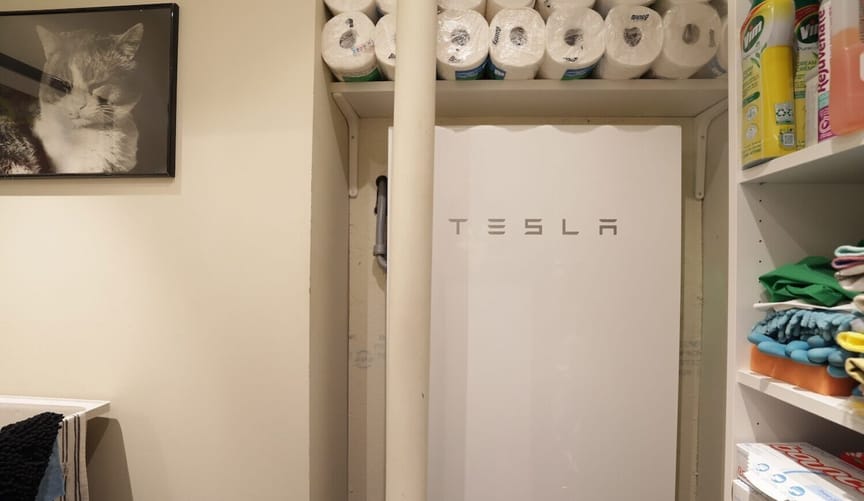
Homeowners in Massachusetts and Connecticut can now get a steep discount on a Tesla Powerwall — but only if they agree to let the backup battery help out the grid, too.
Under a new virtual power plant (VPP) program announced this week, the U.S. market leader in residential energy storage is offering certain households long-term, no-money-down leases for one or more Powerwalls. Massachusetts households would pay about $30 per month less per battery than they would with a standard Powerwall leasing arrangement, while Connecticut households would pay about $60 per month less.
Those discounts could halve the monthly payments of a standard lease, said Kevin Joyce, Tesla’s lead for virtual power plants and electricity retail. But to receive them, these homes must let Tesla control their Powerwall batteries and dispatch them to help the grid during 70 to 100 “events” per year.
These events could be heatwave-driven grid emergencies, like those that solar and batteries helped relieve across New England last summer. But more often, they’re less dramatic: VPPs can make a lot of money by helping reduce the need to fire up fossil-fueled “peaker” plants or other costly energy sources whenever power demand is high.
That’s all invisible to homeowners, though, Joyce said. It’s up to Tesla to make sure its batteries retain enough power to back up homes and reduce utility bills — which is what the households are paying for — while also keeping some available for the company to profit from during these grid events.
Other solar and battery companies that are enrolling customers in virtual power plants — like Enphase Energy, FranklinWH, Generac, LG, Lunar Energy, SolarEdge, Sonnen, and Sunrun — are managing similar challenges.
Typically, the sale of rooftop solar and backup batteries precedes the pitch to sign up for a VPP, not the other way around, Joyce said. So what Tesla is doing in New England is a bit unusual, at least in U.S. markets outside Texas, in that it is using the expected long-term revenue from VPPs to subsidize a lower monthly cost for customers.
The approach could help increase adoption of home batteries, which remain appealing in principle but an expensive proposition for most households looking for backup power.
For years, rooftop solar and battery adopters “have benefited from these programs and enjoyed the value over their lifetimes,” Joyce said. “But we realized long ago that this was never going to make this technology as ubiquitous as it needs to be.”
So why do Tesla and competitors think they can make money by leasing discounted batteries for VPPs? Let’s just say the answer varies, depending on what part of the country you’re in.
Take Texas, where the Tesla Electric retail energy business has already been offering such leases.
Texas is unique in the U.S. for having a highly competitive energy market where retail energy providers can fight to win customers by offering them cheap rates and access to technologies like solar and batteries. That has spurred a plethora of no-money-down deals for solar-storage systems in the state, or in the case of deep-pocketed startup Base Power, stand-alone backup batteries. Retailers use these deals to win new customers — and then monetize the resulting systems by managing when customers draw power from the grid.
In other parts of the country, state-regulated utilities have been tasked with installing batteries that help the grid in people’s homes. Vermont utility Green Mountain Power started offering customers Tesla Powerwall battery leases a decade ago, although it has added more “bring-your-own-battery” options in the years since. Other examples include Rocky Mountain Power’s Wattsmart in Utah and Duke Energy’s PowerPair in North Carolina.
Somewhere in between are the programs that allow nonutility companies to sign up utility customers for VPPs. Some of these arrangements are part of federally regulated wholesale energy markets. Others exist because state regulators have required utilities to create them.
In New England, Tesla has been enrolling its Powerwall-equipped customers in ConnectedSolutions for nearly a decade, Joyce said. That program has allowed battery-equipped customers of major utilities in Massachusetts and Connecticut to earn lucrative payments for power they send back to the grid during times of peak demand.
Importantly, the utilities and regulators in these states haven’t unexpectedly changed the rules or cut compensation for participants, Joyce added. In fact, most alterations to the programs have actually expanded opportunities. That’s the case with increased compensation for utility customers in Connecticut under a new Energy Storage Solutions, which is why Tesla is offering roughly double the typical lease discount in Connecticut as it is in Massachusetts.
“The stability of the VPP programs in Massachusetts and Connecticut are one of the key things that’s enabling us to do this, and why we’re starting here,” he said.
That’s a marked contrast to the situation in California, which leads the country in rooftop solar and residential batteries. In the early part of the decade, when California faced the threat of heatwave-driven rolling blackouts, Tesla asked thousands of customers to volunteer their spare battery capacity to relieve the state’s grid. Tesla and Sunrun have since enlisted residential customers to provide most of what has grown to be the country’s biggest VPP at more than 500 megawatts of capacity.
But the program that’s contributed the lion’s share of that capacity may be shut down this year because of a tight state budget, while a number of bills seeking to expand VPPs were sidelined in the state legislature or vetoed by Gov. Gavin Newsom, a Democrat, last year.
“What makes a good virtual power plant program is certainty,” said Shannon Anderson, a policy director at Solar United Neighbors, a nonprofit group pushing state lawmakers to adopt programs modeled on ConnectedSolutions. “Companies like Tesla invest significant dollars in these efforts,” she said. “Unless they have some level of certainty, they’re not going to be able to make that kind of investment.”
Jeff St. John is chief reporter and policy specialist at Canary Media. He covers innovative grid technologies, rooftop solar and batteries, clean hydrogen, EV charging, and more.