Clean energy journalism for a cooler tomorrow

Plug-in batteries kept NYC renters cool during record heat wave

A new program from startup Every Electric and utility Con Edison lets New Yorkers power their window ACs with home batteries to take stress off the grid.
By Maria Gallucci

  • Link copied to clipboard
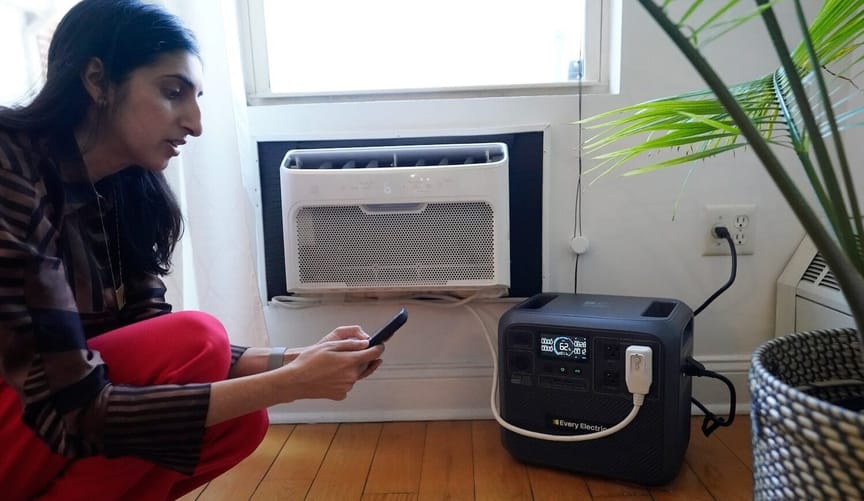
Woman next to air conditioner and battery on light hardwood floor
Sonam Velani hooks up a battery from Every Electric to power an air conditioner as part of a pilot program with the utility Con Edison to reduce pressure on the electrical grid on April 27, 2026, in Brooklyn, New York. (AP Photo/Alyssa Goodman)

Earlier this month, as a historic heat dome smothered the U.S. Midwest and Atlantic Coast, New York City Mayor Zohran Mamdani asked residents to set their air conditioners to 78 degrees Fahrenheit to protect the city’s severely strained grid. Let’s ease demand — and get through the heat — together,” he posted on X ahead of the sweltering July 4 weekend.

Previous NYC leaders and elected officials nationwide have given the same advice ahead of extreme weather events. But Mamdani’s suggestion that everyone pitch in sparked backlash from conservative figures and prompted the Trump administration to remove its thermostat-level recommendations from the Department of Energy’s website.

All the while, in apartments across New York City, hundreds of residents were supporting the electric grid without needing to adjust their AC at all.

The local startup Every Electric launched a novel pilot program earlier this year with the utility Con Edison that allows participants to plug their window air-conditioning units into a battery pack, which itself is plugged into the wall. The Wi-Fi–connected batteries draw electricity from the grid when conditions are calm, then power ACs with the stored-up energy when demand on the grid is highest.

The air conditioner can stay on, but we can still reduce load on the grid,” Andrew Wang, the company’s CEO, told me a few days after the heat wave and a subsequent major storm passed over the metropolis.

And the big thing is, you don’t impact someone’s preferred settings,” he said. In an outage, the batteries can power a typical window unit for about four hours, he added.

Millions of New Yorkers live in older apartment buildings without central air conditioning. Many residents instead use two or more window AC units to keep their homes cool. On blistering, humid days — like July 2, when temperatures hit 104℉ — these appliances can represent about 20% of the entire city’s electricity demand, Wang said. On a household level, it’s more like 75% of total peak energy use.

Every Electric, which ran a small internal pilot last year, has so far delivered over 1,000 batteries to roughly 600 apartments, including mine. It’s free to participate, though I had to pay a $50 refundable deposit for the power bank, which is now shoved against the wall between the window and my bed. (Every Electric’s lithium-iron phosphate devices are different from the beat-up lithium-ion batteries linked to e-bike fires in my Brooklyn neighborhood and citywide.) 

Chart titled "We powered >1,000 A/Cs without stressing the grid."
In this chart, the blue line shows how ACs in Every Electric’s program kept running during the heat wave. The green line shows the times when batteries fired up and reduced the units’ draw on the power grid. (Every Electric)

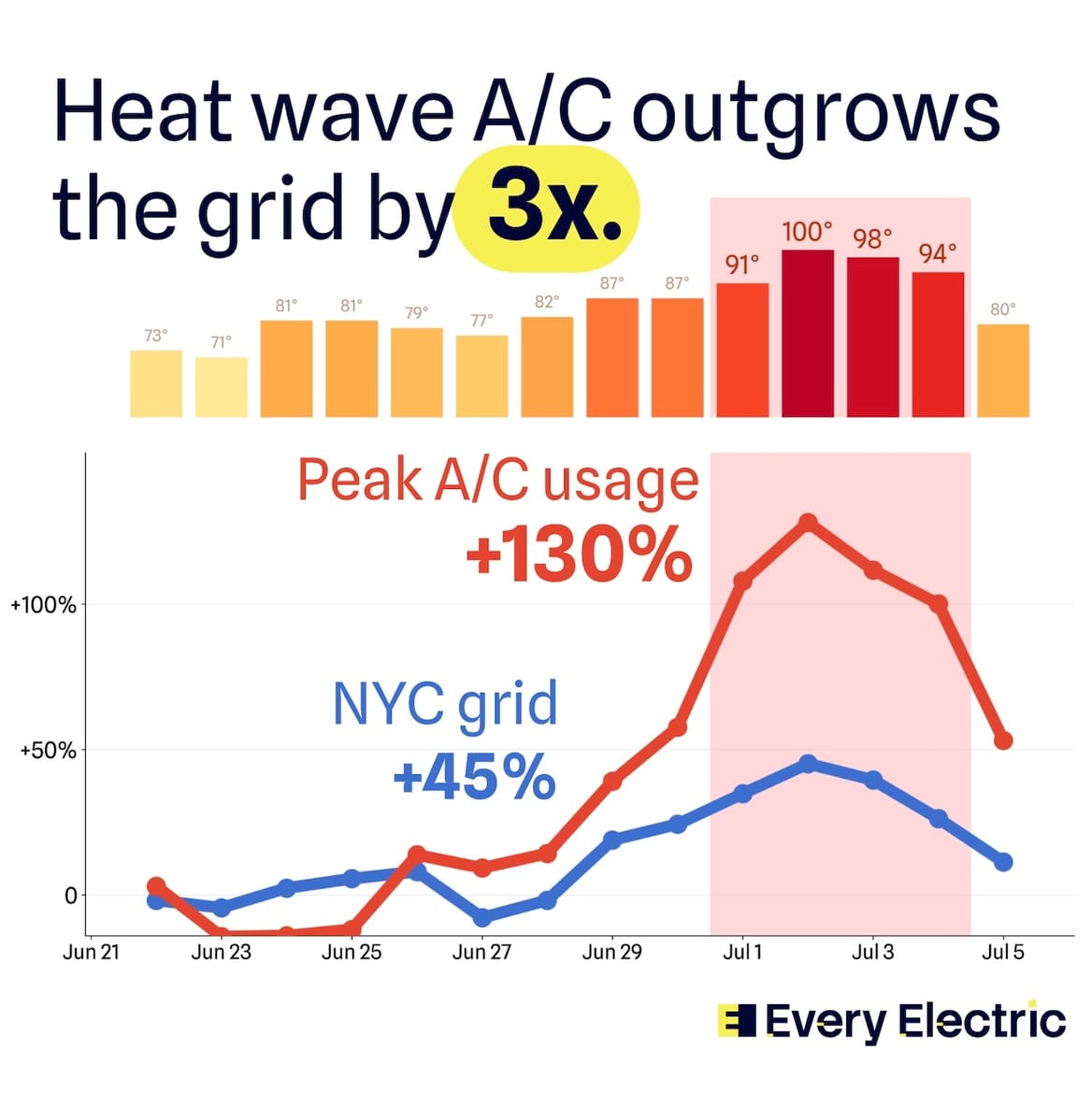
Wang said that heading into the heat wave, New York’s grid operator forecasted a 45% jump in NYC-wide peak demand for July 2. The window ACs in Every Electric’s program used 130% more electricity at their peak that day than they do in a typical week. Yet the company’s batteries met much of that demand, mitigating a source of grid stress and allowing renters to keep cool, even as Con Edison reduced voltages in certain areas to prevent widespread outages.

Collectively, Every Electric’s battery fleet can provide about 2.5 megawatt-hours of distributed energy storage. That’s a teeny sliver of the total power draw from window ACs. But experts say that such programs, when scaled, can play a crucial role in boosting grid reliability, reducing utility costs — and making the overall system more resilient to climate change.

On brutally hot days, utilities often fire up expensive, old fossil-fuel-burning peaker plants to meet the extra demand. Then there are the added maintenance costs and infrastructure upgrades. In May, Con Edison said it was investing a record $3.9 billion to lay more cables and build new transformers and substations to maintain reliable service as extreme heat becomes more frequent and severe.” 

Chart titled "Heat wave A/C outgrows the grid by 3x."
This chart shows how peak power use spiked among the ACs in Every Electric’s program. (Every Electric)

Distributed energy storage is a resource that [utilities] can leverage to avoid these peak demand spikes, and there’s a clear benefit for them, in terms of deferring their capacity investments,” said Bryan Bollinger, a professor of marketing and economic policy at the Tuck School of Business at Dartmouth, who studies how consumers make energy decisions.

A growing number of states, led by California, are increasingly adopting programs that call upon networks of customer-owned energy devices — like Tesla Powerwalls charged by rooftop solar panels — to support the grid when needed. But these initiatives, also called virtual power plants, primarily serve homeowners who are able to outfit their homes with clean technologies.

Every Electric’s renter-friendly approach targets a different population completely,” Bollinger said. You’re getting a bunch of consumers who also want to feel like they’re doing their part, but who don’t have the ability to do things like install solar panels.”

The company’s program also skirts the challenges facing large-scale battery storage systems in New York City. Big batteries can provide even greater relief to the grid, but local developers are ensnared in a regulatory battle with Con Edison related to the cost and effort of connecting to the system. Every Electric’s microwave-sized batteries face no such issues: As the utility sees it, the power bank in my bedroom is no different from a computer or TV.

Participants will be rewarded for our goodwill to the grid, with a payment that reflects each household’s peak summer monthly utility bill, up to $150 per power bank pairing.

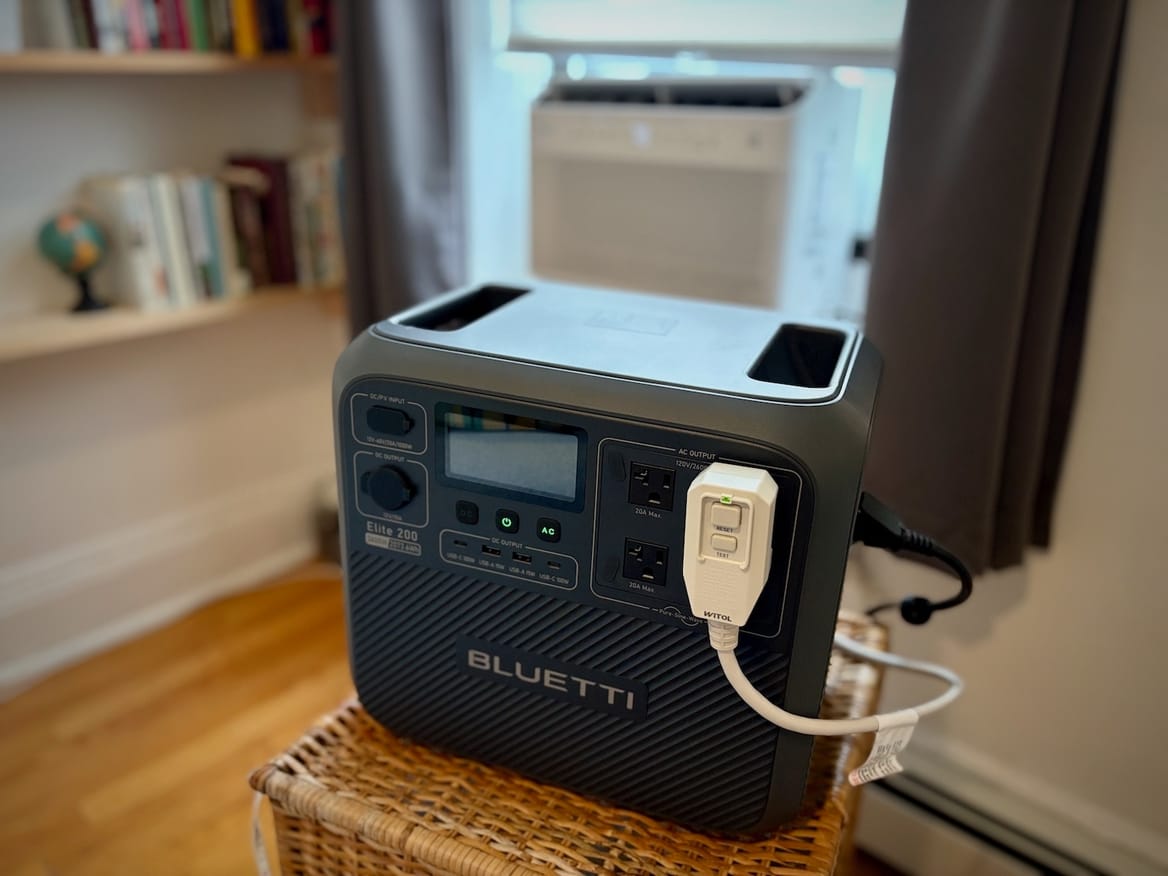
Black battery plugged into a window AC unit atop a wicker hamper
A 2-kilowatt-hour battery, staged temporarily atop a hamper, directly powers the window air conditioner behind it. (Maria Gallucci/Canary Media)

The money comes from Con Edison’s Smart Usage Rewards program, under which the utility pays its customers to actively reduce energy use during specific blocks of time, in specific neighborhoods, on the hottest days of the year. Every Electric is enrolled as an aggregator” that virtually manages all the power banks in its network. Wang’s team distributes a portion of the rewards it receives to its own participants, while keeping the rest to cover its costs and expand the program.

The ability to earn money while staying cool has an obvious appeal: The owners of some 10,000 window ACs units have requested batteries. Every Electric said it’s working to fulfill as many of those orders as possible over the summer.

Con Edison, which serves 3.7 million customers, said over 50,000 electricity users representing 500 megawatts in capacity are enrolled in the utility’s demand-response initiatives. During the past heat wave, the company called on customers to curb energy use 27 times across its networks in NYC and neighboring Westchester County.

A spokesperson said Con Edison doesn’t yet have specific data on how Every Electric’s pilot and other programs performed during the record-breaking heat. But in general, such efforts, combined with infrastructure investments and technological upgrades, have helped limit strain on the grid when it’s needed the most.

Beyond the Con Edison program, Wang declined to get specific about Every Electric’s financials, though he said the six-person startup is supported by a blend of sources. That includes private investors, debt financing from social-impact funds, and grants from the New York State Research and Development Authority.

We’re excited by how scalable this can be,” Wang said, adding that the utility and state regulators are telling everyone to look under every rock to find ways to make the grid run a little bit cheaper and more reliable.”

Bollinger, who until recently was a New York City renter himself, said he hopes that programs like Every Electric’s can catch on nationwide — because they can both bolster the grid and benefit more consumers. It provides access to this kind of technology to non-homeowners as well, which we just haven’t seen with a lot of renewable energy technologies,” he said. 

This signup form requires necessary cookies.

Allow marketing cookies to load the newsletter signup form.

Maria Gallucci is a senior reporter at Canary Media. She covers emerging clean energy technologies and efforts to electrify transportation and decarbonize heavy industry.