New net-zero community will become Michigan’s first virtual power plant
The development in Ann Arbor will share its solar and battery power with the grid, as part of a pilot that aims to lower energy costs and provide reliability.

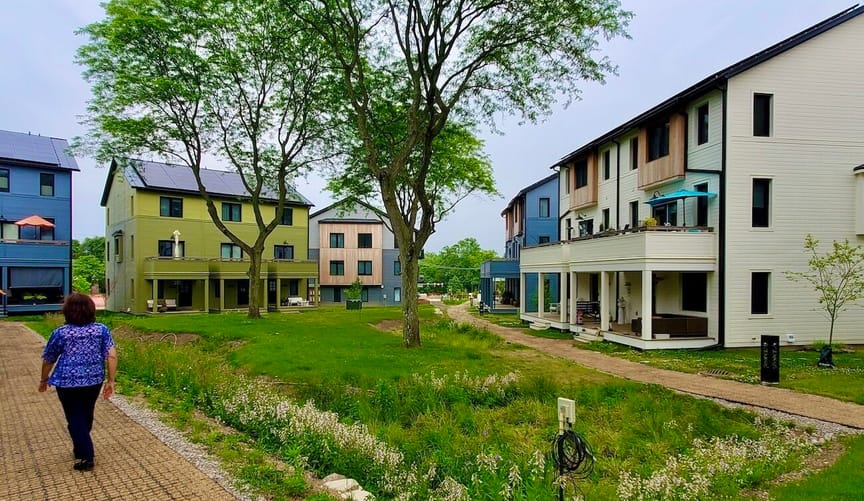
Mitch Hall and his wife, Lori, live in one of the most sustainable communities in the U.S. Their town house is among a few dozen residences constructed so far at Veridian at County Farm, a fossil-fuel-free, net-zero-energy development in Ann Arbor, Michigan. Homes here make about as much solar energy as they consume, with the help of batteries that save solar power for use in the evenings.
Now, the couple is eager to share the benefits of their clean energy infrastructure with the wider grid.
In the coming weeks, Veridian households can enroll in Michigan’s first residential pilot of a virtual power plant; Detroit-based utility DTE Energy will then be able to remotely control the network of residents’ home batteries to inject their stored solar power onto the grid when operators need it most.
“This pilot is an opportunity to test an approach that could ultimately provide a lower-cost way to meet growing energy needs and strengthen reliability,” Joi Harris, president and chief executive officer of DTE Energy, said in a statement. VPPs can smooth out demand peaks, reducing the utility’s need to invest in grid-infrastructure upgrades and generate kilowatt-hours with expensive fossil-fuel peaker plants, both of which would pile costs on consumers.
The initiative “should work well for the residents, too,” Hall said. “DTE will pay us a little bit to be part of this project.” Because the utility will pull battery power automatically when the grid is strained and electricity prices are likely to be highest, “a neat part about the virtual power plant is you don’t have to spend a lot of time learning and trying to optimize,” he noted. “DTE will manage that battery for you.” (DTE did not respond to Canary Media’s request for exact figures on how much it would compensate customers in time for publication.)
VPPs have existed for years but have been slow to gain widespread traction because of a host of factors. Utilities often haven’t been incentivized to embrace the approach, while home solar and batteries remain too expensive for many households in the U.S. But as electrification and the data center rush spur unprecedented demand, VPPs are taking off as a fast way to get power on the grid. Earlier this month, the Brattle Group estimated that 524 gigawatts of distributed energy resources harnessed in VPPs could save households on average $122 per year by 2050.
Currently, “there’s immense untapped capacity,” said Kevin Brehm, manager in the carbon-free electricity practice at clean energy think tank RMI.
Matt Grocoff, the founder of Thrive Collaborative, started to consider a VPP pilot at Veridian in 2019. He wanted the neighborhood to mimic an ecosystem — a resilient web of relationships in which individual organisms do more than just extract resources. For example, a tree in a forest turns sunlight into nutrients and shares them symbiotically with a vast, interconnected underground web of fungi.
Likewise, with a VPP, each Veridian home “can be producing energy that it needs and mutually beneficially sharing it across a network of energy rather than a linear grid that flows in only one direction,” Grocoff said.
DTE expects nearly 100 battery-equipped Veridian homes to ultimately participate in the pilot. So far, 44 market-rate homes with solar and batteries have been built, out of 120 planned, as have 50 affordable housing units that don’t have batteries yet, according to Thrive Collaborative. Battery manufacturer Sonnen USA, maker of the home storage systems installed at Veridian, is helping DTE operate the pilot using Sonnen’s proprietary software.
“Veridian is a test bed,” said Geoff Ferrell, executive vice president of Sonnen USA’s VPP business unit. The initiative, which is expected to be able to deliver up to about 300 kilowatts for three hours, will give DTE a clearer picture of how much power the home battery fleet can actually generate and when, providing “a really great basis” for a scaled-up program, he noted.
Ferrell points to another Sonnen-facilitated VPP that also sprang up as a humble pilot project, but rapidly mushroomed into a full-scale program because of early positive results. That initiative started in 2017 with a new apartment building topped with solar, Soleil Lofts outside Salt Lake City.
Sonnen hadn’t even finished installing batteries in each of the development’s 600 units when the utility Rocky Mountain Power and the state utility commission decided that the initial data was promising enough to merit extending the program to every residential customer in the utility’s territory, Ferrell said. Today, about 7,900 homes and businesses participate in the program, now called Wattsmart Battery, in Utah, Wyoming, and Idaho.
Given the success of that VPP and many others, Brehm would like to see more utilities go full throttle at the outset.
“Do you need another pilot?” he asked, noting that numerous VPP programs exist for utilities to model their own programs after.
But for utilities that do approach VPPs with caution, Rocky Mountain Power’s pilot is a good model, according to Brehm. The utility’s employees were able to rapidly understand how the residential battery fleet worked and how to deploy it, he said, “so that they could integrate these batteries into their operations initially, and subsequently [into their resource-capacity] planning.” He’d like to see DTE do the same.
The VPP pilot at Veridian is already starting to inspire developers and utilities outside Michigan, including the development Peace Hill in Townsend, Washington, said Grocoff of Thrive Collaborative.
“We’re getting calls from all over the country,” Grocoff said. “It’s really exciting.”
Alison F. Takemura
is reporter at Canary Media.


