

These Maine heat-pump owners will get discounted power this winter
A top utility has rekindled a program that could save heat pump owners hundreds of dollars a year — and nudge more residents to ditch pricey heating oil.

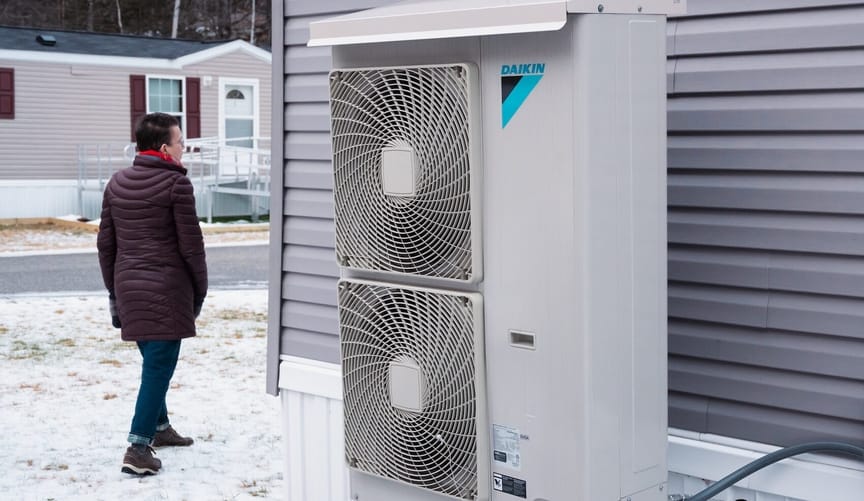
A discount electricity rate for heat pump owners in Maine seemed dead earlier this year. Now, it’s been revived as regulators look for ways to encourage households to ditch increasingly pricey heating oil and make winter warming more affordable for those already using the electric systems.
The Maine Public Utilities Commission last week approved the rate structure proposed by the state’s top electric utility, Central Maine Power, which serves more than 670,000 households across most of the western half of the state. CMP expects the voluntary program, which kicks in Dec. 1, to save participating customers hundreds of dollars annually compared to default rates.
The heat pump rate eliminates transmission and distribution charges during the winter, leaving customers to pay for their electric supply — 13.63 cents per kilowatt-hour as of the new year — and a monthly fee of about $41 (somewhat higher than the $27 monthly fee paid by standard-rate households). Customers who opt into this rate will then see a higher rate during the summer months: 25 cents per kWh, as opposed to the standard rate’s 12 cents per kWh.
The idea is that the savings from winter operations will be greater than the additional summer costs, giving customers a net financial advantage. A customer who uses 500 kWh per month in the summer and 1,200 kWh per month in the winter would save $211 per year, compared to standard rates, according to CMP’s calculations. Use less in the summer and more in the winter and the savings go up.

Having these savings available also amplifies the case for switching from oil heat to heat pumps, supporters of the rates say.
CMP originally launched the heat pump rate as a pilot at the beginning of 2023. It expired on Jan. 31, 2026, and was not extended, following a study that found the offering did not create significant savings for customers or motivate meaningful changes in how much power participants used.
Now, however, circumstances have changed. The price of heating oil — used by roughly half the homes in Maine — has spiked as a result of the ongoing war in the Middle East, lingering just below $6 per gallon in recent weeks. Heat pumps and the accompanying discount rates could offer much-needed savings this winter, regulators reasoned in their decision approving the new pricing structure. Essentially, the heat pump rate is just more likely to drive heat pump adoption at this point than during the pilot, supporters argued during the approval process.
“The cost of delivered fuels is incredibly high right now,” said Alex Lopez, senior manager of regulatory policy at electrification nonprofit Rewiring America, which was not directly involved in the Maine decision. “Heat pumps represent an opportunity to upgrade heating systems with a fuel that is less volatile, more efficient, provides healthier indoor air quality … there’s just so many benefits.”
Heat pump rates are gaining traction in other cold-winter places as well. Massachusetts requires all three of its major electric utilities to offer a lower seasonal rate for heat pump users, which took effect last winter. In that first season, the rates saved customers more than $37 million, an average of more than $250 per household. In Minnesota, Xcel Energy offers a program that lowers seasonal rates for homes with electric heat — both heat pumps and resistance. Colorado utilities will be required to consider heat pump discounts in future rate requests, and New York is looking at whether it can alter its current time-of-use rates to create more savings for heat pump users.
Supporters of heat pump rates emphasize that these are not a handout or subsidy, but instead a fair way of charging for the infrastructure these systems use. The electric grid is built to carry all the power needed when demand is highest, which generally happens on hot summer days. In the winter, therefore, there’s plenty of room on the system to carry electricity to heat pumps without spending money on improvements. So making heat pump owners pay more when they aren’t adding cost makes no sense, Lopez said.
As more heat pumps hook up to the grid, a time will come when demand peaks in winter instead of summer. At that point, new rate-setting approaches will be needed. In the meantime, though, heat pump rates are an appropriate way to encourage electrification and make the system more fair, Lopez said.
“Heat pump rates are a tool that will help us through that transition,” he said. “They are a bridge solution.”
Hey, thanks for reading! Can you please make a donation to Canary Media? As a nonprofit newsroom, we rely on our readers to power our journalism.
Sarah Shemkus is a reporter at Canary Media who is based in Gloucester, Massachusetts, and covers New England.
read next
-

Electric vehicles
Uber drivers are flocking to EVs amid high gas prices
-

Canary Media
Make a gift today
-

-
