Next Upcoming
Rural America & The Clean Energy Transition at Climate Week NYC
By Canary Media
NEW YORK CITY — Manhattan is teeming with skyscrapers that seem to reach into the clouds. But a gleaming commercial building near the Hudson River is more impressive for how it stretches down into the dirt.
Beneath the floors of 555 Greenwich St. are 68 geothermal energy piles that run nearly 120 feet deep, dodging utility pipes and tunnels that crisscross the busy urban underground. During the sweltering summer, the long vertical piles collect heat from the 16-story building and dump it into the earth, cooling the offices above. In the chillier months, the equipment retrieves that warmth to keep the rooms cozy.
The geothermal system is a key reason why 555 Greenwich can operate without using fossil fuels, making it the city’s first commercial office building to hit that milestone. That’s according to the owner, Hudson Square Properties, which is a joint venture of the real estate company Hines, Trinity Church NYC, and the investment arm of Norway’s sovereign wealth fund.
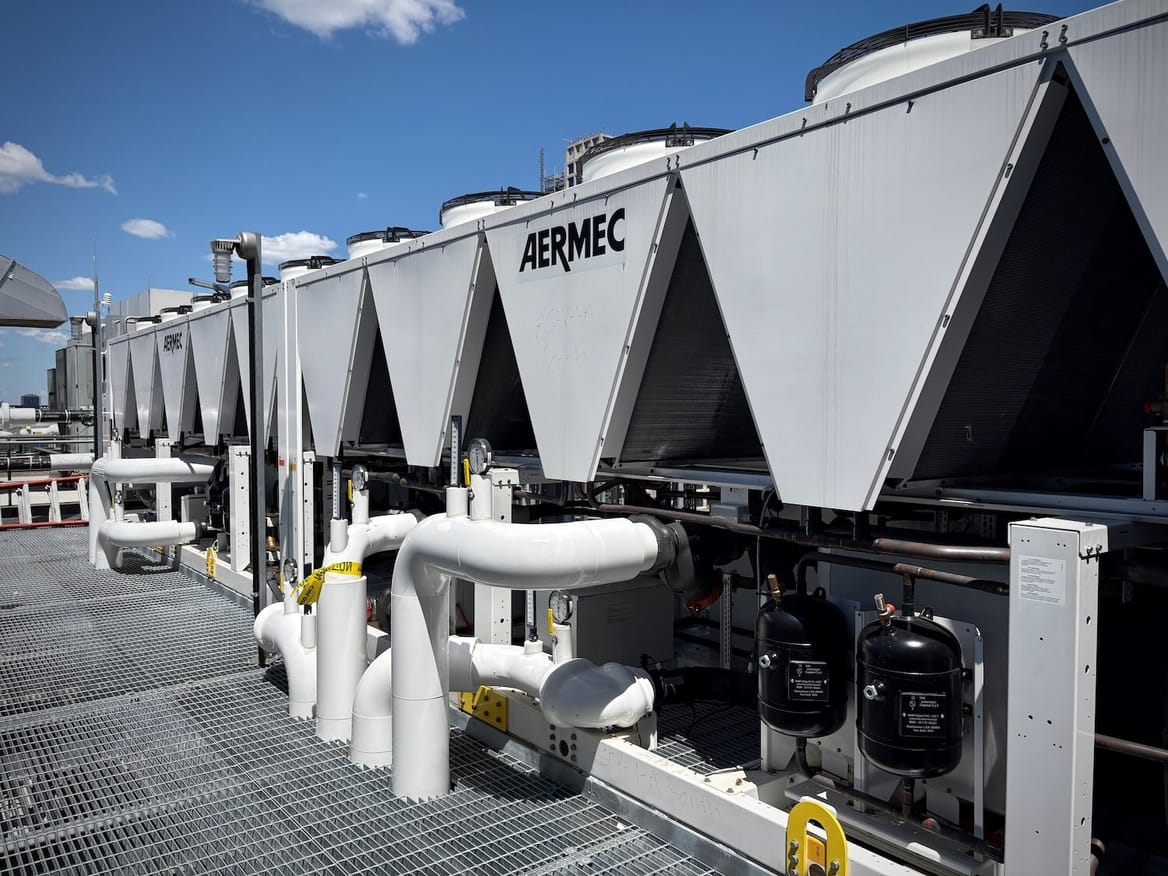
The building, which finished construction in 2023, should be able to meet half of its heating and cooling needs from geothermal when fully occupied, said Jason Alderman, senior managing director and head of New York at Hines. The other half will be met primarily by the two enormous air-source heat pumps sitting on the rooftop, which overlooks the city’s most iconic towers and the green edges of Central Park.
When I visited the 270,000-square-foot property in early June, Alderman explained that the fossil fuel–free building is a reflection of both New York City’s aggressive climate change policies and the partners’ own ambitions for a highly efficient, carbon-cutting design.
“We wanted to think outside of the box and help set the standard for what others can do,” he said.
We were standing beside the only visible part of the geothermal system: an array of small, dusty pipes peeking out from the partially finished floor of a forthcoming restaurant. In a nearby utility room, I saw control boxes managed by the company Endurant Energy, which monitors temperatures in the underground geothermal piles to determine whether it’s more efficient for the building to grab heat from the earth or run the heat pumps on the roof.
On days when the geothermal setup can produce more energy than needed, it pipes the excess heat directly into its sister property, a nearly century-old Art Deco edifice on 345 Hudson St. The developers recently renovated the older building and combined it with 555 Greenwich to make a single 1.2-million-square-foot office complex in lower Manhattan.
The newer property uses 40% less energy than typical top-quality office buildings and well exceeds New York City’s 2030 climate targets, according to its owners. The older property, which is still transitioning to an all-electric energy system, is on track to reduce its carbon emissions by 90% within the next decade.
Geothermal heating and cooling systems are steadily proliferating beneath the city’s newest buildings, despite the complex engineering challenges and expensive installation costs. Property owners are looking to not just comply with regulations but also to generate long-term energy savings by avoiding natural gas.
Buildings account for more than two-thirds of New York City’s greenhouse gas emissions. Since 2019, city leaders have adopted laws to rein in that planet-warming pollution.
Local Law 154 prohibits the use of fossil fuels in most new construction and will start applying to high-rise buildings in 2027. Local Law 97 requires most buildings over 25,000 square feet, whether new or old, to meet escalating energy-efficiency and emissions standards, with stricter limits set to take effect in 2030.
The city’s deadlines are approaching at a time when New York state is abandoning its most ambitious climate targets. In late May, Gov. Kathy Hochul, a Democrat, signed a budget bill that effectively vaporizes a 2030 mandate to curb statewide emissions by 40% from 1990 levels, replacing the target with a watered-down goal that critics fear will slow the state’s buildout of clean energy technologies.
The rollback at the state level is causing some doubt within the city’s real estate sector about whether the building-decarbonization timelines are really as firm as they seem, experts say.
“When there’s a lack of clarity, it makes it a challenge for building owners to pull the trigger” on efficiency and electrification projects, said Laura Bendayan, director of strategic partnerships at Entech. The NYC-based firm helps buildings optimize their existing boiler systems to reduce energy bills and lower emissions.
“We always recommend that [owners] be ahead of the game,” she added. “But there’s this sense of uncertainty that you can’t take away.”
Hudson Square Properties, for its part, says it’s pushing ahead with its no-fossil-fuels approach in both of its buildings.
During my visit, Alderman led me to the top of the newer building, showing me the controls for the radiant heating and cooling system, which circulates chilled or warm water through tubing beneath every floor. This technology provides a “baseline comfort level” and supplements the larger geothermal system, he said. Vents above our heads draw fresh outdoor air into the building, a step that helps lower the structure’s overall energy use by taking strain off the HVAC equipment.
From there, we walked through a heavy set of doors leading into the old building. The highest of 345 Hudson’s 17 floors is a cavernous empty room that originally housed massive printing presses, whose humming sounds and ink smells filled the neighborhood until the 1980s.
The developers are working floor by floor to phase out the existing gas-fueled heaters and boilers and replace them with a kind of thermal energy network. A labyrinth of pipes circulates water throughout the building; heat pumps can then tap into or reject heat from this system to keep occupants comfortable.
“You’re trying to reuse all of the energy that you’ve brought into the building, in the different places where it’s needed,” Alderman said. It’s the complete opposite of New York City’s district steam system, which gets rid of excess heat by piping clouds of vapor out onto the streets.
The 345 Hudson retrofit won a $5 million grant from the New York State Energy Research and Development Authority, as part of the Empire Building Challenge, which advances low-carbon retrofits in the state’s tallest buildings. The developers also raised more than $30 million in private funding for the project.
New York state’s retrenchment from ambitious climate policies might wind up undermining some of those efforts. As buildings shift toward using all-electric technologies, the level of emissions reductions they achieve will largely depend on how clean the electric grid is, said Kelly Dougherty, president of FirstService Energy, a New York–based firm that helps manage energy systems for residential buildings.
“If it’s rolled back any further, then we may have some issues,” Dougherty said about New York state’s landmark climate law. Still, “a lot of work has been done on reducing greenhouse gas emissions in the city,” she added. “I don’t think it’s going to go away.”
At the end of our tour, standing on an enviable rooftop patio, Alderman said he’ll be watching to see how the two buildings perform as they fill up with tenants and operate over time. As of now, his firm estimates that 555 Greenwich alone should save around $3 million over 15 years in avoided energy bills.
“I hope we can prove to ourselves and to others some of the long-term operating-cost savings — and that people will look to these as examples of what can be accomplished,” he said.
Maria Gallucci is a senior reporter at Canary Media. She covers emerging clean energy technologies and efforts to electrify transportation and decarbonize heavy industry.
This video requires marketing cookies.
Update your cookie preferences to watch the video.