Clean energy journalism for a cooler tomorrow

In this Brooklyn warehouse, stoves are turned into batteries

Startup Electra is outfitting induction stoves with slender batteries that enable the electric appliances to be plugged into a standard outlet — and help the grid.
By Maria Gallucci

  • Link copied to clipboard
Bert Muthalaly, Electra's CEO, inside the company's Brooklyn warehouse (Maria Gallucci/Canary Media)

BROOKLYN, N.Y. — When the startup Electra Research launched four years ago, its founders set out to hook more batteries up to the electric grid. Energy storage is key to balancing the coming and going of wind and solar power, and it can help reduce strain on the electricity system during the busiest hours.

But with the line to plug into the grid being very, very long, Electra opted for a faster route: It would put batteries directly in people’s homes, only with a twist. Instead of installing whole-home backup storage, the firm would pair smaller batteries with energy-intensive appliances. The goal was to help people clean up their homes, reduce energy use — and add some useful capacity to the broader electricity system.

It became clear that the straightforward thing to do is to colocate a battery with the biggest loads in the house, which are water heating, refrigeration, HVAC, and cooking,” Bert Muthalaly, Electra’s CEO, told me from the startup’s new warehouse in Brooklyn.

And when you look at it that way, there is one that people care about,” he said. People love their stoves.”

Today, Electra makes battery-powered induction stoves, which it began shipping to U.S. customers in April. The startup recently gave me a first look at its operation on the edge of Brooklyn’s Bushwick neighborhood, where the glass-fronted warehouse sits somewhere between a pickle-packing plant and a kitchen-supply distributor.

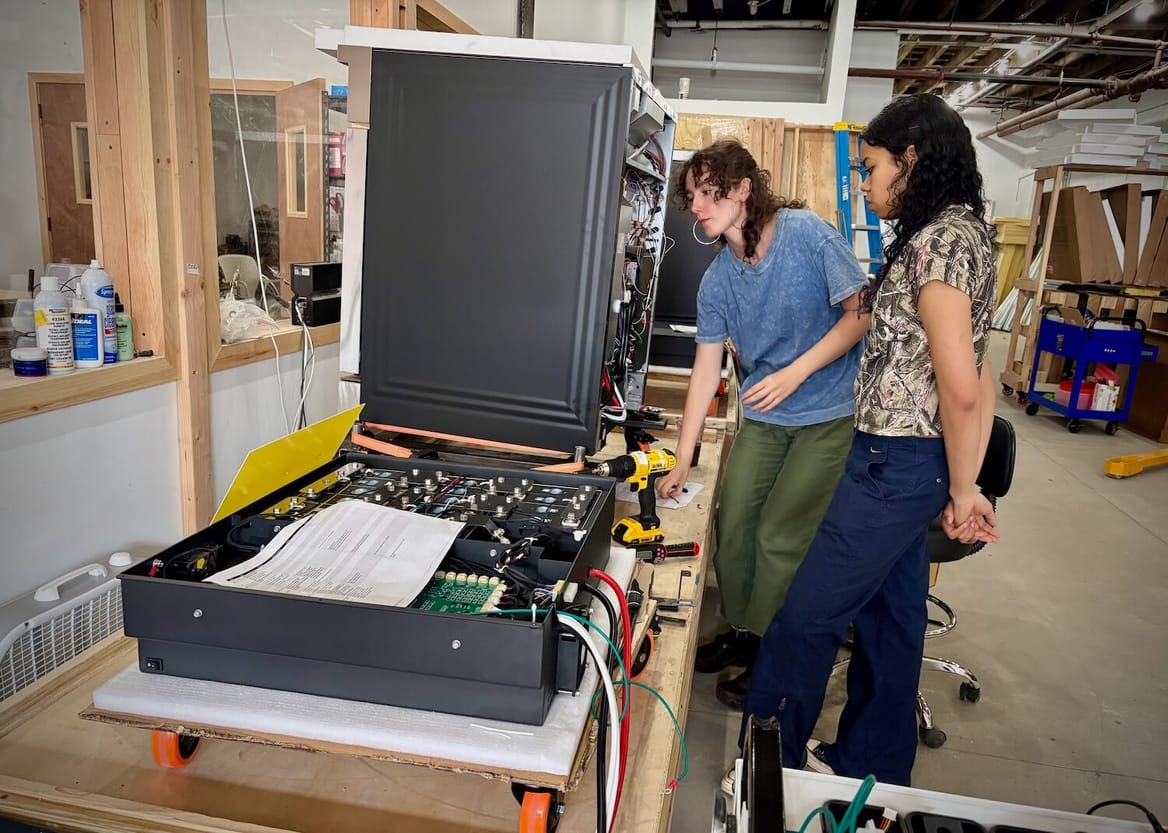
When I visited on a cloudy day in late June, Alexia Avina was rewiring a 305-pound appliance to connect a slender battery pack, which fits beneath the drawer that holds broiler trays and pans. Electra does the metalwork for its stoves in China and final assembly at the Brooklyn facility, turning them into energy-storing, Wi-Fi-enabled devices — ones that won’t fill your kitchen with harmful pollution by burning natural gas.

Alexia Avina, pictured left, and Amelia Chan rewire a battery-powered stove on Electra's fledgling production line. (Maria Gallucci/Canary Media)

Avina joined the team in May, having mainly worked in restaurants and as a musician before training with Electra’s engineers to outfit the stoves. It’s been cool to learn something totally different,” she said later while standing next to stacks of stoves packed in cardboard boxes. It’s rare to have hands-on opportunities like this.”

Unlike many induction stoves on the market, Electra’s model can plug into a standard 120-volt outlet and draw power to charge a 5-kilowatt-hour battery. The induction cooktop heats pans directly using electromagnetism, while the oven cooks food using electric-resistance elements.

Customers can choose to turn their batteries into helpful grid tools. With its software partners, Electra directs the batteries to charge up during the most beneficial times — for example, when solar power production is most abundant — and to discharge power during the grid’s peak demand periods. Electra estimates its appliance uses roughly 80% less peak power than a typical electric-resistance stove.

The company now employs nearly two dozen people, eight of whom work on the Brooklyn production line. It’s self-funded but declined to share financial details.

Electra’s appliances are hitting the market at a time when induction cooking is becoming increasingly popular in American kitchens. The technology cooks faster and more efficiently than gas and traditional electric appliances, and, unlike gas stoves, it doesn’t release pollutants that can harm people’s health. Although federal rebates for electrification expired early under the Trump administration, some states and utilities still offer incentives to help defray the upfront cost of going electric.

Installing Electra's induction stove is meant to be as easy as "slide it in, plug it in, turn it on," said CEO Bert Muthalaly. (Electra)

Electra’s induction stove costs $3,999. That’s more than triple the price of Wirecutter’s highest-rated electric range — although because that model uses 240 volts, it might require upgrading a home’s electrical panel, rewiring the kitchen, or hiring electricians to hook it up. All that can add thousands of dollars to the final bill. Electra says its unit avoids those added costs and, thanks to its battery, can even operate for several meals in a blackout.

The plug-in-ready approach is similar to that of Copper and Impulse Labs, two leading companies in the niche but growing category of battery-powered induction ranges (who, as it happens, are suing each other). California-based Copper has sold over 1,000 units, and it was awarded $32 million last year to design, test, and install 10,000 of its stoves in New York City public housing facilities. Electra says it designed its own model for that same competition.

The startup began receiving stoves from China around three months ago. Electra has since shipped 75 of its appliances from Brooklyn to customers across the United States, and it plans to send out thousands more by the end of this year. Early data show that people who cook frequently are still using only about a fifth of the battery’s power per day, which bodes well for the lithium iron phosphate device’s longevity, Muthalaly said.

The company is also developing a pilot program with the city of Burbank, California, to help residents electrify their kitchens. And it’s partnering with a property owner closer to home, in the Bronx, to equip an 80-unit apartment building with its stoves. In both California and New York, local building codes are effectively pushing natural gas appliances out of new buildings in order to reduce carbon emissions and improve air quality, raising the incentive for households to explore options like Electra’s.

Electra's new warehouse sits along a quiet industrial stretch near Brooklyn's Newton Creek. (Maria Gallucci/Canary Media)

Muthalaly described Electra as a climate research lab,” and the company continues to refine and develop its stove technology. Greg Shakar, an electrical engineer on staff, was testing a unit for electromagnetic noise,” or unwanted radio interference, when I walked through the side of the warehouse dedicated to R&D.

But as orders pick up, Muthalaly said the company is constantly evaluating which parts of the assembly process should remain in-house or should move overseas for higher-volume, lower-cost manufacturing.

We’re thinking about this as an experiment,” Muthalaly said of the Brooklyn operation. We’re going slow, but we’re learning from each install. And it’s getting smoother and smoother.”

This signup form requires necessary cookies.

Allow marketing cookies to load the newsletter signup form.

Maria Gallucci is a senior reporter at Canary Media. She covers emerging clean energy technologies and efforts to electrify transportation and decarbonize heavy industry.