Next Upcoming
Rural America & The Clean Energy Transition at Climate Week NYC
By Canary Media
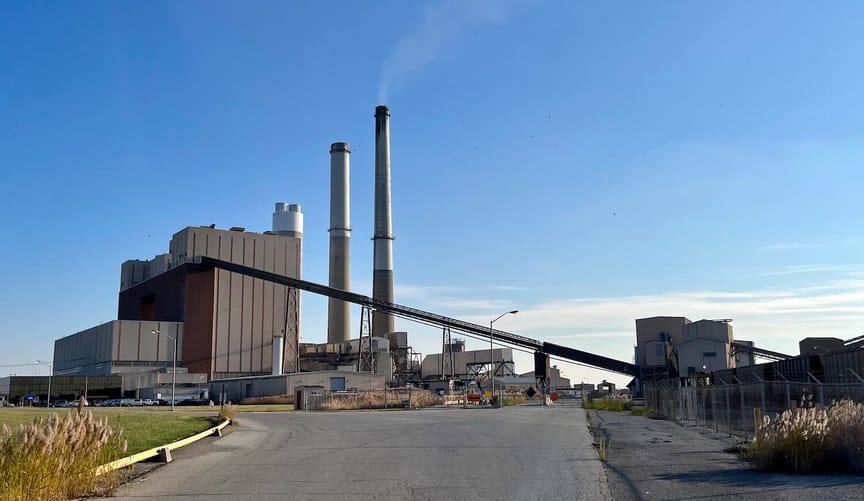
Illinois had big plans to turn a bunch of old coal plant sites into solar and battery farms. But the program has turned out to be kind of a bust.
The state created its Coal to Solar and Energy Storage Initiative five years ago, hoping it would speed clean energy deployment by making use of the grid infrastructure and land left behind when coal plants close — as well as replace some of the lost local tax revenue and jobs.
The program was supposed to lead to at least six significant solar and battery storage arrays and five larger stand-alone battery banks. But in the end, only three relatively small solar farms with storage were built, and no stand-alone storage, finds a new report by the University of Illinois’ Climate Jobs Institute and the nonprofit Prairie Rivers Network.
“It’s a kind of sexy idea — we’re building solar on coal plants. It’s a neat picture of the green transition,” said Roshan Krishnan, a report co-author and research specialist at the Climate Jobs Institute, which studies the impacts of state energy policies. “But in reality, it ends up being more complicated.”
The researchers stressed that the lackluster results don’t mean that redeveloping shuttered coal plants into clean energy hubs is a bad idea — it’s just that the design of this specific effort didn’t make the conversion attractive for developers. The silver lining is that the results offer lessons for future coal-to-solar initiatives in Illinois and beyond.
“The clean energy transition and how we incorporate a just transition and energy community reinvestment is new. It’s uncharted territory,” said Amanda Pankau, the lead author of the report and director of energy and community resiliency at Prairie Rivers Network. “This isn’t just a dead end; there are other paths forward.”
Only two companies had sites eligible for the Illinois program: NRG Energy and Vistra, which helped craft the initiative and pushed legislators to include it in the state’s 2021 clean energy law.
NRG abandoned both the stand-alone battery projects it initially proposed. Vistra, which built the three successful solar-plus-storage installations, ditched plans for three other solar-storage arrays and three stand-alone batteries to be developed under the coal-to-solar program. Vistra did not respond to a request for comment.
The report partially chalks up the cancellations to inadequate financial incentives.
The incentives for building solar came in the form of renewable energy credits, but the companies could claim the credits only if they also built between two and 10 megawatts of battery storage on-site. Companies claim credits based on the generation from their solar array, and then sell those credits to Illinois utilities looking to meet the state-mandated target of 100% clean energy by 2030.
The state set a fixed price for the credits of $30 each. Although Vistra had pushed for a higher price, legislators figured that was sufficient, given market conditions at the time.
But the $30 ended up being too low to spark development after inflation, supply chain challenges, increasing borrowing costs, and other factors made building solar farms and batteries more expensive than expected, the report explains.
At the three sites Vistra developed, the company installed the minimum amount of storage — 2 MW — necessary to collect the solar incentives. Originally, it had proposed up to 39 MW of storage across six sites. Vistra also scaled back the size of these solar arrays, from a total of 294 MW down to 164 MW.
The report concludes that the initiative may have been more successful if the renewable energy credit price had been flexible and pegged to market forces, including inflation, interest rates, and the cost of acquiring solar panels. Illinois has a larger incentive program for solar that offers flexible credit prices.
“The lesson for Illinois is pretty clear: Incentive structures need room to adjust as costs change, or projects simply won’t get built,” Johnathan Hettinger, communications director of the Climate Jobs Institute, said in a statement.
To spur stand-alone storage, the program offered grants to NRG and Vistra to build systems of 37 MW each. But the companies backtracked, with the state receiving only one proposal and making no awards.
The funds for both types of incentives were collected from Illinois utility customers, and the unused dollars will be returned.
The report flagged other challenges, too: The program excluded municipal utilities and rural electric cooperatives from participating. Securing grid interconnection was expensive and time-consuming, even when reutilizing existing transmission infrastructure. And toxic coal ash on coal plant sites made it impossible to build in many areas — an issue the report notes is unlikely to abate anytime soon given the Trump administration’s rollback of federal rules mandating coal ash cleanup and the state’s slow progress on this front.
Meanwhile, the solar farms Vistra did develop drove home the fact that clean energy installations can rarely replace all the jobs lost when fossil fuel plants close.
“The jobs don’t translate neatly over,” Krishnan said, noting that after construction is done, solar and storage arrays typically offer only some monitoring and maintenance positions. “Some of the guys working at the coal plants end up in those jobs, but we’re talking single digits per site.”
And solar farms often bring in less tax revenue for local governments.
For example, the solar installation Vistra built at its Baldwin coal plant, which is scheduled to close in 2028, is projected to bring in about $6 million in property taxes over its lifetime, while the coal plant brought in over $3.1 million in tax year 2025, and $4.8 million in 2016, at the height of its operations.
The tax revenue from renewables can “be a piece of the puzzle,” Krishnan said, “but not a one-to-one replacement” of dollars lost from coal plants.
Despite this program’s lackluster results, advocates said the state and power companies should not give up on developing renewables and storage on retiring coal plant sites.
Vistra is in fact pursuing several such projects, just not under the constraining framework of the program created by the 2021 law, which required clean energy to be built directly on the coal plant site. For instance, the company is building a solar array eight miles from its Joppa coal plant, but still using the coal plant’s interconnection infrastructure to attach to the grid.
Illinois has other incentives that can be used for building solar and storage on retired coal plant sites. That includes a program aimed at brownfield redevelopment and another focused on spurring community solar in places that have borne the brunt of polluting fossil fuel plants and mines.
“The idea of coal-to-solar and energy community investment doesn’t have to be specific to a piece of land, but rather ensuring those communities and workers aren’t left behind as the energy system changes,” Pankau said. “That spirit is still alive and well in Illinois.”
While the coal-to-solar program was among the state’s early forays into incentivizing batteries, last year Illinois passed an energy law that subsidizes utility-scale storage arrays and sets an ambitious goal of attaching 3 gigawatts to the grid by 2030. This initiative aims to attract developers with indexed storage credits, a flexibly priced and competitive structure similar to that of the state’s main solar energy credit program. Developers are expected to submit proposals for large-scale storage, and the state will select winners during a procurement on Aug. 26.
The need to spur these technologies is growing more urgent as energy-gobbling data centers bear down on the state, Pankau said.
“Though this program was not as successful as we’d hoped, we are proactive and trying new things,” she said of the state’s efforts, “not just battery storage but new energy-efficiency initiatives, virtual power plants.
“These things are new,” Pankau said. “We’re learning as we go.”
Kari Lydersen is a contributing reporter at Canary Media who covers Illinois, Indiana, and Wisconsin.
This video requires marketing cookies.
Update your cookie preferences to watch the video.