Next Upcoming
Rural America & The Clean Energy Transition at Climate Week NYC
By Canary Media
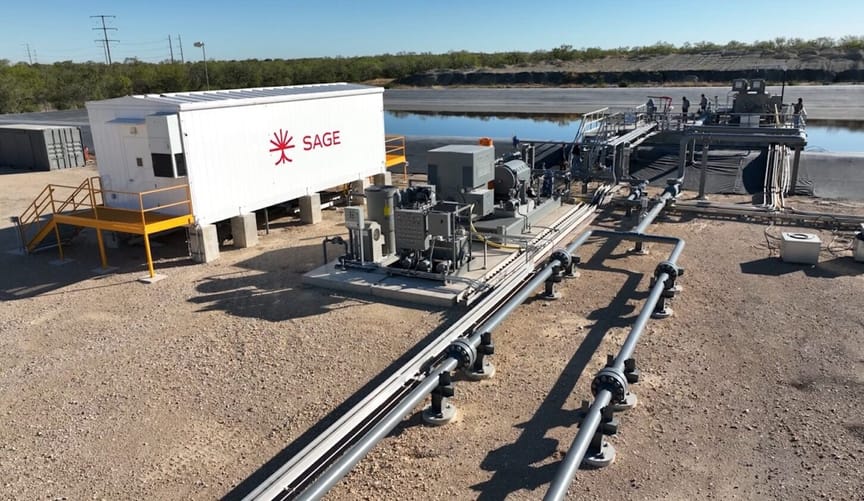
Sage Geosystems has hit a big milestone out on a rugged tract near San Antonio: The startup is producing power from its first next-generation geothermal plant. The system is just the third of its kind to come online in the U.S. as the sector races to commercialize the source of on-demand clean electricity.
The novel geothermal facility in Texas has been running since April, Sage exclusively shared with Canary Media. The Houston-based firm said the 3-megawatt pilot plant has performed reliably and as predicted after more than 120 days of grid-connected operations.
Cindy Taff, Sage’s CEO, said the results will “directly inform and de-risk” an upcoming collaboration in Nevada with Ormat Technologies, a conventional geothermal leader that is increasingly dipping its toes into next-generation technology. The Nevada project is a necessary precursor to Sage’s deal with Meta to develop 150 MW of geothermal power.
Sage’s enhanced geothermal system is a type of nascent tech that involves drilling deep into hot rocks and fracturing them to create water pockets, then using the heat to generate power. It’s distinct from the decades-old traditional geothermal plants that rely on what Taff called “very unicorn geology” — the few places in the world where a combination of water, heat, and permeable rocks are easily accessible.
For all the buzz around the technology, just two other enhanced systems have connected to the U.S. grid so far.
In 2013, Reno-based Ormat completed a 1.7-MW demonstration project at its conventional Desert Peak facility in western Nevada, before returning its focus to old-school geothermal for a time. A decade later, Fervo Energy began operating a 3.5-MW geothermal plant in northern Nevada in partnership with Google. Building off that project, Fervo is now constructing a 500-MW facility in Utah, which is set to come partially online in October.
Sage likewise expects its early success in Texas to fuel its commercial-scale ambitions.
The startup has been developing the pilot since 2024, when it reached a deal with San Miguel Electric Cooperative to use land near a coal-fired power plant in the town of Christine. Sage built its own substation there and intermittently sells power to the Texas grid.
Taff said that one of the most promising outcomes has been the relatively limited water loss from the underground system. Sage’s approach involves creating a network of fractures, into which it pumps and stores large volumes of water. As hot water pushes up against the rocks around it, mechanical pressure builds, which is released when the crew opens a valve at the top. This is different from other enhanced projects, which use fractures to flow water between two wells without pressure.
In both cases, water can migrate into surrounding rock formations as it moves through the fractures. The more water a project loses along the way, the less efficient it becomes at producing energy.
Sage lost less than 10% of the water that it cycled through the Texas system on multiple occasions, which Taff said bodes well not just for the company but also for the larger universe of enhanced geothermal, if it adopts similar methods.
“The net power output that you can produce from these technologies is going to go up, she said, noting that curbing water loss will enable enhanced systems to scale commercially at a competitive cost.
Initially, Sage planned to use similar geothermal techniques to develop a long-duration energy storage system near the coal plant. But in recent years, Texas has built one of the largest grid-battery fleets in the world, making the timing less ripe for rolling out a novel storage technology. So Sage is now primarily focused on meeting the nation’s growing demand for around-the-clock clean electricity.
To that end, Taff said Sage expects to begin drilling its first well at one of Ormat’s conventional geothermal plants in Nevada later this year. Sage will provide the hot water it produces to Ormat to generate electricity at the existing facility — allowing Sage to demonstrate its technology without going through the costly, lengthy steps of connecting to the grid or building a power plant.
Sage hasn’t yet specified how large this system will be, but does expect to start producing electricity in 2027 and reach full-scale production in 2028. Once that happens, Sage will begin working with Meta to start developing 150 MW of next-gen geothermal power somewhere east of the Rocky Mountains. All told, Sage has lined up about a gigawatt’s worth of projects on paper.
The Texas pilot enables Sage to “actually model and predict how the [reservoir] behavior is going to be going forward,” she said. “And that sets us up very nicely for scaling and building commercial facilities with our approach.”
Maria Gallucci is a senior reporter at Canary Media. She covers emerging clean energy technologies and efforts to electrify transportation and decarbonize heavy industry.
Clean energy manufacturing
This video requires marketing cookies.
Update your cookie preferences to watch the video.