Next Upcoming
Rural America & The Clean Energy Transition at Climate Week NYC
By Canary Media
This analysis and news roundup come from the Canary Media Weekly newsletter. Sign up to get it every Friday.
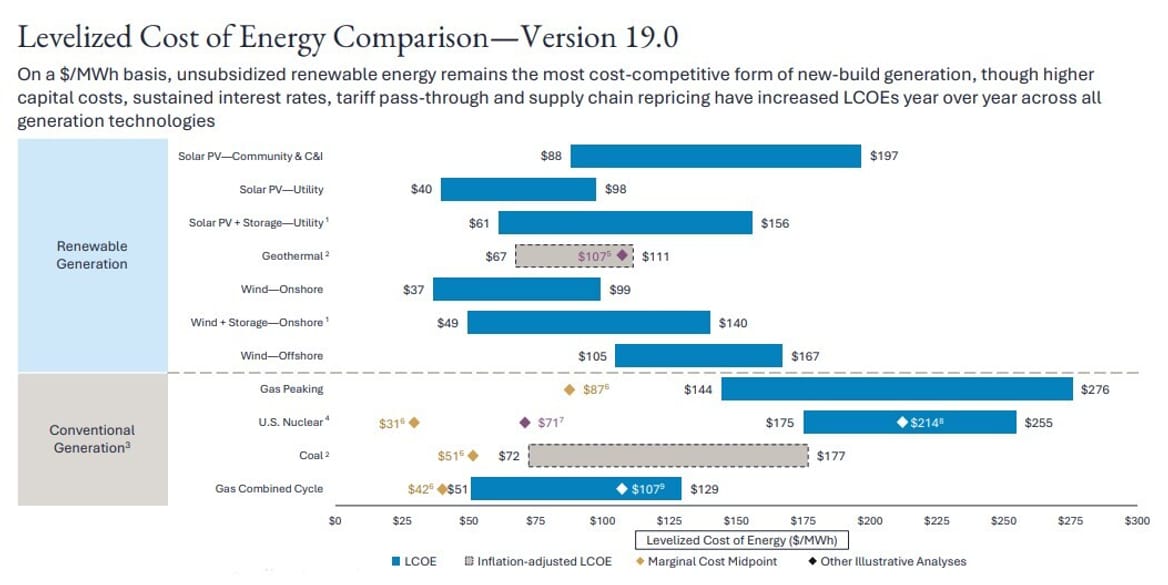
Pretty much every type of energy is getting more expensive in the U.S., but clean energy is still a better bet than fossil fuels.
That’s the topline from investment bank Lazard’s latest annual report on the levelized cost of energy, or LCOE — a metric widely used to compare how expensive different sources of electricity are. Put simply, it expresses the present-day price of generating a megawatt-hour of electricity from a solar farm, a gas plant, or another power source, all while accounting for that source’s full lifetime operating costs. For example, it takes into consideration that a solar farm’s fuel and operational costs are tinier than a fossil fuel plant’s.
For the last decade, Lazard’s reports have basically reached the same conclusion: Onshore wind and utility-scale solar have a lower LCOE than fossil fuels. While that’s still true this year, the average LCOE of onshore wind and solar did surge by 11% and 18%, respectively, from last year, thanks to the loss of federal renewable energy tax credits, increased tariffs, high interest rates, and other challenges.
But the fossil fuel sector also faced headwinds over the past year, as a supertight market for turbines drove up the cost and timeline of building a gas plant. The LCOE of gas power from modern “combined-cycle plants” — which was already about $20 higher per megawatt-hour than solar’s and onshore wind’s in 2025 — rose by 15%. Still, those higher prices and construction delays haven’t stopped developers from pursuing ambitious gas projects as the AI boom sparks a scramble for on-demand power.
Although LCOE is a pretty handy way of comparing energy costs across sources, it has its limitations, the Clean Air Task Force argued in a report last year. The climate advocacy group says LCOE isn’t a good method for long-term decarbonization planning because it doesn’t account for many real-world concerns, like a power source’s land and health impacts or its ability to generate nonstop electricity.
Even so, plenty of evidence indicates that renewables will retain their cost-competitive edge. For one, they’re not subject to rocky fuel prices like oil and gas are — something that’s been on full display as conflict in the Middle East continues. And while solar and wind power generation remain at the mercy of the weather, batteries are making their fatal flaw of intermittency a thing of the past.
A first-in-the-nation data center ban
New York has become the first state to enact a moratorium on building hyperscale data centers. After a few weeks of will-she-won’t-she uncertainty, Gov. Kathy Hochul (D) signed an executive order barring data center construction for up to a year as the state hammers out regulations.
The move comes as data centers face criticism from both sides of the political aisle over their power use, and especially their potential to drive up electricity costs for residential utility customers. But despite the facilities’ widespread unpopularity, other governors have been reluctant to go as far as Hochul. In April, Maine Gov. Janet Mills (D) vetoed a bill that would have halted construction through November 2027. And just this week, Michigan Gov. Gretchen Whitmer (D) asked data center developers to pledge they wouldn’t raise power costs for state residents, but stopped short of calling for a total ban on construction.
Clean energy beats the heat
This week was another hot one in the Northeast, though temperatures weren’t quite as bad as they were earlier in July, when a major heat wave tested — but didn’t knock out — the power grid.
As I wrote last week, clean energy played a big role in meeting soaring demand while millions of people cranked up their air conditioners. Some New York City households even kept cool without adding to the grid’s burden. Our reporter Maria Gallucci is one of a few hundred New Yorkers participating in a pilot program that provides apartment dwellers with a small battery pack to plug their window AC into, reducing stress on the electric system, helping prevent blackouts, and even earning them a little cash.
Maria stayed on the heat wave beat with a look at how offshore wind tackled spiking power demand in New England. The region had to turn to oil power last year when it faced a similar hot spell, but this year, the emergence of more offshore wind meant the grid didn’t need as much of the dirty fossil fuels.
Endangered again: The Trump administration finalizes a change to how the Endangered Species Act is enforced, opening up critical wildlife habitats to oil and gas drilling and other development. (NPR)
Google’s big clean bet: Cypress Creek Energy breaks ground in Arkansas on what could be the largest solar and storage project in the U.S., with power from its first two phases purchased by Google to offset its data center demand. (Canary Media)
Weatherization win: A federal housing law that recently passed with bipartisan support will require the Trump administration to enact stronger energy conservation standards for manufactured homes, which aren’t subject to local and state building codes and are often inefficient. (Canary Media)
Fast food, fast charge: EV chargers are proliferating especially quickly in the South, including at fast-food chains like Bojangles and convenience stores. (New York Times)
Smoking out solar: The wildfire smoke that turned skies orange and hazy in much of the Northeast this week also caused solar production to plummet in New England. (WBUR)
A balcony solar deal: Nonprofit Bright Saver is selling zero-markup balcony solar packages starting at around $300 as more states pass laws allowing residents to use the plug-in panels. (Canary Media)
Turbines torpedoed: The Trump administration has delayed 155 new wind energy projects across 24 states over allegations that turbines threaten drone detection and national security. (Grist)
Kathryn Krawczyk is the engagement editor at Canary Media.
This video requires marketing cookies.
Update your cookie preferences to watch the video.