Next Upcoming
Rural America & The Clean Energy Transition at Climate Week NYC
By Canary Media
There’s never been a better time to build energy storage in the U.S. than right now.
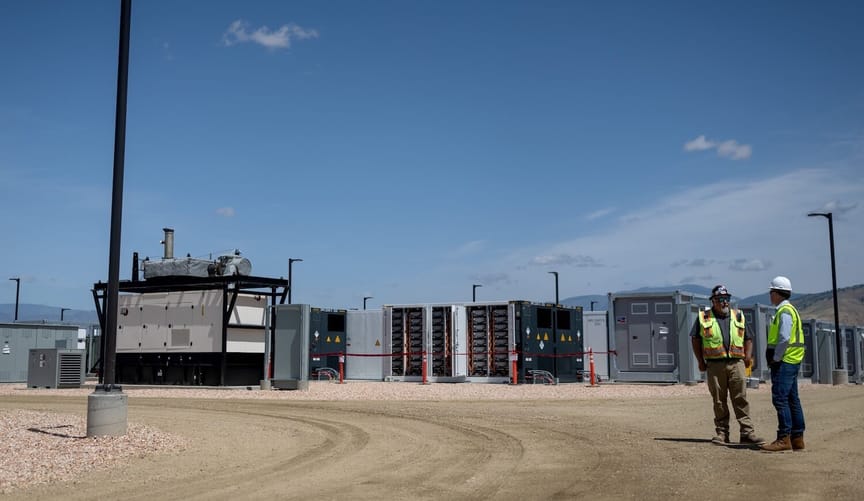
Grid batteries — which sop up power when it’s abundant and discharge that energy when it’s needed — have been ascendant for a decade, as the price of the underlying lithium-ion cells fell precipitously. Bolstered by plummeting costs and increasing familiarity with the tech, developers started building bigger and in more parts of the country.
Now, the U.S. power sector has added more battery capacity in the second quarter of this year than any quarter ever, according to a report out today from the Solar Energy Industries Association and Benchmark Mineral Intelligence. Even as the wind and solar industries face uncertain futures, the outlook for continued battery growth is so strong that Benchmark Minerals upped the prediction for cumulative installs through 2030 by 11.5% from its previous report, issued just three months ago.
The 20.2 gigawatt-hours of battery capacity built from April through June represents one-tenth of the nation’s entire grid storage capacity. Seven of the new projects mustered at least 1 GWh or more of storage capacity, reflecting developers’ rising appetite for megabatteries.
To contextualize the numbers, the second-quarter installations can inject 6.7 gigawatts of instantaneous power onto the grid — equivalent to nearly seven big old-school nuclear reactors, but without the decade-plus wait time for construction. That comparison has its limits, though, because nuclear plants can generate around the clock, whereas batteries must refill and discharge.
Batteries can make a huge difference in places where the grid is stretched thin, and can be built quickly and closer to centers of energy consumption than new fossil-fuel-burning plants with their smokestacks and emissions.
Those qualities make the tech attractive in places where capacity is scarce, which happens to include California, Texas, the Southeast, the mid-Atlantic, the Northeast, and just about anywhere else. AI data center developers are turning to batteries to ensure they can keep the algorithms running during peak demand hours. And solar developers leverage batteries to turn their clean electrons into a more valuable on-demand resource; 44% of the new storage capacity was built alongside solar plants.
This widespread zeal for batteries extends to the Trump White House, which revoked wind and solar subsidies last year but kept Biden-era tax incentives for batteries. As the executive branch found novel and often legally dubious means to thwart wind and solar construction, it has left battery developers to go about their business.
Recently, the administration has more proactively encouraged the battery industry, loaning $490 million dollars to a battery project in Puerto Rico as well as funding efforts to reshore the supply chain for critical minerals used to make the tech. Energy Secretary Chris Wright, who regularly blasts solar power on his official platforms, recently stopped by the Maine site of a novel iron-air battery that Form Energy plans to build, with help from Department of Energy grant funding.
An observer unencumbered by historical nuance might conclude that Trump is the battery president, and that no president has done more for batteries than he. SEIA even gestures in that direction, noting in its press release that large-scale storage nearly doubled during the first year and a half of the second Trump term, and that 74% of the second-quarter storage additions happened in states that voted for him — like Texas, Utah, and newly minted battery storage powerhouse Arizona.
The reality is these outcomes took years to build up to. Technologists tinkered with batteries in big boxes; California mandated its utilities buy storage and subsidized it for smaller customers; Texas wildcatters took big risks on early battery investments and made windfall profits; and companies like LG and Tesla built huge factories to solidify domestic battery supplies. Now, all that hard work is paying off with installations on a scale we’ve never seen before.
Julian Spector is a senior reporter at Canary Media. He reports on batteries, long-duration energy storage, low-carbon hydrogen, and clean energy breakthroughs around the world.
Virtual power plants
This video requires marketing cookies.
Update your cookie preferences to watch the video.