Next Upcoming
Canary Live Bay Area
By Canary Media
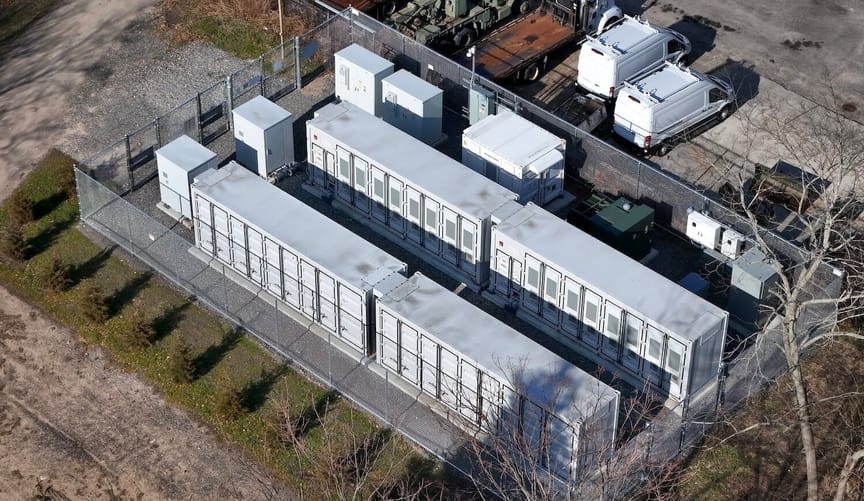
New York set an ambitious goal to eliminate fossil-fueled electricity by 2040. Doing so will almost certainly require widespread adoption of batteries to store renewable generation and make it available on demand, thereby reducing the need for fossil-fueled “peaker” plants. Yet the state has seen hardly any large-scale battery construction to date.
As of March, New York state contained just 80 megawatts of operational “bulk” storage, plus around 335 MW of small-scale batteries. That’s a far cry from the state’s goal of installing 1,500 MW by 2025, though officials claimed success by factoring in not-yet-built projects that had been awarded or contracted.
Now, New York is taking its biggest step yet to unlock the widespread grid storage that states like California and Texas have been enjoying for several years.
Eight grid battery projects won state contracts last week, which collectively will add 950 MW of non-emitting, on-demand power by 2030. That’s meaningful progress toward the state’s goal of 6 gigawatts by 2030. The New York State Energy Research and Development Authority plans to run two more solicitations like this one to accelerate the momentum.
New York’s paltry track record on batteries is not for lack of trying. The state adopted its first formal storage target in 2018, but the market dynamics in the statewide grid system haven’t supported battery development on their own. The capacity market, for instance, offers only six months of predictable revenue, which makes it hard to convince financiers to fund a 20-year battery investment. Utilities’ attempts to procure large batteries over the years have largely proved bootless.
So the state stepped in.
NYSERDA’s 2022 Energy Storage Roadmap called for a new, centralized procurement to jump-start progress toward the state’s storage goal. It took until June 2024 to get official approval for the plan from the state’s utility regulator. NYSERDA released the call for battery proposals in July 2025 and last week announced eight winners from 46 bids.
“To earn an award, proposers need to demonstrate that the project is competitively priced, is mature and viable, can provide electric system value, and spurs in-state economic activity,” the agency said in an email to Canary Media.
The winning developers — including Flatiron Energy, Grid Connected Infrastructure, Key Capture Energy, Savion, and Zenobē — won’t get buckets of cash from the state; instead, NYSERDA structured the deal to provide long-term certainty that the batteries will make enough money to keep operating.
Applicants submitted a strike price that reflects the revenue they need in order to make the project worth building. Once the batteries enter the market, NYSERDA will calculate a monthly reference rate for what a battery should have earned in its part of the grid, based on real market pricing.
“If the wholesale markets are lower than what the project needs, then NYSERDA tops us up,” said Amit Barnir, vice president of network infrastructure at Zenobē, a U.K.-based storage developer that won a contract for its 100-MW battery development in Burns, New York. “On the flip side of that, if we are generating more than what the project needs, we actually pay back NYSERDA.”
That design is intended to protect ratepayers, NYSERDA noted.
This market-based incentive pushes battery owners to bid low enough to win a contract, though if they undercut the real cost of their projects, they’ll likely struggle to make money in the long term. Battery operators also can earn more money by outperforming the regional reference case through savvy location and trading strategy, so they have an incentive to maximize their participation in New York’s grid.
“You are settled on a zonal level, but the project earns revenues at a nodal level,” Barnir said. “So picking the right node is critical for being successful in this program, from our perspective.”
Zenobē, for instance, chose to develop its battery near a 100-MW solar plant that is being built by power company AES. That solar power will feed into the same substation that the battery hooks up to, so Zenobē will be especially well positioned to charge up on cheap solar power and discharge it during peak hours that fetch a higher price.
NYSERDA announced a portfolio of 719 MW of renewables contracts at the same time as its battery selections, so there will be more clean energy for batteries to store in the future.
This buildout should put downward pressure on energy prices for New Yorkers. In markets where they compete, batteries handily undercut peaker plants by arbitraging electricity, instead of having to burn fuel to generate it. New York City, in particular, still relies on many decades-old fossil peakers that are expensive, are inefficient, and pollute their surrounding neighborhoods. A state environmental rule called for shutting down those plants, but the city has struggled to build local battery capacity to replace them.
The problem isn’t that batteries wouldn’t be valuable in New York; it’s that the existing rules made it nearly impossible to finance them. NYSERDA’s plan aims to solve that by promising 15 years of predictability, with minimal outlay from the ratepayers. It’s been a long time coming, but now New York could position itself as a battery leader in a region that has been slow to adopt this grid technology.
Julian Spector is a senior reporter at Canary Media. He reports on batteries, long-duration energy storage, low-carbon hydrogen, and clean energy breakthroughs around the world.
Marine transport
This video requires marketing cookies.
Update your cookie preferences to watch the video.