Next Upcoming
Rural America & The Clean Energy Transition at Climate Week NYC
By Canary Media
Just northeast of Columbus, Ohio, the leafy Main Street of New Albany gives way to lush green fields and agrarian ponds — but soon the countryside transitions into mile after mile of enormous white boxes that emit a low hum. This patch of former farmland has become one of the densest clusters of AI computing in the nation, recently joined by Intel, which is constructing a $28 billion computer-chip factory at the northern end of the industrial bloc.
All of this requires a tremendous amount of electricity, but the area falls within the multistate market managed by PJM Interconnection, which has consistently struggled to bring new power plants online even as demand booms. The resulting power price spike has drawn the ire of both Republican and Democratic governors, who are demanding that PJM and tech giants figure out how to stop data centers from driving up costs for everybody around them. No less than the White House is pushing AI companies to “build, bring, or buy new power supply.”
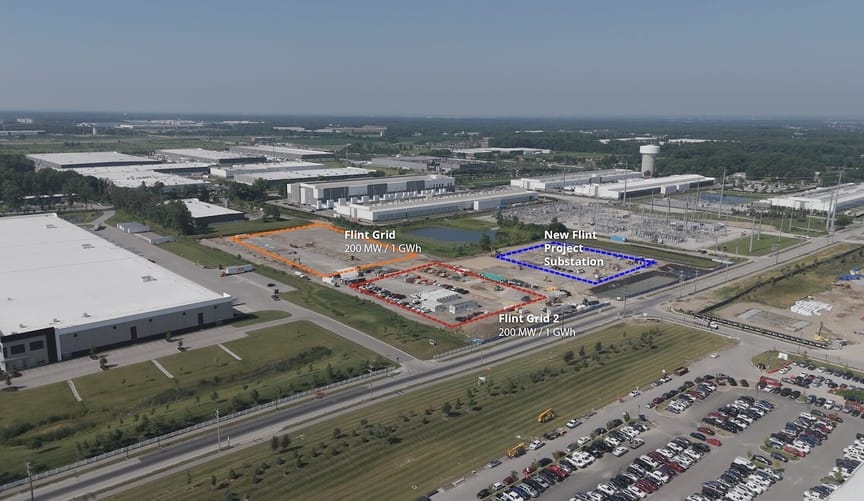
A huge battery that just began construction in the heart of the New Albany computing cluster could model a way to accomplish that task.
Developer Eolian announced on Wednesday that it’s broken ground on its Flint Grid battery project. The first phase is due online by June of 2027, and will be able to inject 200 megawatts for up to five hours straight into an electrical substation that serves the computing hub. With 1 gigawatt-hour of storage capacity, this battery won’t just be the biggest on the 13-state PJM market; it’ll be the biggest battery east of the Mississippi.
The system will help lower electricity prices by charging up when energy is cheap and abundant and dispatching that stored power onto the grid at times of peak demand — exactly what big batteries have been doing for years in places like California and Texas.
“There are things that have been in progress for a long time, designed to solve these very problems,” said Eolian CEO Aaron Zubaty, in response to the “snowballing narrative” that the grid can’t keep up with demand.
Batteries have set new installation records in the U.S. year after year, swiftly becoming the nation’s top pick for on-demand capacity and beating out new gas plant construction. But construction has clustered in the West, and developers have struggled to make inroads in the Midwest or the densely populated Eastern Seaboard. However, now that those areas face tremendous AI data center growth, they could use the instantaneous power that massive batteries provide.
Eolian can deliver that in New Albany because the firm got started a decade ago, taking calculated risks that seem to have paid off.
“This isn’t just some random 200 megawatts,” Zubaty said. “This is 200 megawatts at the epicenter of one of the largest industrial buildouts ever seen in our country, and by putting it at this spot, it will actually allow more stuff to get built.”
Zubaty didn’t originally have Ohio top of mind for his clean energy ambitions. By the early 2010s, northern Virginia led the nation in data center density, and Zubaty wanted to develop solar farms near those major energy consumers. But he ran into obstacles finding enough land. Solar development had to contend with northern Virginia’s horse farms and suburban subdivisions, and further west from Dulles airport, you hit the Appalachian Mountains.
“Where do the mountains end? A little bit east of Columbus,” Zubaty said.
Central Ohio was already growing in population and economic vitality, Zubaty noted, anchored by a skilled workforce and The Ohio State University. And it had a lot of open space that could accommodate new growth if the titans of the internet wanted to branch out from northern Virginia.
“We started doing land research, looking at where we could build solar in proximity to the Columbus metro area,” Zubaty recalled. “Lo and behold, we stumbled upon a couple obscurely named LLCs that were buying up a bunch of land at substations, and it was Amazon.”
Amazon Web Services opened its first data center outside New Albany in 2016. That kicked off a frenzy of tech companies buying the larger parcels of land nearby. One smaller tract — with an old house, lots of foliage, and a small pond — got left behind in the land race as data center companies bought all the property around it. The owners agreed to sell to Eolian, which considered the acreage well suited for a battery plant.
Today, that house is gone, and the once-peaceful parcel is fully surrounded by looming warehouses filled with servers. Crucially, it abuts a substation owned by utility AEP that receives power from a high-voltage transmission line and feeds it to a lower-voltage line that loops through the data center region. That potent grid backbone is what makes it possible for the area to host so much computing — and gives the battery a means of charging up.
After securing the land, Eolian got to work on permits, interconnection to the grid, and approval from the Ohio Power Siting Board. At the time, PJM’s power prices were quite low, offering little incentive for companies to build new power plants, even as “we were watching this massive amount of data center development unfold at a really epic scale,” Zubaty said.
By 2025, Eolian was ordering transformers and other long-lead-time equipment, even though it lacked a deal to sell power to one of the many corporate customers operating nearby. In December, Zubaty had sufficient confidence in the project to bid it into PJM’s capacity auction, which would award contracts for power delivered for one year starting on June 1, 2027. The auction hit the maximum possible price, signalling that long-simmering demand had unquestionably outstripped supply in PJM.
That win started a clock ticking to build out the site, because “there’s a massive financial penalty to bidding and then not showing up,” Zubaty said. (Eolian also plans to add a second phase of the same size by 2029.)
Typically, power plant investors want to see decades of revenue commitments in order to finance construction. PJM, though, only offers one year of certainty for that capacity payment.
Eolian took the risk of building in the hopes that further contracts will materialize.
Now, it looks increasingly likely that one of the many hyperscalers in the area could sign a deal that lets it take credit for the battery project’s contributions to PJM capacity. This could offset that customer’s need to buy power at sky-high market rates, but it also may become necessary to operate at all.
Tech giants are under tremendous political pressure to figure out how to meet their electricity needs without burdening the power system overall, especially in PJM territory. The White House’s Ratepayer Protection Pledge has pushed leading AI companies to say they will cover their own energy costs. New York state recently froze data center construction for a year, giving itself time to make rules to prevent the development from driving up electricity costs, and other liberal states are considering similar measures.
Should hyperscalers look for a well-situated battery to help meet their needs, they won’t find many. PJM can’t wind back the clock and ask for more developers to have applied for grid connection and secured land near future AI hubs eight years ago. Nor is there any indication PJM will soon refine its rules to allow the kind of flourishing of batteries seen in Texas’ competitive wholesale market.
But once one developer shows it’s both possible and valuable to build big batteries in the region, the sheer pressure to meet the AI moment may carry more batteries through the impasse.
Julian Spector is a senior reporter at Canary Media. He reports on batteries, long-duration energy storage, low-carbon hydrogen, and clean energy breakthroughs around the world.
Corporate procurement
This video requires marketing cookies.
Update your cookie preferences to watch the video.