• Data center demand is soaring, and off-grid gas won't fix the problem
  • Account
  • Donate
Clean energy journalism for a cooler tomorrow

Data center demand is soaring, and off-grid gas won’t fix the problem

As tech firms look to build their own gas generators, a new report reveals that likely won’t be enough to avoid a hefty power shortfall in the coming years.
By Kathryn Krawczyk

  • Link copied to clipboard
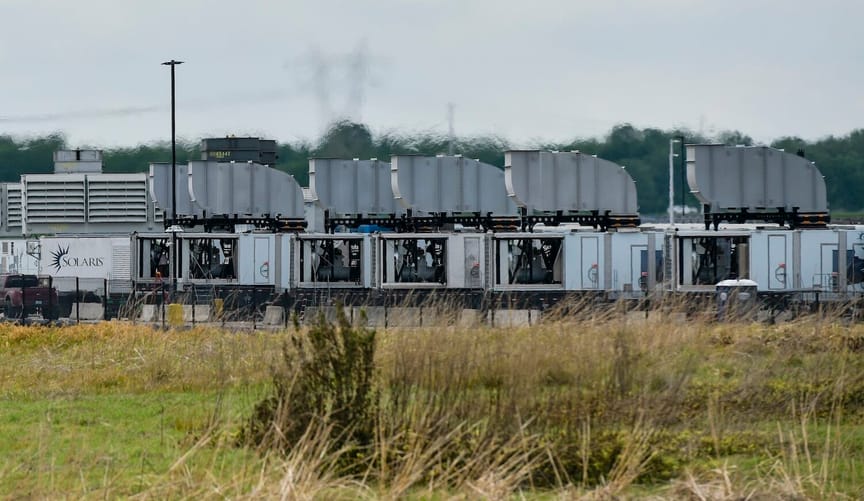
Truck beds with gas generators; grassy lot in foreground
Portable gas turbines have been powering xAI’s Colossus data center near Memphis. (Brandon Dill for The Washington Post via Getty Images)

This analysis and news roundup come from the Canary Media Weekly newsletter. Sign up to get it every Friday.

It’s no secret that data centers are slated to bring stunning levels of new power demand to the grid in the coming years.

Report after report has tried to put a number on just how much electricity these facilities will actually use, and BloombergNEF joined the chorus this week. Its report projects that U.S. data centers will consume 20% of the country’s power in 2035, up from 5.9% today.

In all, data centers will consume as much as 194 gigawatts of power in 2035, the report estimates. That’s nearly double the amount BloombergNEF forecast back in December, and it’s more than the firm’s analysts expect the power grid to be able to accommodate.

So what’s a data center developer to do? Well, if you’re Elon Musk, you buy a company that’s operating tons of mobile gas and diesel generators that can provide your data centers with power that’s not connected to the grid.

Federal records unearthed last week by Electrek show that in May, the xAI founder bought APR Energy, a Florida company that runs more than a gigawatt of these portable fossil-fueled turbines. These generators can be installed in just a few days, as opposed to a traditional gas plant, which may take years to build.

This isn’t a new avenue for xAI. Since last August, the company has been using diesel generators propped on truck beds to power its Colossus 2 data center project outside Memphis. A lawsuit from the NAACP and its allies alleges the turbines are running without required permits and releasing tons of pollution that harms nearby, majority-Black communities.

Other data center projects are turning to gas, too, or hope to do so in the future. In Ohio, Meta uses modular gas turbines to power servers that, as of June, are stacked up in temporary tents. Some developers want to construct more permanent fossil-fuel solutions: Google, for example, has proposed building its very own utility-scale gas plant alongside a data center in Nebraska.

But experts are casting doubt on just how much off-grid gas power that tech firms will actually be able to build. Among the challenges: Gas turbines are in short supply, and so is the workforce needed to maintain them, as the clean energy industry veteran Jigar Shah noted in an episode of Latitude Media’s Open Circuit podcast.

BloombergNEF projects that even if the grid can accommodate 7 GW of new data center demand each year — the all-time record — and if many hyperscalers install their own gas turbines, the sector will still face a 19-GW shortfall by 2035. For perspective, a standard large-scale nuclear power plant produces about 1 GW of power, and it’s going to be a gigantic undertaking to fulfill the Trump administration’s goal to build 10 of those in the coming years.

Of course, no one knows for sure just how much power data centers will actually end up needing. Data centers could get way more efficient as their processors improve. The AI boom could peter out. Or maybe, just maybe, we’ll unlock the miracle clean power source that is commercial nuclear fusion and use it to meet all our massive electricity needs — but I wouldn’t hold my breath.

More big energy stories

Trump’s ill-timed efficiency rollbacks

America’s war with Iran isn’t letting up, and neither is the energy shortage the conflict has brought upon much of the world.

Energy-efficiency measures could provide one salve to the crisis, but in the U.S., they’re getting ever harder to access. Over the past few months, the Trump administration has scaled back a bevy of programs that make home weatherization and other utility-bill-cutting improvements more affordable. Incentives that helped people trade fossil fuel appliances for electric alternatives are dead, for one.

Even free advice hasn’t survived. The Department of Energy’s website used to be full of tips for lowering your power bills, like how to find and plug drafts in your home. But as Grist reports, those guides disappeared by early July — just in time for a grid-straining heat wave to set in across the country.

State legislatures go easier on renewables

Last year, state legislatures had clean energy in their crosshairs. Lawmakers throughout the country introduced more than 300 bills related to renewable energy siting in 2025, and nearly half of them would have made it harder to build solar, wind, and battery storage projects.

Luckily for renewables, just 10 of those restrictive measures actually became law. But this year is shaping up to be brighter, according to the Siting Solutions Project. While lawmakers introduced 86 measures to rein in solar, wind, and battery permitting in 2026, just one has become law. That record is likely to stick, as most state legislative sessions have already concluded for the year.

A chart shows how state legislative bills would've helped or hurt clean energy.
A smaller share of energy siting bills that would have restricted renewables were introduced this year than in 2025. (Siting Solutions Project)

Meanwhile, a handful of pro-renewables permitting and siting policies made it into law this year in both Democratic- and Republican-run state legislatures, reports Canary Media’s Jeff St. John. That includes measures that aim to curb local bans on renewables, speed review processes, and set best practices for cleaning up retired solar and battery projects.

Clean energy news to know this week

Where to buy balcony solar: A few companies are finding their footing in America’s emerging balcony solar market, with some German firms expanding sales to the States, and U.S. solar manufacturers potentially getting involved soon. (Canary Media)

Iran war strain continues: The world has found ways to adapt without oil from the Strait of Hormuz, but experts predict that fallout from a continued closure could be more severe as countries’ emergency stockpiles near depletion. (Grist)

International nuclear deal: The Trump administration signs a deal with Saudi Arabia that paves the way for nuclear power construction in the country — an arrangement that’s likely to benefit U.S. nuclear developer Westinghouse. (Washington Post, New York Times)

Pumping up iron: Mesabi Metallics sees green steel as a path to revitalize Minnesota’s Iron Range, and it’s rolling out a $2.5 billion plan to mine and produce iron that’s key to lower-emissions steelmaking. (Canary Media)

Coal’s climbing costs: Pushback to the Trump administration’s coal-plant stay-open orders grows, with Wisconsin’s governor saying the costs to utility customers could hit $117 million in coming years, and a Colorado analysis estimating costs over $87 million. (Wisconsin Public Radio, Colorado Sun)

Wind allies unite: A coalition of 18 states and Washington, D.C., looks to join a wind industry lawsuit fighting the Department of Defense’s blockade on onshore wind permitting. (Canary Media)

Digging deeper: Geothermal veteran Ormat Technologies is venturing into the industry’s next generation with projects that can unlock energy where natural geothermal resources don’t exist. (Canary Media)

This signup form requires necessary cookies.

Allow marketing cookies to load the newsletter signup form.

Kathryn Krawczyk is the engagement editor at Canary Media.