Clean energy journalism for a cooler tomorrow
Worker in an orange shirt near a solar array with beautiful views of the city, Diamond Head, and the ocean
A rooftop solar installation overlooking Honolulu (AP Photo/Cathy Bussewitz, File)

Hawaiʻi committed to 100% clean energy. Now it’s flirting with natural gas.

Gov. Josh Green, a Democrat, wants to import LNG to slash energy bills. But the move might not lead to savings — and it could trip up the state’s climate goals.

  • Link copied to clipboard

This story was published in collaboration with Hawaiʻi Public Radio.

On June 8, 2015, Gov. David Ige sat under the great seal of the state of Hawaiʻi and signed the nation’s first legal commitment to run an entire state’s grid system on 100% renewable electricity. 

Ige, a Democrat, lamented that Hawaiʻi was the most oil-dependent state” in the U.S.; unlike others, it relied on oil to produce nearly all of its electricity. 

Making the transition to renewable, indigenous resources for power generation will allow us to keep more of that money at home, thereby improving our economy, environment and energy security,” he said at the time. 

Two months later, he shot down a pricey proposal to use another imported fossil fuel — natural gas — to reduce the islands’ dependence on oil imports. Ige’s reasoning was clear: It’s time to focus all of our efforts on renewables,” he said.

Now, Ige’s successor, Gov. Josh Green, is abandoning that all-out focus on renewables — and throwing his support behind a natural gas import scheme that critics contend would threaten the state’s climate targets while delivering marginal savings, at best, to residents. 

Green, also a Democrat, is backing a $2 billion bid by Japan’s largest energy company, JERA, to construct a floating liquefied-natural-gas import terminal called Longboard LNG. In May, the Federal Energy Regulatory Commission granted JERA’s request to begin the review process for the project.

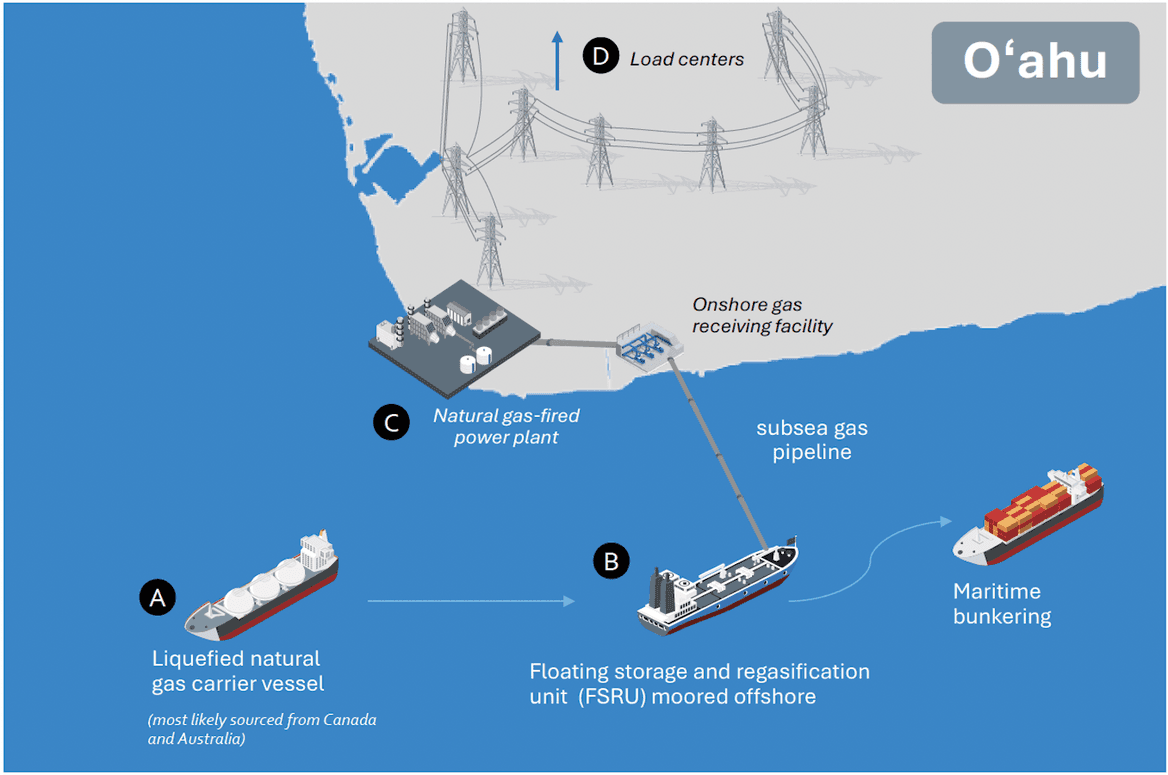
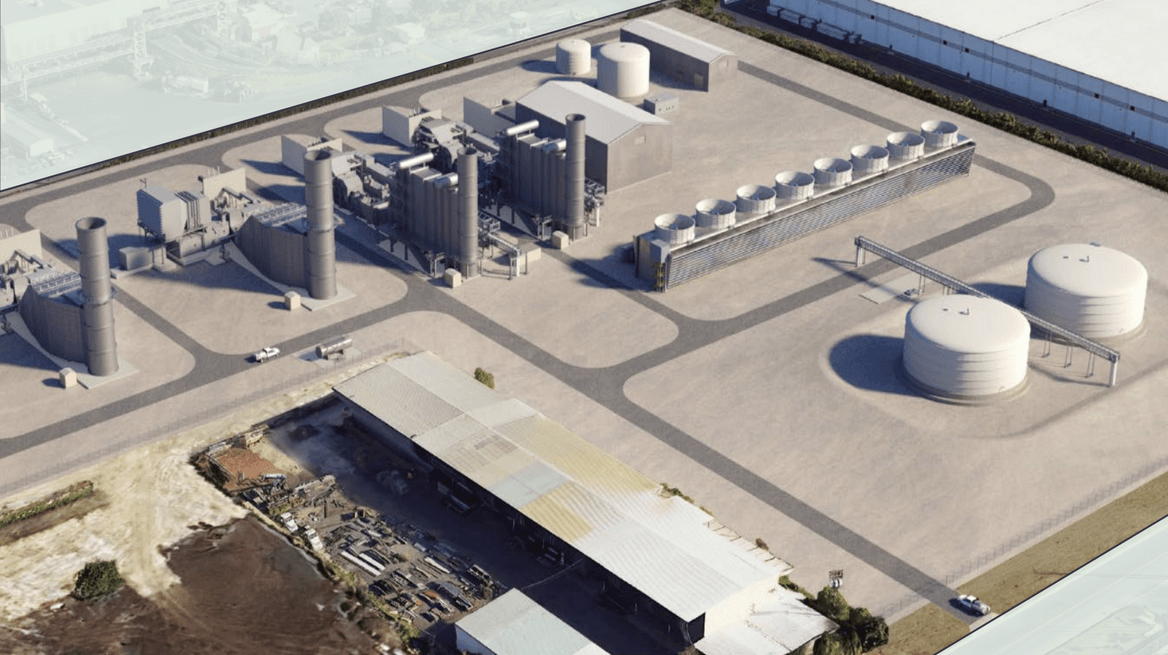
This vessel would ride the surf near Barbers Point, an industrial zone in west Oʻahu that’s home to several power plants. LNG tankers would pull up every three to four weeks to unload the gas, which would flow via undersea pipeline to shore and then fuel a new 500-megawatt power plant to serve Oʻahu, the state’s most densely populated island.

The proposed plant could comfortably meet about 40% of the island’s highest recorded electricity demand and has a target commercial operations date of 2030. Green contends that natural gas can help the state wean off costly and polluting oil without undermining its legal mandate to fully decarbonize its electricity system by 2045. In June, he told Hawaiʻi Public Radio that while the state needs solar and other renewables, it also should have pursued natural gas a decade ago.

We made a mistake not having a more balanced energy plan,” he said.

Long cargo ship with blue and red hull; palm trees in the foreground
A bulk carrier cargo ship arrives at Barbers Point Harbor on O‘ahu. JERA’s proposed LNG terminal will sit in the ocean near Barbers Point. (OntheRunPhoto via Getty Images)

The state’s renewables buildout has been buffeted by a once-in-a-century pandemic, multiple global conflicts, and a catastrophic fire. A decade into the transition, utility customers in Hawaiʻi remain mercilessly exposed to the whims of the global oil market, which saw prices spike this spring after Iran cut off most shipping through the Strait of Hormuz. 

To date, the energy transition has not sufficiently addressed the primary concern of many of Green’s constituents: Their energy rates are the highest in the nation. JERA, meanwhile, claims it can cut Oʻahu households’ electric bills by $500 a year on average.

But critics say that it makes no sense to tether the state to yet another internationally traded fossil fuel — one whose price also shot up thanks to the war in Iran.

You can’t solve this problem of a reliance on imported oil by moving to another import that we don’t control,” said Chris Lee, a Democratic state senator who authored the 100% clean energy law and stood beside Ige as he signed it. And that’s just very painfully obvious.”

Three men, two standing and clapping; man in center with pen and document; state seal and two flags behind them
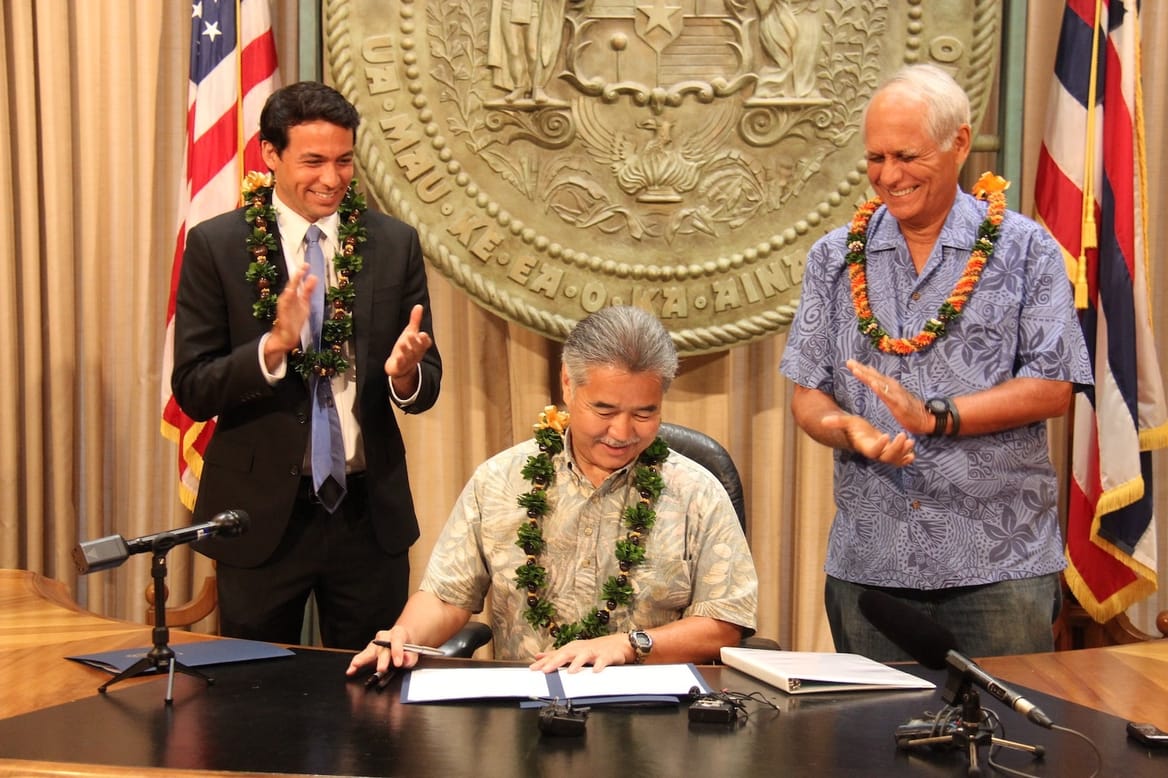
In 2015, then-Gov. David Ige (center) signed a law mandating that Hawai‘i hit 100% renewable electricity by 2045. On the left is Chris Lee, then a state representative. On the right is state Sen. Mike Gabbard. (Gov. David Ige State of Hawai‘i via Flickr, CC BY-NC-ND 2.0)

This isn’t just a problem for the 50th state. Hawaiʻi started a trend with its 100% clean energy law; nearly half of all states followed with similar measures, and many of them have struggled to build renewables as fast as they hoped, too. Now, elected leaders of these states are also grappling with rising energy costs and, in many cases, a slower-than-expected buildout of renewables. 

In New York, long a self-styled leader in the fight against climate change, Gov. Kathy Hochul (D) just eliminated binding interim carbon-reduction targets due to concerns about affordability. Several other Northeastern states considered weakening or undoing their own climate policies in spring legislative sessions, signaling a broader shift toward a less hopeful era of the clean energy transition. 

While Hawaiʻi has not yet touched its marquee climate laws, the politics of affordability are clearly having an impact: The biggest energy conversation over the last year in one of the nation’s bluest states has revolved around a massive fossil fuel investment. If Hawaiʻi locks in this natural gas infrastructure, it would mark a significant change from the path it first laid out when it bet on the clean energy transformation. 

Part 1: The road so far

Lee, who represents part of Oʻahu’s eastern coast, spent three years arguing on behalf of the 2015 climate legislation before skeptical colleagues, hesitant state agencies, and a reluctant utility. When it finally passed, Lee recalled it signaled a paradigm shift.”

We realized this is very possible, and not only possible, but inevitable,” he said recently from his office at the Hawaiʻi State Capitol.

Ultimately, advances in renewable energy technologies, like wind and solar, helped make the case for decarbonization, Lee said. The goal also tapped into a broad desire to make Hawaiʻi more self-sufficient.

For a long time here in Hawaiʻi, we’ve been dependent on imports — food, energy, pretty much everything we consume — and that’s been one of our Achilles’ heels,” Lee said. We spend billions of dollars that we send overseas every single year to import these things that we rely on, bare necessities.”

In 2018, Hawaiian Electric, the investor-owned utility that supplies power to 95% of customers in the state, awarded bids to four new large-scale solar projects to move Oʻahu toward the 2045 target. The utility mandated the projects come online by the end of 2022.

Only one of those projects, Clearway Energy’s Mililani I Solar, hit that deadline. The others stumbled amid COVID supply chain disruptions and the state’s notoriously slow permitting process. The last of the batch, Hoʻohana Solar, came online last year.

A group of people at an opening ceremony at a solar-plus-storage facility in Hawaii
Former Hawai’i Gov. David Ige (center, in aqua shirt) and others attend an opening ceremony at the Mililani I Solar site. (Julian Spector/Canary Media)

The utility was just beginning to move on from the challenges of the pandemic when a deadly blaze burned through the town of Lahaina on Maui on Aug. 8, 2023, killing 102 people and damaging or destroying thousands of buildings. A local and federal investigation implicated Hawaiian Electric’s equipment; the utility subsequently confirmed that broken power lines had ignited dry vegetation and started a fire, which later rekindled and spread out of control. 

In the wake of the fire, Hawaiian Electric’s credit rating dropped to junk status, leading Clearway to cancel three major solar projects and other developers to raise their electricity prices. 

Despite the sluggish large-scale solar buildout, Hawaiʻi is technically on track to meet its interim targets under the clean energy law. Hawaiian Electric hit 37% qualifying renewable generation in 2025, mostly due to broad adoption of rooftop solar. Hawaiʻi has the highest rooftop solar penetration of any state in the U.S.; around half of single-family homes on Oʻahu boast panels.

Homes of one and two stories with rooftop solar panels near a vibrant blue sea and lush trees, palm and others
Homes with rooftop solar on O‘ahu (Tony Webster, CC BY 2.0, via Flickr)

Rooftop solar delivers substantial savings for those with the means to install it, and has reduced the overall volume of oil the state needs to burn to meet electricity demand. But that progress isn’t translating into savings for most customers: Families without solar on their homes are still paying the highest electricity rates in the nation and remain susceptible to dramatic shocks in the global oil market. When Russia invaded Ukraine in 2022, for instance, power prices for average Hawaiʻi households jumped by more than 20%.

In May 2015, an Oʻahu residential customer who used 500 kilowatt-hours of energy in a month paid $140.48. In May 2026, that same customer using the same amount of energy paid $256.27, according to Hawaiian Electric’s estimates. In a state that also has some of the nation’s highest food and housing costs, Hawaiʻi’s most vulnerable residents are often burdened with more bills than they can reasonably pay.

At a local energy conference in May 2024, Green suggested publicly that LNG could reduce the state’s reliance on oil — and thus energy bills — while it worked toward the 2045 clean energy mandate. Last October, the governor’s office announced a strategic partnership with JERA.

On the table, I have the offer of over $2 billion of private investment,” Green told Hawaiʻi Public Radio in March. We have an opportunity, if I’m constructive and pragmatic, to help our next generation have a lower cost of energy.”

Three men in suits seated at a light-wood table, heads down signing documents
Hawai‘i Gov. Josh Green, center, signs an agreement alongside JERA Global CEO and Chair Yukio Kani, right, and Steven Winn, left, another JERA executive, in Tokyo in October 2025. (Office of Gov. Josh Green)

Part 2: The official case for LNG unravels

Aside from the governor, the loudest local champion of the JERA project has been the Hawaiʻi State Energy Office, led by Chief Energy Officer Mark Glick. 

In March, Glick appeared before the state’s House energy committee to discuss a study his office conducted on alternative energy pathways for the state. The study, which came out in January 2025, concluded that switching to imported gas power could save residents hundreds of dollars a year on energy costs, or a total of $700 million in net present value compared to sticking with oil. 

He was followed at the podium by Matthias Fripp, an electrical engineer who taught at the University of Hawaiʻi at Mānoa for a decade and now conducts energy policy analysis at Energy Innovation, a San Francisco–based think tank that advocates for decarbonization. 

It’s an honor to be here — it’s my first time speaking in front of a legislature, so I’m a little bit nervous, but thank you for having me,” said Fripp, sporting dark-frame glasses and an aloha shirt adorned with green leaves and orange flowers. 

Fripp had pored over the spreadsheets the Energy Office had shared with him, and in doing so, he told the committee, he had uncovered a series of errors that collectively inflated the supposed benefits of LNG by $1.2 billion. Most glaringly, a spreadsheet formula left out the fuel cost of LNG in comparison to fuel oil, such that the projected benefits would only accrue if Hawaiʻi miraculously got LNG delivered for free. Removing those errors, Fripp said, reversed the administration’s top-line finding: Instead of saving money, LNG would actually cost consumers around $300 million. 

Rep. Nicole Lowen (D), the committee chair, pressed Glick to acknowledge these errors. He initially called out the way that this is transpiring,” adding that we received no ability to even look and understand what the differences are, because we’re being delivered this in real time.”

Fripp then testified that he had emailed Glick’s team about the errors some three weeks prior, and never heard a response. Glick challenged that assessment, but under subsequent questioning, his colleague Monique Zanfes confirmed receipt of the email in question and acknowledged that the team had not followed up on it. 

Head of man with white-gray hair and dark-rimmed glasses
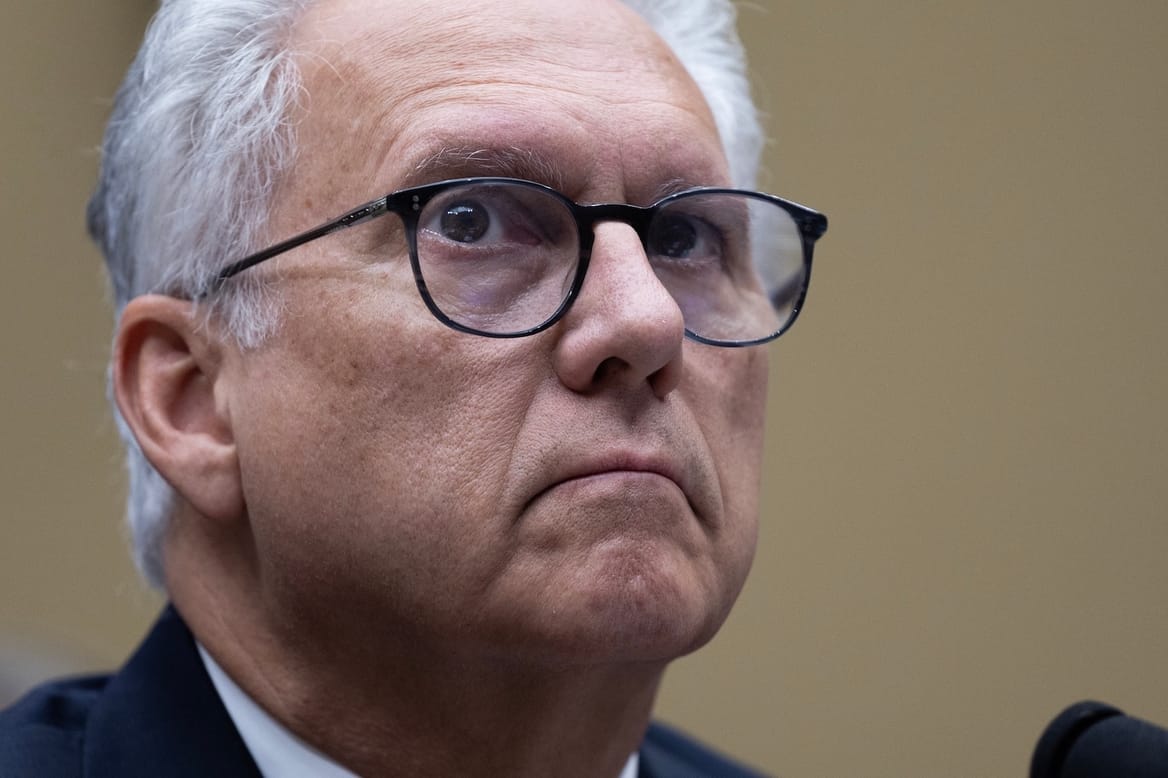
Mark Glick, Hawai‘i’s chief energy officer (Tom Brenner for The Washington Post via Getty Images)

The next day, March 13, the Energy Office posted a defensive Instagram message calling Fripp’s assertions INCORRECT” and stating HSEO unequivocally stands by its work on the study.” Six days later, the office officially acknowledged an unintentional algebraic syntax error” and retracted the scenario that had shown the greatest net benefits, to the tune of $700 million. 

The Green administration and the Hawaiʻi State Energy Office continued to push for natural gas despite the collapse of their official case. 

Within days of the committee hearing, administration officials coordinated the release of a sleek slide deck laying out JERA’s project proposal. Emails obtained by the environmental groups Earthjustice and Life of the Land through public records requests show that throughout that time, the governor’s office and the Energy Office collaborated on a media campaign to promote the LNG proposal with iQ 360, a public relations firm contracted by JERA.

One email chain from March 16 shows state press officers working alongside a rep from iQ 360 to craft responses to questions from a journalist with Bloomberg News.

I think we do need to add something to the effect that this program aligns with our 2045 aspirations. Both Mark and Erik spoke to it tonight and national story must carry this aspiration,” wrote the Energy Office’s Strategy and Marketing Officer Yvonne Hunter, referring to an event in which Glick appeared alongside JERA Americas Vice President of Development Erik Montague. 

Map illustration of LNG port and load centers
JERA included the above illustration of its proposed LNG project in the slide deck it released in coordination with the Green administration. (JERA)

Life of the Land, founded in 1970, regularly intervenes in regulatory proceedings involving new energy projects. Executive Director Henry Curtis said that with the JERA LNG project, the Energy Office has stepped well outside its usual role. 

We’ve never seen the State Energy Office handpick a specific technology and a specific company and throw their weight behind it,” he told Hawaiʻi Public Radio.

The Energy Office has since revised its non-retracted scenarios, which currently show more substantial benefits from LNG. In the scenario the state is leaning on now, net present values jumped from $150 million to $651 million in the republished study. 

While that may sound impressive, experts at Hawaiʻi Natural Energy Institute, the state’s primary academic body researching and modeling the energy transition, say those savings are negligible. HNEI Director Rick Rocheleau said that after spreading $651 million out over the proposed 15-year timeline for burning gas and then breaking it down by the energy Hawaiian Electric sells, it boils down to less than a penny per kilowatt-hour in savings.

We would effectively be breaking even,” Rocheleau said. 

JERA has run its own calculations on what LNG could save customers and produced a figure higher than that in the Energy Office’s study: It claims that by burning gas instead of oil, it can lower energy costs by 20% and provide Oʻahu households with an average of $500 off their bills each year. 

Rocheleau called those numbers a mirage.” He said that JERA is calculating its savings per meter, not per household, and neglected to distinguish between commercial and residential meters. Large commercial customers will see higher savings, whereas residents would get a much lower return — closer to 2 cents per kilowatt-hour, or 5% of the average customer’s bill, according to Rocheleau’s calculations based on JERA’s assumptions. 

To put it in perspective, total fuel cost is only about 20% of our electricity costs now, so LNG and the infrastructure would have to be free for us to save 20%,” Rocheleau said. 

Part 3: The trouble with gas as a quick fix 

Even if the case for savings was airtight, the JERA proposal makes other questionable assumptions. It has little margin for error in its projected timeline, especially if the LNG facilities will indeed comply with the 2045 clean energy deadline, as Green insists is the case.

JERA is offering to front roughly $2 billion to build the gas infrastructure, and plans to profit from this investment by charging Oʻahu residents for the gas-fired electricity. JERA hopes to have its LNG terminal and power plant fully constructed in 2030, an extremely optimistic timeline that would still allow only 15 years to make money burning gas before that becomes illegal. 

But gas power plants are hefty investments, so developers or utilities typically run them for decades to recoup what they spent; JERA’s calculation for the supposed household savings assumes a 40-year power plant operating life, which would stretch into the 2070s. 

Once you build the infrastructure, unless you’re going to keep it for a very long time, anything you do to amortize it quickly is going to drive up the cost,” said Jay Griffin, who chaired the state utility regulatory commission from 2019 to 2022. If you’re really intent on saying We’ll only do this for 15 years,’ now it’s a 15-year mortgage on a $2 billion loan, versus 30 or 50 years.”

Gray gas plant with various tanks
An illustrative rendering of JERA’s proposed gas plant at a potential site identified by the State Energy Office (JERA)

To hit that 2030 target date for commercial operations, JERA would have to make quick work of permitting this complex and multifaceted project, and shepherd the controversial plan swiftly through approvals at the Public Utilities Commission. 

That alone can take years because the PUC takes its job very seriously. These are very technical issues,” said Isaac Moriwake, the environmental attorney who leads Earthjustice’s Mid-Pacific Office. 

Navigating PUC approval will also require some degree of buy-in from Hawaiian Electric, the electric monopoly that actually runs the Oʻahu grid. JERA needs the utility to either solicit bids for the project or request a waiver from the competitive bidding process on JERA’s behalf. Thus far, the utility has played no formal role in JERA’s proposal, and one of its press statements about LNG exuded a rare degree of saltiness for the typically bland genre of utility communications, noting how the state has zigzagged in its approach to LNG over the past quarter century. Hawaiian Electric confirmed to Canary Media and Hawai’i Public Radio that it has not formed a partnership with JERA.

Even after the PUC rules on the proposal, community members have a right to appeal up to the state Supreme Court, an eventuality Moriwake said was almost guaranteed.”

And even if the project wins all the necessary approvals and deflects legal incursions, it still wouldn’t be out of the woods.

We have an extensive track record of projects going over budget and taking too long,” Griffin said of construction efforts in Hawaiʻi. After all the infrastructure, the build, and any delays, who’s going to guarantee those savings?”

JERA’s Montague acknowledged in an email that 2030 completion would be an aggressive timeline,” but added that we fully believe it can be accomplished.” The company’s slide deck stressed that it still expects savings for customers if the project is delayed by three years or its cost grows by 20%. 

Crucially, though, its expected savings depend on assuming thermal plants switch to renewable fuel at 2045.” JERA asserts that the power plant’s turbines could burn renewable natural gas, clean hydrogen, or clean ammonia with limited upgrades to comply with the clean energy law.

When asked to name power plants burning green hydrogen, Montague said that JERA upgraded a turbine in New Jersey to be capable of burning a 40% blend of hydrogen with natural gas, and noted that GE Vernova sells turbines it says can handle a 100% hydrogen fuel.

Testing is one thing, but power plants have not yet adopted hydrogen as a sole fuel for regular operations. Staking Oʻahu’s grid on clean fuels entails betting on specialized generator equipment not yet in widespread production and an uninterrupted supply of fuels that remain niche and expensive.

Renewable natural gas does exist — it can be siphoned off landfills and manure ponds so it doesn’t hit the atmosphere as unabated methane. But the Energy Office study, for instance, made clear that RNG is not scalable or widely available enough to meet Hawai‘i’s energy demands.”

Should Oʻahu find itself in a position where the LNG plant eventually gets approved, but comes online years late due to the predictable community challenges or construction delays, or both, and then cannot actually deliver a quick and easy switch to burning hypothetical clean fuels by 2045, JERA would have to make its money back in that compressed timeframe, with the captive customers on Oʻahu footing the bill.

This project’s a loser, and for it to make any kind of sense, they’re going to have to sprinkle some fairy dust on it,” Moriwake said. If you sign up for this long-term fossil-fuel commitment, you’re going to be pushing back cleaner and cheaper renewable resources and forfeiting our clean energy and climate goals.”

Part 4: Can O‘ahu just build more solar and storage?

JERA and the Green administration counter those unresolved questions with a sense of urgency. They paint a binary picture: the expensive, polluting, oil-burning status quo versus a cheaper, cleaner future powered by natural gas. On April 16, the 48th day of the Iran war, Green told listeners of Hawaiʻi Public Radio that the state’s dependence on oil had to change. 

Right now, the idea of continuing to rely on oil from places like Libya or worry about what happens in the Middle East when you have a war with Iran, it’s just insanity,” Green said. And I’m just not going to be a governor that sits on my butt and doesn’t do something when I can try to make things more affordable.”

Man in a dark suit, light-blue shirt, blue striped tie
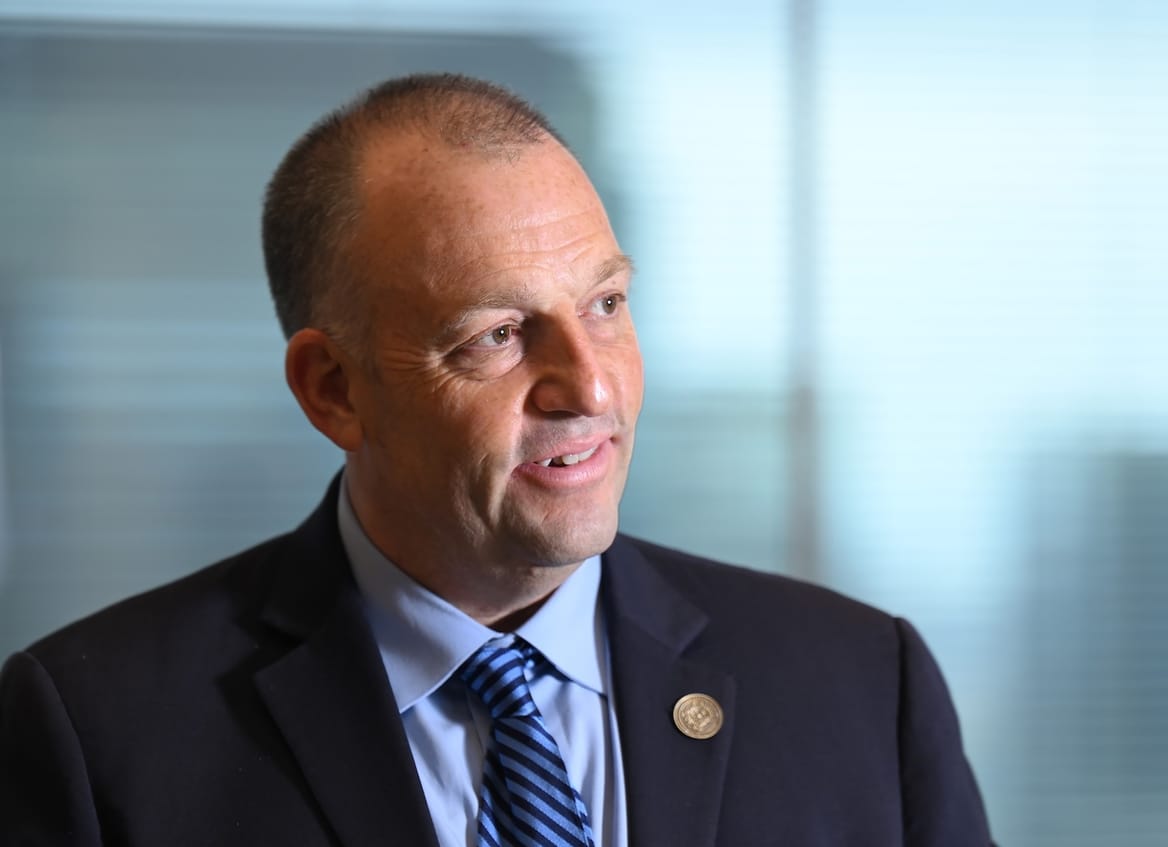
Hawai‘i Gov. Josh Green in Tokyo on Oct. 6, 2025 (The Yomiuri Shimbun via AP Images)

Of course, Iran’s blockade of the Strait of Hormuz didn’t just stop oil flows; it cut off shipping access for about one-fifth of global LNG supply, too. Iranian missiles damaged Qatar’s primary gas facility so badly it will take years to repair, creating a long-term constraint on gas markets in Europe and Asia. 

Even if Green wasn’t pursuing gas import dependence at a historically volatile time for the commodity, his oil-versus-gas dichotomy overlooks another option: solar. 

Clean energy advocates argue that the state should instead fast-track investment in solar and batteries to drastically reduce Oʻahu’s need for imported fuel. If anyone wanted to see receipts from a natural experiment that tested this exact strategy, all they’d have to do is hop on a 40-minute flight from Honolulu to Līhuʻe, Kauaʻi.

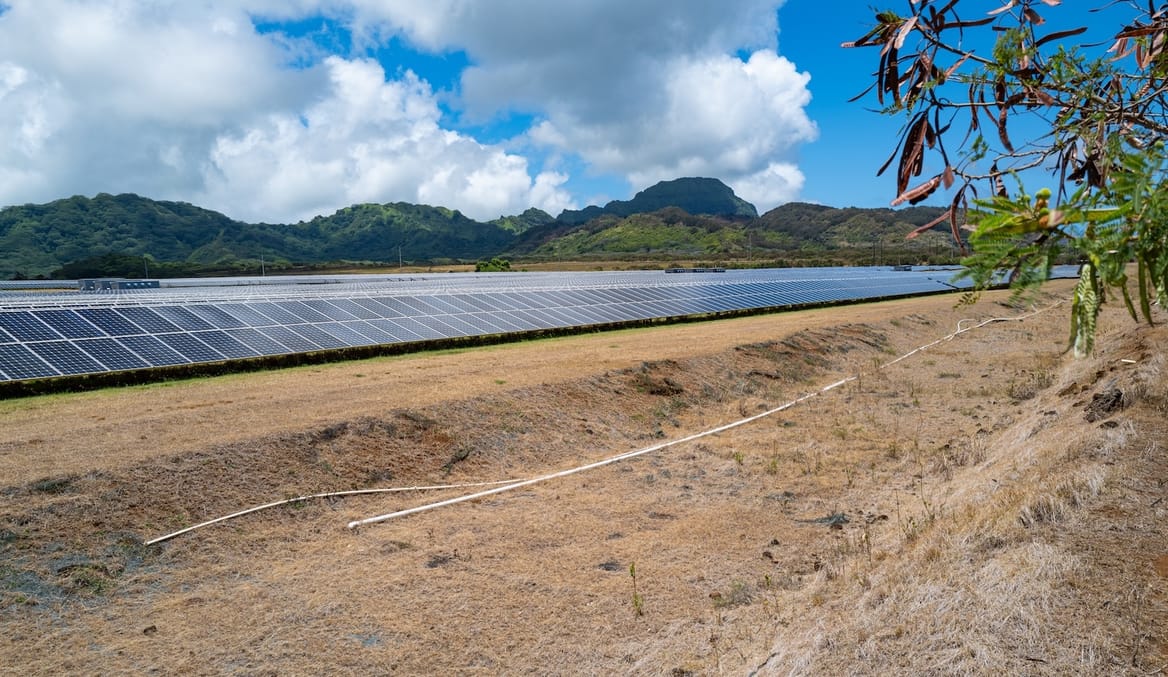
Neighboring Kauaʻi is the only island in the state served by an electric utility outside of Hawaiian Electric’s purview. Member-owned Kauaʻi Island Utility Cooperative (KIUC) built enough solar and batteries that it routinely runs solely on renewable power for portions of sunny days. Its leaders aren’t worried about hitting the 2045 deadline — they expect to entirely forgo fossil fuels by 2033, 12 years ahead of schedule. 

When KIUC formed in 2002, electricity rates on Kauaʻi were 70% higher than on Oʻahu, according to KIUC president and CEO David Bissell. Today, the island has the lowest rates statewide, and Bissell said customers are far more insulated from the vagaries of the oil market. 

Solar investments have been key to KIUC’s success. One-fifth of KIUC’s members have rooftop solar on their homes. Utility-scale solar currently accounts for roughly a quarter of Kauaʻi’s annual generation. Two recently approved solar and battery farms will bring that up to around 60%, each providing electricity at a rate of about 15 cents per kilowatt-hour, a steep discount compared to oil-fired generation. 

These projects, together with KIUC’s other renewable facilities, will help Kauaʻi avoid more than 300 million gallons of fossil fuel use over the next 25 years.

It’s helped our greenhouse gas emissions get radically reduced, and it uses Kauaʻi’s abundant resources to produce energy and benefit the island,” Bissell told state lawmakers in April. 

Line of solar panels with lush mountains in the background and brown grass in the foreground
The Kōloa Solar Array operated by the Kauaʻi Island Utility Cooperative (Chris Allan via Getty Images)

Oʻahu has a much higher energy demand and more land constraints than Kauaʻi, but some experts say the island can overcome those hurdles. In that same April meeting, Fripp appeared alongside Michael Roberts, an economist and fellow at the University of Hawaiʻi Economic Research Organization, to discuss how Oʻahu might achieve comparable results to Kauaʻi.

Roberts and a Ph.D. student updated a model originally designed by Fripp and ran more than 100 scenarios comparing energy project and fuel costs to determine the most affordable path forward for Oʻahu utility customers. This analysis concluded that investments in solar, not natural gas, presented Oʻahu’s best bet at mitigating electricity costs. In late June, Roberts published a report on the Economic Research Organization’s website that built on the initial analysis.

That case for solar became muddied on July 7, when Roberts withdrew his study, noting errors made in the rush to publish, including one in a correction that relied on data points hallucinated by an AI assistant.

Roberts is conducting an internal audit of the report, which he plans to reissue soon. So far, his top-line takeaway stands: Building no new fossil-fuel plant remains the least-cost path for Oʻahu in every corrected case,” he said in a statement.

Gov. Green, in an emailed statement, commended the Economic Research Organization for recognizing the flaws and bias” in the research. The faulty study and analysis, deeply compromised by vested interests, threatens to set back our collective opportunity to build a sane bridge to a fully renewable future.”

Prior to the retraction, the Energy Office had contested Roberts’ expectation that solar will maintain its cost advantage over other sources. The Energy Office had pointed out that Hawaiian Electric recently submitted power purchase agreements to the Public Utilities Commission for two new Oʻahu solar and battery farms, Puʻuloa Solar and Mahi Solar, at price points of about 21 cents and 23 cents per kilowatt-hour, respectively.

That’s double what grid-scale solar has cost in Hawaiʻi in the past. In the contract document, Mahi Solar developer Longroad Energy noted concerns about Hawaiian Electric’s tenuous financial position since the Maui fires and the rollback of federal incentives for solar projects. That price jump, though, is anomalous in the broader trend of solar costs, which have a long track record of declining over time, while the cost to build gas power plants has been rising amid roiling demand.

Griffin, who as a regulator sparred with Hawaiian Electric to pick up the pace of clean energy to avoid surging oil costs when the state’s last coal plant closed, maintains that much of the delay in Hawaiʻi’s renewables buildout is self-inflicted.”

Can we do things better here? One hundred percent,” he said. Do we have more potential to improve the clean energy pathway? Absolutely.”

Amid these conflicting reports on Oʻahu’s energy pathways, state lawmakers have called on the Public Utilities Commission to step in. Lee, in the state Senate, and Lowen, in the House, introduced resolutions that their respective chambers approved requesting that the commission conduct its own analysis on how to cut costs for residents. 

The commission has until the end of the year to return its preliminary findings to lawmakers. In the meantime, Lee said the state shouldn’t tether itself to yet another imported fossil fuel.

Unless somebody can guarantee the price of an imported fuel at a rate that is far lower, or at least comparable to investing in local renewables, … then I don’t see how the math maths,” Lee said.

Julian Spector is a senior reporter at Canary Media. He reports on batteries, long-duration energy storage, low-carbon hydrogen, and clean energy breakthroughs around the world.

Savannah Harriman-Pote is the senior climate and energy reporter for Hawaiʻi Public Radio. She’s reported and produced stories for NPR, BBC, WHYY, and BirdNote.