• Antora snags $550M for heat batteries to run data centers and factories
  • Account
  • Donate
Clean energy journalism for a cooler tomorrow

Antora snags $550M for heat batteries to run data centers and factories

As the California firm boots up a giant thermal battery system in South Dakota, fresh funds will help it build a second U.S. factory and more large-scale projects.
By Maria Gallucci

  • Link copied to clipboard
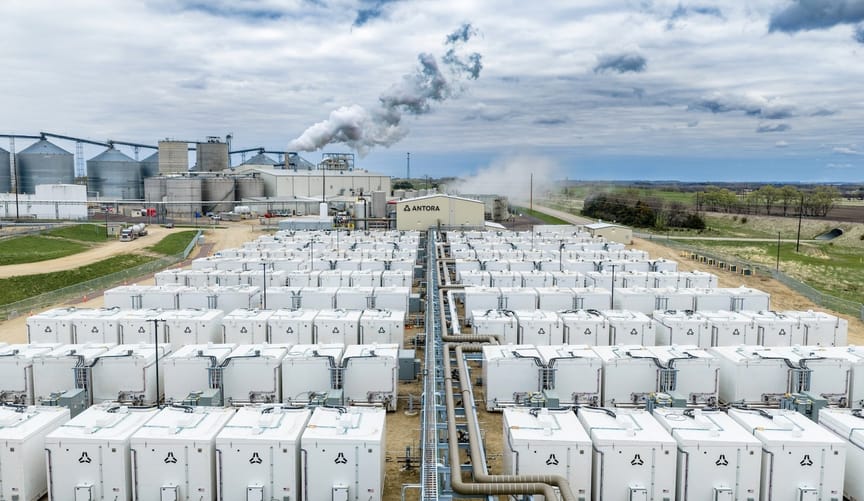
Rows of white batteries in front of a factory, with a beige building between with an Antora sign
Antora Energy’s thermal batteries at the Poet bioprocessing facility in Big Stone City, South Dakota (Antora Energy)

The startup Antora Energy just raised $550 million to build and deploy more of its heat-storing batteries for powering data centers and cleaning up factories.

On Thursday, San Jose, California–based Antora said it closed a Series C funding round co-led by climatetech investor G2 Venture Partners and the VC firm Eclipse, which backs manufacturing-focused startups. That brings Antora’s total corporate and project financing to around $1 billion, the company says, adding that the latest infusion will enable it to expand domestic production of its thermal batteries and accelerate the buildout of large-scale projects.

Eight-year-old Antora has likened its technology to an enormous toaster. Electricity runs through a large resistance heater to warm big blocks of solid carbon to extremely high temperatures for days on end. The blocks release controlled blasts of high-intensity light that can be used to either produce power on demand or generate steam for industrial processes.

Just two months ago, Antora began booting up its first commercial-size system: a 5-gigawatt-hour thermal battery at Poet’s biofuels plant near Big Stone City, South Dakota. The project will turn cheap wind energy into steam the plant needs to convert corn into ethanol, displacing some of the facility’s reliance on coal-fueled boilers.

Antora says this system will be one of the largest battery storage projects in the world when it’s fully operating later this year. Meanwhile, its San Jose manufacturing campus ranks among the country’s largest battery factories.

But the firm is hardly alone. Dozens of thermal energy startups in the U.S. and worldwide are developing systems with a variety of heat-trapping materials, including ceramic bricks, crushed rocks, and stonelike” industrial waste.

The sector is expanding as countries are scrambling to meet power demand from data centers and industrial facilities — and struggling to limit the growing strain on grid infrastructure and household utility bills. In the U.S., high electricity costs have also hindered manufacturers from adopting cleaner, electrified heating technologies.

Energy storage systems in general can address those challenges by charging up when power is cheap and abundant, then dispatching that stored energy when it’s needed, such as by sending electricity to the grid during hours of peak demand. Thermal batteries can also deliver heat directly to factories to keep them from drawing lots of costly peak power.

From factories to data centers, energy is the bottleneck to industrial growth,” Andrew Ponec, co-founder and CEO of Antora, said in a news release. Antora has shown we can help break that bottleneck — delivering energy fast, at massive scale, with American innovation.”

The company launched its first pilot project in 2023: a 5-megawatt-hour system installed at a facility owned by the utility Wellhead Electric near Fresno, California. Months later, Antora raised $150 million from corporate and venture investors to scale up thermal-battery production at the San Jose factory, which it has expanded into a three-building manufacturing campus.

Antora built over 200 battery modules for the South Dakota storage system. But the project is notable for more than its technology. Antora is also pioneering an electricity tariff, designed with the local utility Otter Tail Power, that rewards Antora for charging up during periods of surplus local renewable energy production. The idea is to improve the bottom line for thermal energy systems while also ensuring they benefit everyone on the grid. Antora said it’s working with utilities across the country to develop similar rate structures for future projects.

With the $550 million fundraise, Antora said it plans to build a second U.S. manufacturing hub and to start fulfilling its growing pipeline of signed agreements” with some of the nation’s biggest data center operators and industrial companies, including biofuels and chemical producers and food and beverage manufacturers. The company declined to share more specific details.

We’re in the process of developing many more projects, very similar to the Big Stone project [with Poet], and those projects span a variety of sectors and are sort of a similar size,” Justin Briggs, Antora’s co-founder and chief operating officer, told Canary Media in a May interview.

We’re also developing projects in the power sector that would provide the ability for data centers to come online much faster than they otherwise would,” he said, noting that those systems could be anywhere from five to 10 times the scale of its 5-GWh system at the South Dakota ethanol plant.

Our energy system is at an inflection point, and very few companies can meet soaring power demand,” Jake Tauscher, partner at G2 Venture Partners, said in the news release. Antora is meeting that demand today. They’re deploying at scale, on budget, and on the rapid timelines customers need.”

This signup form requires necessary cookies.

Allow marketing cookies to load the newsletter signup form.

Maria Gallucci is a senior reporter at Canary Media. She covers emerging clean energy technologies and efforts to electrify transportation and decarbonize heavy industry.