• New Mexico’s transition to clean energy is actually ahead of schedule
  • Account
  • Donate
Clean energy journalism for a cooler tomorrow

New Mexico’s transition to clean energy is actually ahead of schedule

The state is forging ahead on wind, solar, and batteries after hitting its 2030 renewables goal early. The transition for coal workers has been more complicated.

By Julian Spector

  • Link copied to clipboard
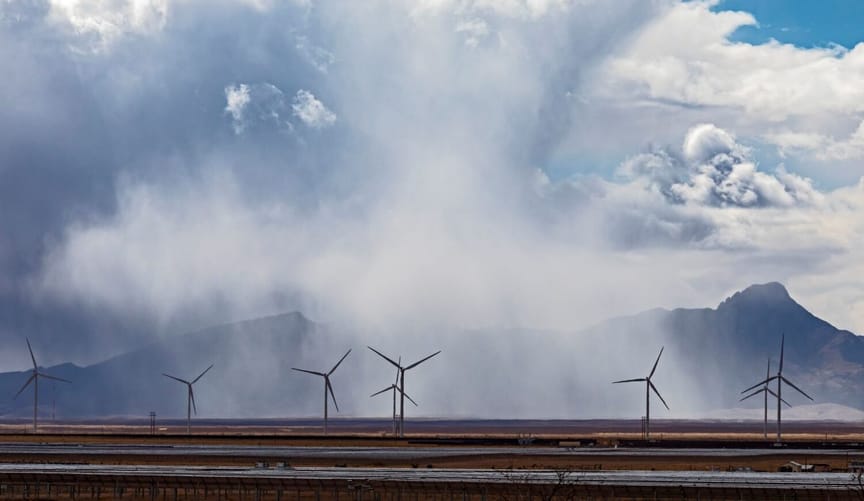
Wind turbines against mountains

A rainstorm at the Macho Springs Wind farm in Nutt, New Mexico (Jim West/UCG/Universal Images Group via Getty Images)

New Mexico boasts stark landscapes unlike anywhere else, a clearly defined regional cuisine built around fiery Hatch chiles, and cultural centers that predate the United States by several centuries. It’s unusual in another way, too: As many states struggle to advance on their path to a 100% clean electricity system, New Mexico is running well ahead of schedule.

The Southwestern state’s 2019 Energy Transition Act stipulates that its investor-owned utilities must reach 50% renewable portfolios by 2030, rising to 80% in 2040 and be 100% carbon-free by 2045. That’s a sweeping shift, but New Mexico hit 50% renewable in 2024 and kept on growing. And the state’s largest utility, Public Service Company of New Mexico, or PNM, produced 80% carbon-free electricity last year.

“We wanted to set very ambitious, important targets, because we knew that this was going to help create economic opportunities and protect our environment,” said Rep. Nathan Small, who sponsored the legislation. ​“We’re ahead of that [2030 goal]. That’s showing us that we can actually move more quickly.”

PNM’s record peak demand is 2.3 gigawatts, and it has 5 GW of nameplate capacity installed today. To keep pushing further, the utility asked regulators in May to approve a nearly 1.7-GW mix of new wind, solar, and batteries, backed up by a diminutive 40-megawatt gas peaker plant. This roster of projects could equip the utility for a July 2031 exit from its 200-MW stake in the Four Corners coal plant, which sits in the northwest corner of the state but is operated by Arizona Public Service.

While other states struggle to meet current energy demand with cleaner sources, New Mexico is building more clean energy to keep pace with an expected 40% growth in consumption by 2032. 

“New Mexico is unique in that it has set these ambitious targets, like some of its neighbor states, but that’s only half the job,” said Dan West, who covers Western state policy for the climate nonprofit Clean Air Task Force. ​“They’ve also built the institutions, the infrastructure, … and the investment environment to deliver on them.”

Even with its momentum, the state still faces hurdles in the energy transition: The latest proposal from PNM is drawing opposition from some environmental groups that are concerned building a new gas plant would violate the legal commitment to phase out fossil fuels. Meanwhile, customers are worried about the utility’s pending takeover by Blackstone, the world’s largest private equity firm, which could alter the company’s trajectory on clean energy. And New Mexico’s experience so far has shown that bringing fossil fuel workers along in the transition can be harder than building the clean energy itself.

Pushing to the next level of clean power

In the early stages of decarbonization, utilities can build a ton of wind and solar, offsetting fuel-burning power generation with cheaper kilowatt-hours. New Mexico is especially well suited for this, as an arid, windy state with a lot of wide open terrain to host wind, solar, and batteries. At a certain point, though, that strategy hits a limit, because the solar and wind cannot deliver power on demand.

“We still have thermal resources in the fleet, and we have to have that,” said Laurie Williams, PNM’s senior vice president for integrated planning and transmission development. (Thermal in this case refers to traditional fossil fuel–burning plants.) 

The utility has a small allotment of nuclear power, which is both carbon-free and available around the clock, from Arizona. But the state lacks other firm, clean sources, like long-duration storage, advanced geothermal, green hydrogen, or nuclear fusion. Such potential solutions, however lauded by the venture capital sector, are not bidding into PNM’s competitive procurements; they are ​“not economic,” Williams noted. And some are years away from commercial availability.

Williams’ team periodically runs a highly detailed statistical analysis of what mix of power plants could cover demand for every hour of every day over the next 20 years. They have to account for the occasional ​“extra cloudy, totally still day,” when wind and solar production plummets but Albuquerque and Santa Fe still need energy.

The number-crunching produced the latest proposed portfolio: an 800-megawatt wind plant in eastern New Mexico, 240 megawatts of solar, and 610 megawatts of battery storage, roughly split between four-hour duration and eight-hour duration, to ensure more on-demand power. But the linchpin that holds it all together, in the utility’s view, is the 40-MW peaker plant known as La Luz II.

“The whole thing is interdependent, and I can only meet the reliability and resource adequacy metrics with the whole package,” Williams said. 

Some environmental groups have opposed PNM building any more fossil-fueled plants ahead of the 2045 clean energy deadline. That argument has to play out at the regulatory commission, which held hearings in October and has more scheduled for January to examine the gas plant specifically. 

The body likely won’t issue a decision until the second quarter of 2027, which limits the window developers have to get construction underway in time to claim the remaining federal tax credits. Those incentives can cut the cost of projects by 30% or more, but only if they are placed in service by the end of 2027 (or for those that began construction before July 4, by the end of 2030).

Lessons learned on taking care of workers

New Mexico’s renewables buildout leaped ahead of expectations, but its efforts to support workers from the fossil fuel economy have faltered.

The state hosted several coal plants and associated mines that powered the growth of the Southwestern economy, namely Four Corners and San Juan. Since the Energy Transition Act would force the end of coal power in the state, it also created a fund to support workers affected by the closures. That money would come from the utility securitizing its coal plants — a form of financing used to save the utility some money while shutting down ahead of schedule.

Layoffs started at San Juan in 2020, ahead of its planned 2022 retirement. But the transition fund got held up. Several environmental and consumer groups sued to stop the coal plant securitization, arguing it amounted to an unconstitutional ceding of the regulator’s duty to protect utility customers. With that financial transaction stalled by the lawsuit, no money flowed to the workers. 

It took until 2022 for the state Supreme Court to let the securitization proceed, but the resulting funds for workers had to be appropriated by the legislature, which didn’t happen until 2023. The effort hit another problem, said Michael Leon Guerrero, a policy adviser on the economic transition who has been interviewing workers displaced by the San Juan closure. The law had earmarked up to $20,000 in direct payments for people who had lost their jobs from the energy transition in the previous 12 months.

“That meant earlier layoffs weren’t eligible,” Guerrero said. ​“It got to be really messy.”

The legislature updated its eligibility requirements in 2023 to include previously displaced workers. By that point, many had left the area in search of work at mines or power plants elsewhere, Guerrero noted. Subsequent funding also covered schooling or apprenticeships to switch to new roles, and the state helped support training programs at San Juan College. 

Guerrero credits the state with going ​“above and beyond” to try to reach displaced workers. But some people never got access to the assistance given the delayed rollout and multiple changes to the rules.

Small, who also chairs the state House Appropriations and Finance Committee, acknowledged that the legal challenges to the funding contributed to ​“really unacceptable delays in getting state funds to workers and communities.” The legislature later accumulated a budget surplus and spent some of that on worker training; a 2025 Community Benefit Fund provided another $17 million for energy transition jobs programs. 

“It’s a good lesson learned for other states that if they’re phasing out a legacy coal plant, or in the next decade or two, a legacy gas plant, you’ve got to have policies in place and long enough runway for communities to make these transitions,” West said.

On the other hand, New Mexico has set a strong example in other areas for states trying to accelerate clean energy. It created a Renewable Energy Transmission Authority, which proactively identifies high-value locations for transmission lines, and streamlines permitting and financing for them, said Natalie Manitius, manager for clean energy infrastructure deployment at the Clean Air Task Force. New Mexico, which covers part of the Permian Basin and produces more crude oil than any state besides Texas, also formed a sovereign wealth fund to channel oil and gas revenues into energy transition funding. That entity has invested directly in potential 24/7 clean energy technologies, like advanced geothermal and nuclear fusion.

Despite the learning curve, Small encouraged leaders elsewhere to push ahead with their own energy transitions.

“Policymakers should feel ambitious and look with some confidence at developing their clean energy resources [while] keeping the costs in line, and understand that you can lead with clean energy, lead with climate friendly policies as you grow and diversify your economy,” he said.

This signup form requires necessary cookies.

Allow marketing cookies to load the newsletter signup form.

Julian Spector is a senior reporter at Canary Media. He reports on batteries, long-duration energy storage, low-carbon hydrogen, and clean energy breakthroughs around the world.