Next Upcoming
Virtual event
Hold onto Your Tax Credits: How to Get Ahead of the 2027 Deadline
By Canary Media
A global supply shortage and U.S. tariffs have roiled the aluminum market this year, putting greater pressure on the United States to produce more of its own metal. Plans to build or reopen giant smelters are moving forward, but they all hinge on securing huge amounts of cheap power — at a time when data centers are chasing every last electron.
Recycling aluminum, on the other hand, uses only 5% of the energy needed to make virgin metal in smelters, and the U.S. has an abundance of scrap. The problem is that millions of tons of it still wind up in landfills, owing to the country’s spotty recycling policies and the logistical headache of salvaging high-quality aluminum scrap.
As U.S. demand grows for the versatile metal — for soda cans, solar panels, lightweight cars, power cables, and data centers — policy experts are pushing states and the federal government to adopt measures that can boost aluminum recycling rates and reduce the country’s dependence on imported and smelter-made metal.
“It’s a secure supply chain issue,” said Joe Quinn, executive director of the Center for Strategic Industrial Materials at SAFE, a think tank that published a report this month on America’s aluminum deficit.
“There are environmental benefits all day long,” he said of recycling. “But I need the metal back in the market.”
A major reason why so much aluminum winds up as waste is that mechanical recycling systems aren’t up to the task.
Aluminum often arrives lumped together with other metals like copper, brass, and titanium. It’s also difficult to identify specific alloys — blends of aluminum that contain other elements to make them stronger and more durable — that are used for certain applications, like electrical equipment or vehicle parts. U.S. scrap metal is frequently shipped overseas and sorted by hand, or shredded and melted down into low-value products.
A handful of companies are rolling out new technologies that use lasers, advanced sensors, and artificial intelligence to find treasure in the trash. The startup Sortera Technologies raised $45 million last year to build a second high-tech recycling facility, in Lebanon, Tennessee, that plucks out valuable aluminum alloys from mixed scrap metal.
A U.K.-based firm, Greyparrot, installs AI cameras in other companies’ recycling plants to track aluminum cans, glass bottles, and plastic packaging with the goal of increasing recovery rates. Mechanical sorting equipment can overlook a large portion of recyclables that move down conveyor belts, especially if the system is overburdened with material or its components are faulty, said cofounder Ambarish Mitra.
Earlier this year, Greyparrot installed its systems at Circular Services’ sprawling facility in Brooklyn, which processes most of New York City’s curbside recycling. Greyparrot determined that 89% of aluminum passing through the plant is recyclable, which is nearly double the average extraction rate for U.S. facilities, Mitra said.
“A substantial amount of money is left on the table,” he added, referring to aluminum that could be sold into secondary markets but slips through the cracks instead. “In every plant we have gone in, the yield has gone up, and the residue line — which is everything that will go into the landfill — has become leaner, because more and more extraction is going on.”
The Center for Strategic Industrial Materials has called on U.S. policymakers to adopt federal incentives and increase research funding for advanced sorting technologies. Benjamin Carlson, the center’s director, noted that using more recycled aluminum across the economy can free up supplies of virgin aluminum for sectors like military defense and aerospace that require high-purity metal.
The lack of suitable sorting tools isn’t the only barrier to scaling up aluminum recycling, Carlson acknowledged. “The real challenge in the United States is just getting people to recycle it, period,” he said.
Recycling rates for beverage cans in particular are declining, in part because of what the Aluminum Association called a “passive approach to recycling policy.” Americans tossed out some 61 billion of the containers in 2023, representing $1.2 billion worth of aluminum, according to the trade group and the Can Manufacturers Institute.
Ten states have enacted “bottle bill” policies over the decades that reward consumers for redeeming beverage containers. The approach has long been considered an effective tool for boosting recycling, though proponents say state policies are in dire need of an update.
New York, for example, has never raised its deposit return fee of 5 cents since creating its system in the 1980s, and recycling centers still receive the original 3.5 cents per can. Given rising inflation and the higher cost of living, the work of collecting and returning containers is losing its appeal for many consumers and becoming less profitable for collection sites.
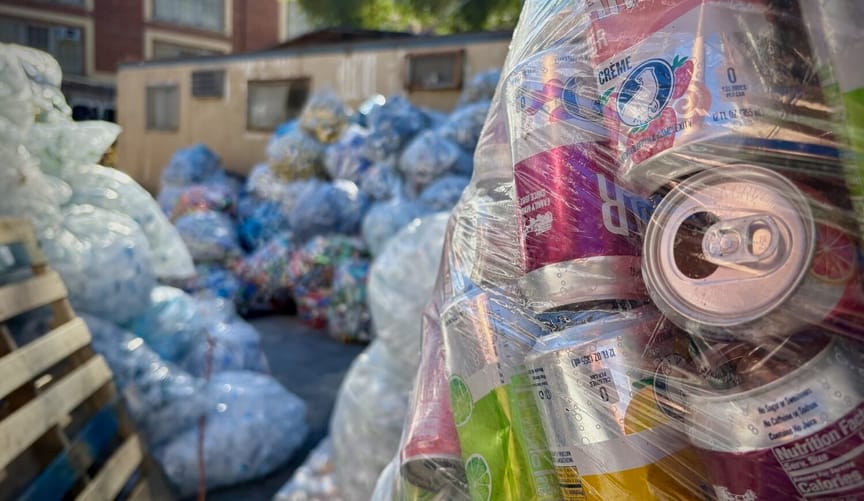
“There are fewer and fewer redemption centers every year and lower and lower redemption rates,” said Ryan Castalia, executive director of Sure We Can, a nonprofit recycling center in Brooklyn, where bags of containers are piled high like mountains. “It’s lost income for everybody, and an increased amount of cans in the landfill.”
However, as Connecticut has learned, raising deposit fees is not a simple fix. After the state increased the value of its own bottle deposits from 5 to 10 cents in 2024, redemption rates doubled by the end of 2025. But many of those cans are likely coming in illegally from out of state, imposing a cost burden on Connecticut’s wholesale beverage distributors, who ultimately foot the bill for the refunded deposits.
Castalia said he’s feeling the effects in neighboring New York. In the past 18 months, Sure We Can has seen a roughly 25% drop in the total volume it handles, from a peak of 13 million containers per year to around 10 million containers, as collectors chase higher deposit fees across the state line. While the center receives grants and philanthropic donations, he said declining revenues make its financial situation more precarious.
Janet Domenitz, executive director of the Massachusetts Public Interest Research Group, said her state’s 5-cent deposit fee is similarly insufficient — not only because the rate is 43 years old but also because the modern explosion in single-use drink containers is causing more litter. She said a regional bottle-bill network for New England states could help enhance recycling and lend momentum to efforts in other parts of the country.
Castalia noted that while a federal program seems “vanishingly unlikely” at the moment, a blanket approach could help address the flaws in the current patchwork of state policies. U.S. Sen. Jeff Merkley (D-Ore.) has led the push for a nationwide bottle bill to both increase aluminum supplies and reduce reliance on plastic packaging, though he last proposed the legislation in 2023.
Merkley said in an email that he will “continue to lead the charge in Congress” for a countrywide model. “Aluminum is infinitely recyclable, and keeping that material in circulation is essential to cutting down on plastic waste and enhancing domestic manufacturing.”
Maria Gallucci is a senior reporter at Canary Media. She covers emerging clean energy technologies and efforts to electrify transportation and decarbonize heavy industry.
Electric vehicles
Clean energy jobs
This video requires marketing cookies.
Update your cookie preferences to watch the video.