Clean energy journalism for a cooler tomorrow

A recent legal victory could free $7B in frozen Solar for All funds

Nonprofits and companies are ready to relaunch solar projects to help low-income residents — if the Trump administration obeys a court order to give them the money.
By Jeff St. John

  • Link copied to clipboard
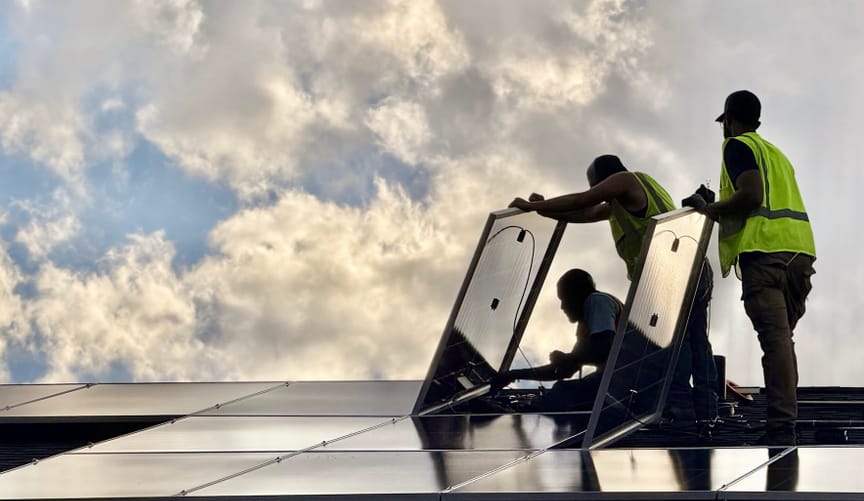
Three people on a roof installing solar panels with dramatic clouds overhead
Sunpath Solar employees install solar panels on the roof of Chamblee First United Methodist Church in Chamblee, Georgia. (Sunpath Solar)

Denise Abdul-Rahman, founder and CEO of nonprofit Black Sun Light Sustainability, can list in detail the harms that the Trump administration’s shutdown of the $7 billion Solar for All program has caused the Indiana communities she serves.

About 1,000 low-income households have been denied access to low-cost solar that would have cut their electric bills by at least 20%, she said. About 200 jobs installing solar and batteries at homes, community centers, and city buildings, representing roughly $9 million a year in wages, haven’t been created. And residents of Gary, Indiana, have been denied solar-and-battery-equipped resiliency centers that could have helped them recover from a nearly two-week-long grid outage in August.

That’s why Abdul-Rahman joined a lawsuit challenging the U.S. Environmental Protection Agency’s decision to kill the program. Last week, a Trump-appointed federal judge with the U.S. District Court for the District of Rhode Island upheld that challenge, ruling that the EPA acted illegally and must let the money flow.

We just want the Trump Administration to comply with the law,” Abdul-Rahman said. We would like them to resume what has started. We’re committed to this because we truly believe it will save lives and change lives.”

Black Sun Light is one of many organizations and companies that have had to cancel work and absorb costs after the EPA terminated the $7 billion in Solar for All program in August 2025. The sweeping initiative was created by the Inflation Reduction Act to deliver more than $350 million in annual electric bill savings to more than 900,000 low-income and disadvantaged households over five years.

EPA Administrator Lee Zeldin’s decision to withhold the money has disrupted work by groups like Abdul-Rahman’s and other lawsuit plaintiffs to supply low-cost solar to low-income residents in Southern states, energy-burdened Native American communities, and state and local governments.

Zeldin claimed that the megabill passed by Republicans in Congress in July 2025 allowed the EPA to cancel Solar for All. But in last week’s order, U.S. District Judge Mary S. McElroy rebuffed that claim.

Congress’s clear intent was that EPA continue to administer the already obligated SFA grants,” she wrote. The agency’s termination of the program is contrary to law and in excess of its statutory authority.”

The order upheld demands from plaintiffs to vacate the EPA’s termination of the program and reinstate funding. The EPA is reviewing the decision and considering options for appeal,” agency spokesperson Carolyn Holran told Canary Media in a Friday email.

Last week’s court order comes shortly after another federal court ruled that the EPA acted illegally in canceling $20 billion in funds from the Greenhouse Gas Reduction Fund, another Biden-era program. That initiative was meant to inject large-scale federal funding into financing for climate and clean-energy projects. The EPA is seeking a stay of that decision.

Nick Torrey, senior attorney with the Southern Environmental Law Center, which represented plaintiffs in the Solar for All lawsuit, said that last week’s order means this $7 billion needs to flow out to communities that are struggling with skyrocketing electricity bills.”

This is a very clear smackdown of an obviously illegal decision to cut off a very important program,” he said. We want to ensure it gets up and running as quickly as possible.”

The groups represented in this lawsuit aren’t direct Solar for All grant recipients, Torrey emphasized. A U.S. Supreme Court decision last year has forced those grantees to pursue efforts to recover funding through the Court of Federal Claims, which handles contractual disputes with the federal government.

Instead, the plaintiffs in the Rhode Island case, including Black Sun Light, the Rhode Island AFL-CIO, the Rhode Island Center for Justice, Solar United Neighbors, and Sunpath Solar, argue that they have been harmed by being unable to continue work and pay costs undertaken on the good faith that their grant-winning partners would have access to federal funding to reimburse them, Torrey explained.

McElroy highlighted this distinction in her order, noting that the plaintiffs in this case lack any contractual relationship” with the EPA. Instead, she wrote, “[t]he sources of the rights upon which they base their claims are the APA [the federal Administrative Procedure Act] and the Constitution.”

Sunpath Solar has had to absorb burdensome costs since the EPA cut off funds the company was counting on receiving, its CEO Seth Gunning said. Sunpath has 25 employees and has installed about 500 solar systems since 2023. When the Georgia-based coalition his company is a part of was awarded a $156 million Solar for All grant, we scaled our operations in preparation to do that same work for 10,000 households,” he said. That meant moving our operations to a new facility, bringing on more capacity, more employees, more trucks.”

All his would-be clients have suffered too, Gunning said, by being denied the low-cost solar and battery installations they were promised. Thousands of households paying $300 to $400 a month in utility bills don’t have the resources to install these systems,” he said. There could be thousands of households saving hundreds of dollars a month, at a time when energy costs are inflating.”

Abdul-Rahman highlighted similar damage done in Gary, where a third of residents live below the federal poverty line, and aging housing stock and rising utility rates are squeezing household energy budgets.

We are in an electricity affordability crisis in Indiana,” she said. Utility Northern Indiana Public Service Co., which serves Gary, is raising rates to cover rising costs to maintain aging grids and serve booming data center load, she said. New solar systems and batteries could be an opportunity to strengthen our grid and make energy affordable for more people.” 

This signup form requires necessary cookies.

Allow marketing cookies to load the newsletter signup form.

Jeff St. John is chief reporter and policy specialist at Canary Media. He covers innovative grid technologies, rooftop solar and batteries, clean hydrogen, EV charging, and more.