• Another offshore wind firm is seeking a payout as Trump stifles sector
  • Account
  • Donate
Clean energy journalism for a cooler tomorrow

Another offshore wind firm is seeking a payout as Trump stifles sector

Engie is talking to the Trump administration about canceling its U.S. offshore wind leases, even as a similar $1 billion deal with TotalEnergies sparks legal concerns.
By Maria Gallucci

  • Link copied to clipboard
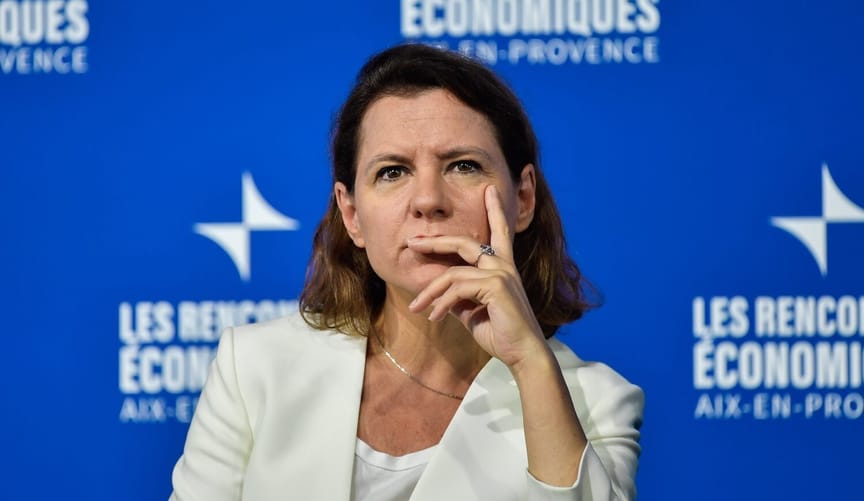
A woman in a white jacket holds her hand against her face and stares into the distance.
Engie CEO Catherine MacGregor (Laurent Coust/SOPA Images/LightRocket via Getty Images)

A second French energy firm is pursuing a refund on its U.S. offshore wind leases — and analysts say the trend could spread further, despite major legal questions about the Trump administration’s approach.

Engie, which had been planning three U.S. projects, is in talks with the administration about forfeiting the company’s offshore wind leases in exchange for reimbursement. Engie CEO Catherine MacGregor disclosed the development on April 21, a month after the French oil giant TotalEnergies struck a similar deal for nearly $1 billion with the U.S. Department of the Interior.

Discussions are ongoing, and we’ll see if an agreement is possible,” MacGregor told reporters at a press meeting in Paris.

Economically and also in terms of public acceptance, I strongly believe in offshore wind power,” she added. However, One must be able to say that energy policy is stable enough whatever the political color of the government” to continue investing in the clean energy resource.

Engie builds offshore wind farms through Ocean Winds, its joint venture with the Portuguese developer EDP Renewables. The entity previously bid a total of roughly $1 billion for three lease areas off the coasts of California, Massachusetts, and New York, where it planned to build projects totaling 6.8 gigawatts. That power capacity would go a long way in helping those regions cut planet-warming pollution and meet rising electricity demand.

Over the last year, the Trump administration has repeatedly sought to block wind development in U.S. waters by freezing leasing, halting construction on in-progress wind farms, rolling back tax credits, and attempting to rescind key permits. Federal judges have struck down several of those efforts in recent months. Now, the administration is trying a different tactic: paying developers to walk away.

That Engie is considering the idea in the current political climate hardly comes as a shock to some offshore wind experts.

The problem with developing offshore wind in federal waters is that you need the federal government to be on board,” said Rob Freudenberg, vice president of energy and environment at Regional Plan Association, a nonprofit based in the Northeast. 

If you’re a company responsible to shareholders, and you have money sunk into something that you’re not going to be able to move on anytime soon — and the federal government is looking to buy you out — I can understand why a business decision might lead you to pull out,” he said, calling the development unfortunate.”

All told, Interior’s Bureau of Ocean Energy Management has awarded nearly three dozen offshore wind leases since July 2013, netting a total of roughly $6 billion. Freudenberg and others say they expect more of these leaseholders to explore buyback deals like Engie and TotalEnergies have.

Even so, Tony Irish, a former attorney in Interior’s Office of the Solicitor, said he found the Engie news to be surprising” given the growing level of scrutiny surrounding the government’s agreement with TotalEnergies.

In March, the Interior Department said it would reimburse TotalEnergies for nearly $1 billion in lease fees the company paid in 2022 for areas off the coasts of New York and North Carolina. In exchange, the energy company pledged not to develop any U.S. offshore wind projects and to invest in domestic fossil-fuel projects instead. 

Few details of that deal have been publicly disclosed, and Sen. Sheldon Whitehouse (D-R.I.) recently opened an investigation into the Trump administration’s agreement, citing several serious legal concerns.” 

To start, experts say that no legal process exists for the bureau to return the funds it collects from leasing federally controlled waters. And the fact that TotalEnergies and the government aren’t embroiled in litigation — but rather voluntarily entering an agreement — also undermines Interior’s plan to tap the Justice Department’s Judgment Fund, which uses taxpayer dollars to settle legal claims against federal agencies. Plus, while TotalEnergies said it would spend its refund in the U.S., every new project in the company’s development pipeline is outside of the United States.

I simply advise anyone who is contemplating such an agreement with the department to tread carefully, because there is vigorous interest in what is going on,” Irish said, adding that there is a desire to both get to the bottom of it and take accountability, whether that is now or sometime in 2029” under the next administration.

A spokesperson for Engie declined to provide additional comments, and the Interior Department said, We don’t have anything to share at this time.”

The particulars of their discussions remain sparse, including how much money Engie is potentially seeking to reclaim and whether the company might offer anything to the government in return.

Notably, Engie and EDP’s joint venture, Ocean Winds, won its initial offshore wind lease during the first Trump administration. 

In 2018, it successfully bid $135 million for a nearly 130,000-acre swath off the coast of Massachusetts. Its project, now named SouthCoast Wind, was expected to generate up to 2.4 GW of clean electricity for Massachusetts and Rhode Island when fully developed.

In a stark reminder of how much the political environment has changed since then, Ryan Zinke, President Donald Trump’s first interior secretary, said this about the 2018 offshore wind auction: To anyone who doubted that our ambitious vision for energy dominance would not include renewables, today we put that rumor to rest.” 

In 2022, during a record-setting auction, Ocean Winds bid $765 million for a 72,000-acre area near New York and New Jersey, where it planned to build the 2.4-GW Bluepoint Wind project. A year later, the joint venture and private equity firm CPP Investments together bid over $150 million in California’s first offshore wind auction. Their Golden State Wind project called for installing 2 GW of floating offshore wind turbines off California’s central coast.

None of the three projects have started construction, and development on the wind farms has been significantly scaled back due to immense policy uncertainty. They’re in hibernation mode,” Miguel Stilwell d’Andrade, CEO of EDP, told Bloomberg on April 15. EDP and Engie have booked impairment charges — meaning a reduction in assets’ value — related to Ocean Winds since Trump returned to office last year. 

Outside the U.S., Ocean Winds is operating or building 3.8 GW of offshore wind capacity in the United Kingdom and mainland Europe, and it is developing an additional 10.8 GW of projects in Australia, Europe, the U.K., and South Korea. The potential shrinking of its U.S. portfolio arrives as America faces an electricity crisis, one that’s been compounded by the global energy shocks spurred by war in the Middle East.

We’ve eliminated the possibility for clean, stable, reliable energy, at the same time that energy prices are going through the roof and energy demand is going sky high,” Freudenberg said. 

He said he still believes offshore wind has a future in the United States, albeit on a dramatically delayed timeline, and that state governments can use this federal pause to improve and streamline their own processes for permitting and supporting wind farms and related transmission projects. 

If we can weather these years where there’s going to be obstruction, I think the states have an important role to play signaling continued support for offshore wind,” he said.

Maria Gallucci is a senior reporter at Canary Media. She covers emerging clean energy technologies and efforts to electrify transportation and decarbonize heavy industry.