• Industry can dodge fuel shocks by electrifying. What’s the holdup?
  • Account
  • Donate
Clean energy journalism for a cooler tomorrow

Industry can dodge fuel shocks by electrifying. What’s the holdup?

As the Iran war spikes fossil fuel prices, Oxford University experts demystify electric tech’s vast potential to decarbonize industry — and how policy can help.
By Alison F. Takemura

  • Link copied to clipboard
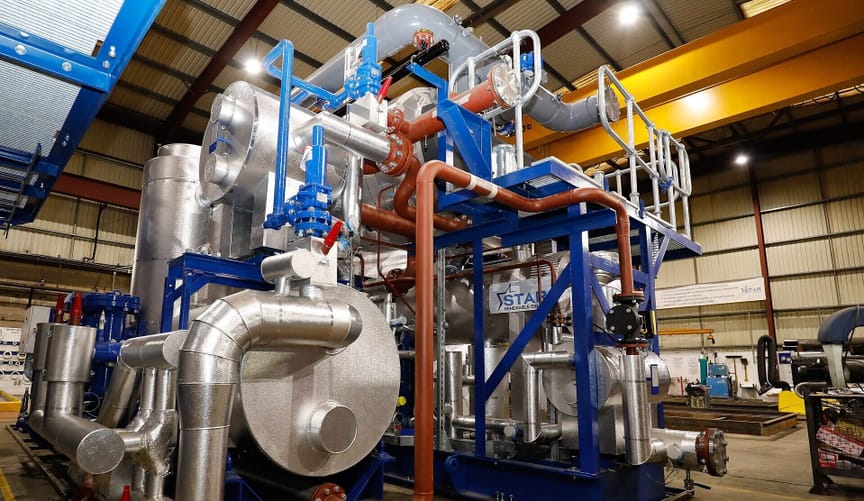
Silver, blue, and red pipes of a large heat pump in a factory
Star Renewable Energy, in Glasgow, Scotland, developed an industrial water-source heat pump. (Scottish Government, CC-BY-2.0 via Wikimedia Commons)

Steel and sweatshirts. Trucks and smartphones. Snickers and beer.

The stuff in modern life requires huge amounts of dirty fossil fuel to make. And lately, that’s been a liability for industries battered by the global energy shocks of the 2020s.

First, the Russian invasion of Ukraine in 2022 spiked liquefied natural gas prices, affecting manufacturers around the world and even forcing factory shutdowns in Pakistan and Bangladesh. In recent weeks, the U.S.-Israel–led war in Iran has choked the flow of oil and gas through the Strait of Hormuz, driving up costs yet again for plants in Europe, Asia, and beyond.

A new University of Oxford report points to a solution: Electrify industrial operations. Existing and emerging technologies — such as huge heat pumps, thermal batteries, electric-resistance heaters, induction tech, and plasma-based systems — that are able to run on an increasingly clean grid have vast potential to reduce companies’ fossil-fuel exposure, the report notes.

The industries that electrify fastest will stop being victims of the next crisis,” said Jan Rosenow, professor of energy and climate policy at Oxford and co-author of the report. Every unit of fossil fuel eliminated from an industrial process is a unit that can no longer be held hostage by a pipeline shutdown, a strait closure, or a price spike.”

That’s not to mention how decarbonizing industry would also slash planet-warming emissions, clear smoggy skies, and save lives in communities downwind of factories.

Yet policymakers and factory owners are not acting fast enough, according to Rosenow. There is still a perception that industry is too hard to abate, so we can worry about it later,” he said.

Even among people who do see the urgency of decarbonizing a sector that accounts for nearly a third of global CO2 emissions, the majority assume the solution is not electrons, he finds, but molecules we can burn: biomass, biogas, and clean hydrogen.

When I go to meet with policymakers or speak at industry conferences, this [idea] is still fairly widespread,” Rosenow said. Until recently, I was under the same impression, because that’s what most people have been saying.” But these fuels aren’t widely available, and combustion still produces negative health effects even when the input isn’t oil or gas.

To investigate the extent to which industry can decarbonize using electric power, he and his co-author, Cassandra Etter-Wenzel, a researcher at Oxford’s Environmental Change Institute, analyzed two lines of evidence: detailed technical studies on the potential to electrify industrial processes and more than 1,600 publicly available global decarbonization scenarios. These possible paths provide minimum-cost estimates of how quickly industrial subsectors can electrify given favorable policies, like a tax on carbon pollution.

Both datasets led to the same conclusion: Roughly 85% of industrial energy demand could be electrified by 2050 — and upwards of 90% in the long term — with existing and emerging electric tech. Near complete electrification is technically possible,” Rosenow said.

The question is whether policy moves fast enough to realise it,” Etter-Wenzel said in a statement.

A smattering of industrial electrification projects have come online in recent years — for example, heat pumps installed at a brewery in Colorado, a distillery in Scotland, and a paper mill in Finland. Systemic barriers, however, are slowing progress.

A big one is the grid interconnection bottleneck. Queues to connect new facilities to the grid have reached record levels worldwide, according to the International Energy Agency. Without a fast grid connection, factory owners may forego electric equipment for fossil-fueled options that last 20 years or longer, Rosenow said.

Zero-emissions tech, such as heat pumps, is more efficient than combustion systems, but can cost more up front as well as to operate. Electricity is usually more expensive per unit of energy delivered than burning gas, Rosenow said. Many countries still overtax electricity and undertax fossil fuels.”

Policymakers can deploy under-the-radar approaches to clear these hurdles. Some places are already putting such strategies to the test.

To address its grid bottleneck, the United Kingdom, for example, is ditching the traditional first-come, first-served model to instead assess projects on their merits, such as readiness and alignment with national energy goals. The country’s National Energy System Operator estimates that the new policy will shrink the reordered queue by two-thirds and unlock $54 billion in annual investment, including industrial projects seeking power.

To address operating costs, regulators can rebalance electricity and fossil-fuel charges by redesigning rates to make electrification more attractive. In the U.S., Massachusetts is demonstrating how effective this approach can be at the residential level; 140,000 heat pump owners saved an average of more than $250 per customer this winter, thanks to a new seasonal electricity rate.

For another way to make electricity cheap, just look to Spain and its embrace of clean energy. In 2018, Spanish industry paid 32% more for electricity than the European average. By 2024, it paid 21% less, thanks to rapid growth in solar power.

Clean-air requirements can push industries to electrify, too. In 2024, Southern California’s air regulators approved first-in-the-nation rules to gradually prohibit the sale of new gas-burning light-industrial and commercial boilers, steam generators, and process heaters in the smoggy region, starting this year.

Finally, policymakers can pair carrots with their sticks by deploying direct subsidies for industrial decarbonization projects. In the U.S., California, Colorado, and Pennsylvania are taking this tack.

A German program also shows promise, according to Rosenow. To get energy-intensive industries such as steel and cement to decarbonize, the nation’s economics ministry has created Carbon Contracts for Difference. These flexible subsidies de-risk projects by paying for each ton of carbon avoided for up to 15 years, in order to cover any difference in profitability caused by the cleantech investment.

The latest global energy crisis won’t be the last. Rosenow hopes that the fossil-fuel shock will spur governments and industries to look at electric tech with a gimlet eye toward the bottom line. Electrification isn’t just a decarbonization strategy, he said. It’s an insurance policy.

Alison F. Takemura is reporter at Canary Media.