• As Ohio grapples with fake comments on clean energy, some want crackdown
  • Account
  • Donate
Clean energy journalism for a cooler tomorrow

As Ohio grapples with fake comments on clean energy, some want crackdown

Apparently fake public input has promoted fossil fuels and attacked clean energy in Ohio and beyond. Here’s what officials could do to try to stymie the problem.
By Kathiann M. Kowalski

  • Link copied to clipboard
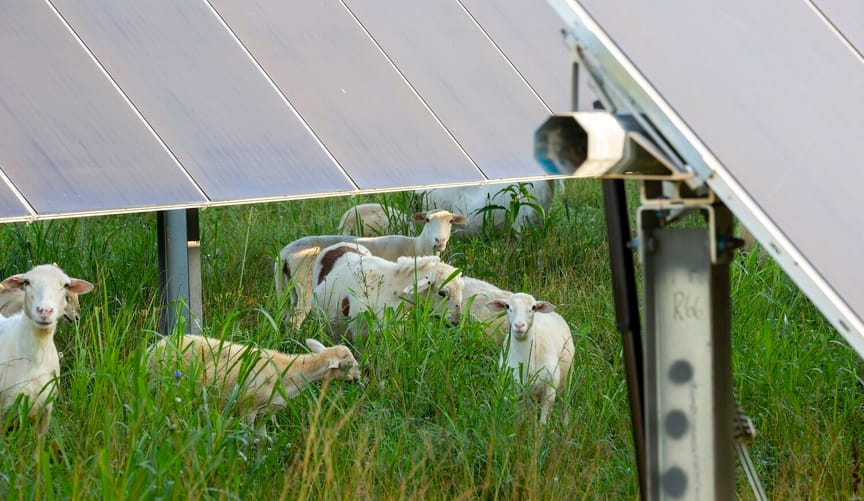
Sheep under solar panels
The Ohio Power Siting Board denied a permit application for a project that would have combined solar panels and grazing, like this one in Lancaster, Kentucky. (Jim West/UCG/Universal Images Group via Getty Images)

A troubling trend has shown up in some communities around the U.S.: Public officials are being inundated with seemingly fake public feedback that aims to block renewable energy and promote fossil fuels.

In Ohio, one of the states grappling with this issue, regulators have done little to crack down on the problem, sparking concern among advocates for clean energy and good government that agencies will continue to get public comments from people who didn’t authorize them or simply don’t exist.

If we don’t address it, we’re definitely not going to fix it,” said Catherine Turcer, executive director for Common Cause Ohio, which works to strengthen public participation in U.S. democracy and hold officials accountable to citizens.

Fabricated comments corrupt public decision-making by diluting the impact of genuine people who take the time to share their views, Turcer explained. That’s especially true if officials focus on the numbers of pro and con comments versus their substance.

It skewers the whole process, and you don’t know who to trust,” said Beth Nagusky, an adjunct law professor who has taught at Case Western Reserve University and Cleveland State University and who was previously a utility regulator in Maine.

The issue of fake comments has loomed large over Crossroads Solar Grazing Center, a 94-megawatt project proposed in central Ohio’s Morrow County that would combine solar panels with sheep grazing. Earlier this year, the Ohio Power Siting Board denied the solar farm’s permit application — a controversial move since the agency had received evidence from developer Open Road Renewables that dozens of public comments opposing the project appeared to be fabricated. Even though the solar farm met all other legal requirements and the regulators acknowledged concerns about fake comments, they nonetheless concluded that the project fails to serve the public interest” because of consistent and substantial opposition” from local governments and nearby residents. The board did not ask the Ohio attorney general to investigate who was behind the fishy comments.

Open Road Renewables pushed back on the idea that locals overwhelmingly disliked the proposal with an analysis that shows nearly half the public comments from people in nearby towns approved of the project, once the duplicate, anonymous, and unverifiable submissions were removed. The firm has twice asked the Power Siting Board to reconsider its decision, without success.

Ohio had an earlier brush with ostensibly false feedback in 2023. Pro-fracking comments submitted to Ohio’s Oil and Gas Land Management Commission included nearly 150 names of people who denied sending them. The commission declared it would not consider the contested comments; ultimately, it greenlit drilling and fracking under state park and wildlife areas.

After an investigation, the Ohio attorney general’s office found that tactics used by a subcontractor on behalf of the Consumer Energy Alliance, a fossil fuel–aligned group that backs fracking, likely misled people into allowing the use of their names and other information. The language used to solicit individuals’ alleged consent was vague, did not disclose the consumers would be signing a letter, and failed to provide the language of the letter,” wrote Melissa Wright, section chief for consumer protection for then–Ohio Attorney General Dave Yost, in 2024.

But the attorney general’s office filed neither civil nor criminal charges. Instead, Wright sent a letter encouraging the Consumer Energy Alliance and its contractors to review and comply with the law in the future. If CEA is going to contract with third parties to carry out its campaigns, then CEA must ensure those campaigns are being carried out in accordance with all applicable laws,” Wright wrote.

The Consumer Energy Alliance’s then–vice president for media and strategic communications, Bryson Hull, celebrated the attorney general’s move in a 2024 email to board members. The victory is that the misconduct is attributed to the third-party vendor, which is critical to our reputation and ability to influence how CEA is described publicly by others,” he said.

According to the Energy and Policy Institute, a watchdog group, the Consumer Energy Alliance was also involved in allegedly fraudulent submissions of comments on the Nexus pipeline in Ohio, petition signatures for a net-metering case in Wisconsin, and emails to enlist South Carolina lawmakers’ support for a Dominion Energy acquisition.

Among other recent cases, hundreds of seemingly false emails flooded county commissioners’ mailboxes last year in Forsyth County, North Carolina, urging them to back a petroleum pipeline. Questions arose about whether the pipeline company’s owner used contractors for an astroturf campaign.

Some in Ohio argue that the state needs to take stronger action to find out who exactly is behind fake comments and punish them for fraudulent conduct.

Misleading public officials through known false testimony is illegal and should be prosecuted. Full stop,” said John Kulewicz, a Columbus-area lawyer who is currently a candidate for Ohio attorney general. Agencies should refer false comments for prosecution.”

The Ohio Power Siting Board, for its part, has not referred any fake public comments for prosecution within the last 10 years. As a rule, it has been infrequent that staff has encountered this issue, so our approach has been to clean up the docket,” spokesperson Matt Butler said.

Butler noted that the agency sends emails to let commenters know their message was received and filed in the case record. The agency does not automatically remove comments when its emails bounce back, although it has removed public comments at the request of individuals who have informed the Board that comments filed in their name were not authentic,” Butler said.

Ohio has recently made some policy updates that could help curb falsified public feedback — if enforced. A revision to the Ohio Administrative Code last year clarified that deceptive consumer practices include using fine print online and other misleading actions to gather names for submissions to public agencies. No enforcement action has been taken under the new rule yet, said Steve Irwin, communications director for Ohio Attorney General Andy Wilson.

While many government agencies across the U.S. have not taken vigorous enforcement action against people and groups seeking to sway public officials with fake comments, companies can be held responsible.

In 2023, for example, New York Attorney General Letitia James announced a $615,000 settlement with companies responsible for millions of fake comments urging regulators to end net neutrality.

Meanwhile, California legislators are considering Senate Bill 1159, which would forbid the knowing use of artificial intelligence to falsely represent that a real person engaged with or submitted information to an agency. The legislation was introduced after the Los Angeles Times reported that an AI-powered campaign resulted in a slew of potentially fake comments submitted to Southern California regulators, urging them to reject landmark rules that would phase out fossil-fueled heaters. CiviClick, the firm linked to the Southern California comments, insists it did not use AI for that project. So cases like it or ones with made-up names would not fall within the scope of SB 1159.

Tech tools could also help agencies in Ohio and elsewhere do a better job screening for possible fakes, said Dave Anderson, policy and communications manager for the Energy and Policy Institute. Metadata could identify submissions prepared by a common source, for example. Then automated emails could require commenters to verify that the communication is genuine before it becomes part of the record.

An additional approach could be to add captcha-type verification for people to get into comment portals, suggested Turcer of Common Cause Ohio. These and other methods would assure real individuals that their input was received, while frustrating some AI bots or other dubious tactics.

The consequence of letting apparently fake comments continue to come into the public record is eroded public trust in government, said Anderson. People will fairly have questions about how fair the two sides in the case are being viewed.”

That already seems to be happening in the Crossroads Solar case. Two days after the Ohio Power Siting Board handed down its rejection of the project, a resident in central Ohio’s Franklin County wrote to the agency, challenging its decision and accusing it of relying on fake comments to reject the project.

This is deeply concerning,” said S.A. Linden, whose message Canary Media verified is genuine. It makes one wonder about the integrity of the Ohio Power Siting Board. We have enough corruption in Ohio politics. We definitely do NOT need more.” 

This signup form requires necessary cookies.

Allow marketing cookies to load the newsletter signup form.

Kathiann M. Kowalski is a contributing reporter at Canary Media who covers Ohio.